All species › Pigeons and doves › Doves and pigeons › Crested Pigeon
Crested Pigeon | Ocyphaps lophotes
Australische kuifduif | Paloma bronce crestada
The Crested Pigeon is the pigeon with the black knitting needle on its head: a stocky grey-brown bird with a thin upright crest, an orange-red eye-ring and a wing full of black bars and green-purple gloss. The oddest thing about it is not the plumage but the sound of its wings — it whistles as it takes off, and that whistle turns out to be an alarm signal to other pigeons.

Voice
The voice proper is soft and easily missed: a short, low whoop, repeated from a wire or a bare branch, with a deeper moaning in display. What really names the bird is mechanical: on take-off the strongly narrowed eighth primary produces a shrill rhythmic tseef-tseef-tseef that runs with the wingbeat. A bird flushed in alarm whistles faster, and the rest of the group lifts with it at once.
Recording: Peter Russell — CC BY-SA 4.0 · Cooya Pooya, Shire of Roebourne, Western Australia, Australia · xeno-canto
Identification
A compact pigeon of 30 to 35 cm, mostly grey-brown with a pink wash over breast and belly and a long pointed tail. The thin upright black crest is unique among the pigeons of settled Australia. Fine black bars cross the wing, and the secondaries carry a green to purple glossed panel that fires only in sunlight; the eye is set in an orange-red ring. On landing the tail flicks up and the bird bows forward, a posture that identifies it at range.
Confusion species
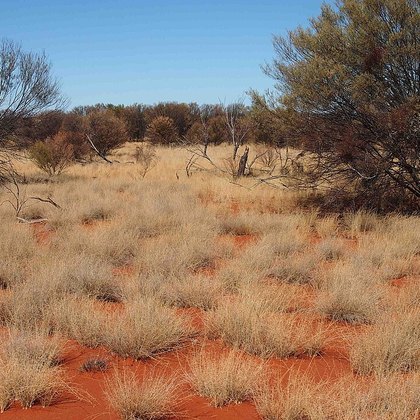
Common Bronzewing (Phaps chalcoptera) has the same glossed wing panels but no crest and is bulkier and darker. The pigeon of the spinifex country, Geophaps plumifera, also has a pointed crest, but is rufous, much smaller and confined to rocky desert inland. Rock Dove (Columba livia) shares the city street but is short-tailed, crestless and more heavily built; the wing whistle rules out any confusion instantly.
Habitat
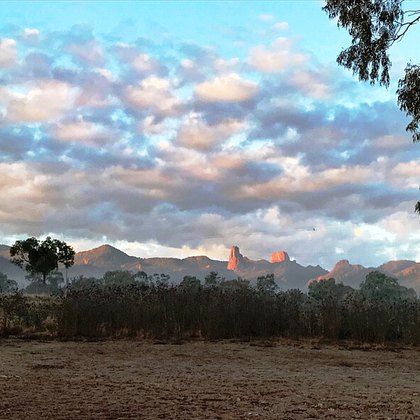
Lightly wooded grassland is its measure: open eucalypt woodland, mulga with clearings, grain paddocks, roadsides, sports fields, gardens and city parks. It avoids dense forest and must drink daily, so it is rarely far from water — a stock dam, a bore or a pond will do. It feeds walking on bare ground, almost entirely on seed; the nest is a thin platform of twigs in a low tree or shrub.
Where the bird is most often found, arranged by main group and formation.


Range and movements
Across virtually all of mainland Australia, absent from Tasmania, from closed rainforest and from the wettest coastal strips. It was originally above all a bird of the dry interior; with grain growing, stock dams and suburban planting it has advanced in every direction and now lives in the inner suburbs of Sydney, Melbourne and Perth. It does not migrate, but in drought groups shift to wherever water still stands.
- Resident
- dark = core range, pale = thinly spread
Where and when to look
Let your ears do the work: the shrill rhythmic whistle of a bird taking off carries a long way and can be mistaken for nothing else. Then look for it on a wire or a bare twig along a country road, because it likes to perch high and clear. Sit by a stock dam or a trough in the late afternoon; groups come in to drink at set times and the wing gloss is at its best in low light.
Conservation
Least Concern (LC), and one of the clearest winners from European farming in Australia: grain, permanent drinking water and open mown grass have carried it from the interior to both coasts. It is numerous, still expanding, and faces no known threat of consequence; traffic and house cats take birds in town, but not on a scale that counts.
Scientific name
Ocyphaps lophotes | (Temminck, 1822)
Temminck described the bird in 1822 as Columba lophotes; because it was later moved to another genus, author and year stand in parentheses. The genus Ocyphaps was introduced by G. R. Gray in 1842 and is built from Greek okys, 'swift', and phaps, 'pigeon' — after the fast, darting flight. lophotes goes back to lophos, 'crest'. The type locality is New Holland, later taken to mean New South Wales.