All species › Pigeons and doves › Doves and pigeons › Wompoo Fruit Dove
Wompoo Fruit Dove | Megaloprepia magnifica
Wompoejufferduif | Tilopo magnífico
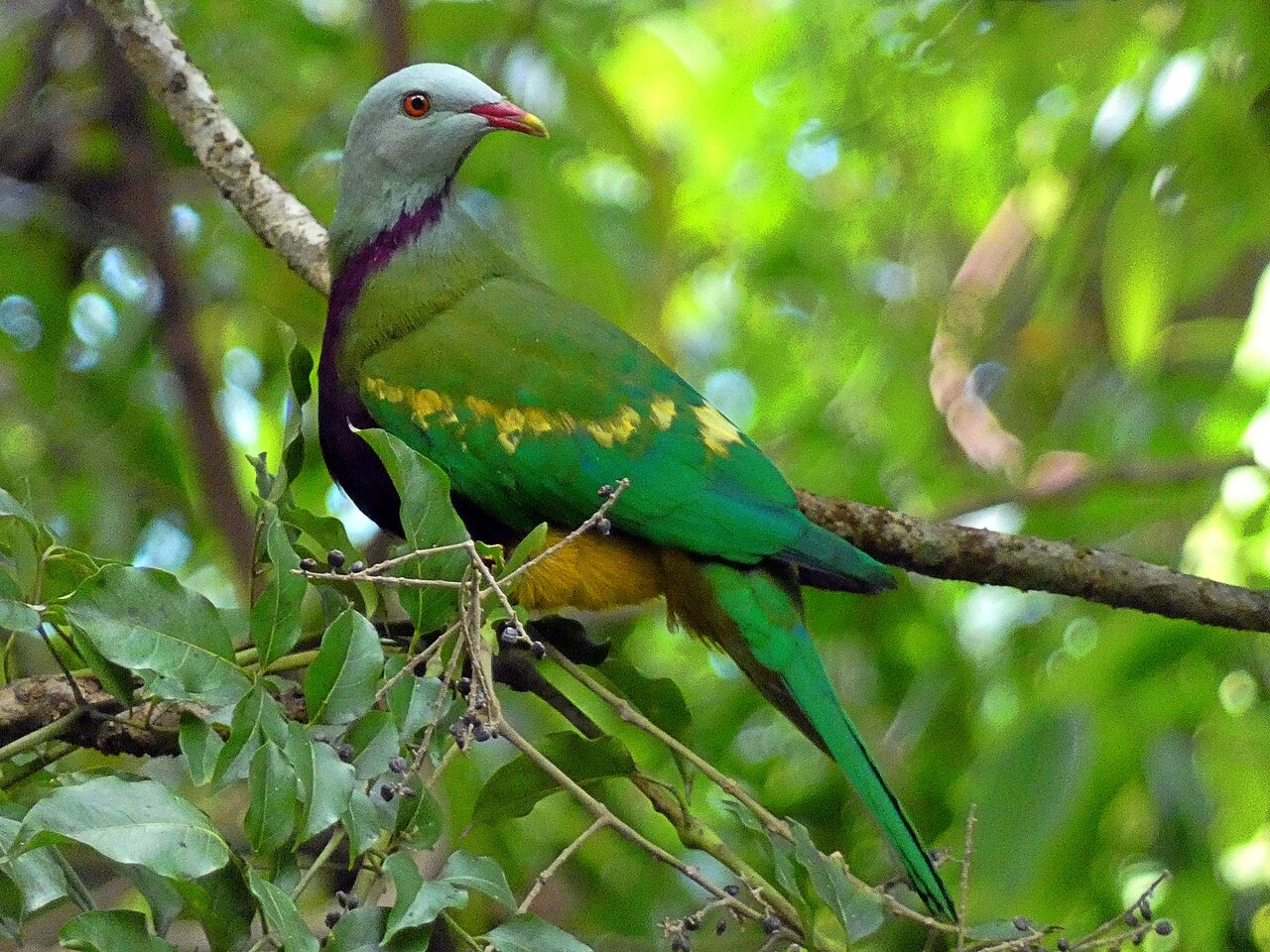
Australia's largest fruit dove and at the same time one of the hardest rainforest birds to see: deep purple breast, bright yellow belly and green upperparts, and exactly that combination dissolves in the dappled light of the canopy. You almost always hear it first — a deep, near-human call coming from high above you.
Voice
A deep, resonant call that sounds like wollack-a-woo and gives the species its name; some birds turn it into book-a-roo. There is also a shorter, abrupt boo. The sound is so low and so human in quality that walkers regularly take it for a voice further along the track. On take-off the wings clatter heavily through the foliage.
No freely licensed recording has been found for this species yet; what to listen for is described below.
Identification
A solid pigeon of roughly 35 to 50 cm, long-tailed, with a heavy, unhurried flight. Head and neck are pale blue-grey, throat, breast and upper belly deep purple to wine-red, lower belly and undertail coverts bright yellow, the rest green. A conspicuous yellow bar crosses the folded wing and is the clearest mark in flight. Sexes alike; young birds are duller and greener with little purple. Northern birds from Cape York are noticeably smaller than those of New South Wales, which you cannot judge on a single bird but which explains the wide length range.
Confusion species
No other Australian pigeon is purple and yellow, so a bird seen well cannot be mistaken. The two small fruit doves of the same forests, Superb Fruit Dove (Ptilinopus superbus) and Rose-crowned Fruit Dove (Ptilinopus regina), are barely half as long, have a grey rather than purple breast and lack the yellow wing bar. A silhouette high in the canopy can suggest Brown Cuckoo-Dove (Macropygia phasianella), but that bird is plain rufous with a far longer, pointed tail. Black-banded Fruit Dove (Ptilinopus alligator) is a similar size but black and white and confined to Arnhem Land, thousands of kilometres away.
Habitat
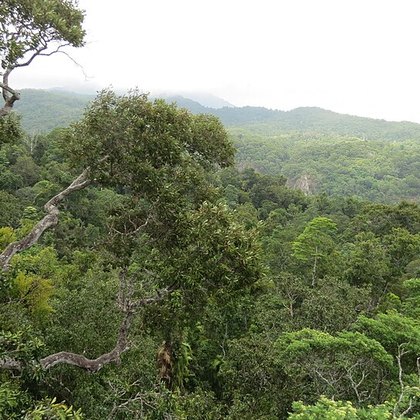
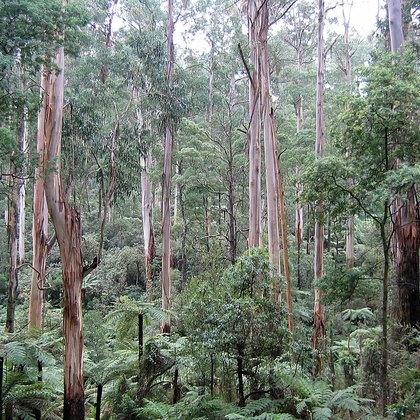
Rainforest, from the subtropical forest of northern New South Wales to the tropical lowland rainforest of the Wet Tropics, and rarely anywhere else. It keeps to the canopy of the wettest ground: gallery forest along rainforest creeks, deep gullies and the adjoining edges of wet eucalypt forest where fruiting figs, palms and laurels stand. It moves locally from tree to tree rather than travelling far.
Where the bird is most often found, arranged by main group and formation.

Range and movements
Three separate populations along the east coast: central eastern New South Wales to central eastern Queensland; separately, north-eastern Queensland around the Atherton Tablelands; and separately, northern Cape York Peninsula. It grows steadily more numerous northwards; in the south it is scattered through remnants of lowland rainforest. Beyond Australia it occurs on New Guinea and nearby islands, but within this map window it is strictly a bird of the east coast.
- Resident
- dark = core range, pale = thinly spread
Where and when to look
Stand on a rainforest track early in the morning where a fig is in fruit — Lamington, Dorrigo, Mount Tamborine or the Curtain Fig on the Atherton Tablelands — and stay still for fifteen minutes. The call gives away the height; then look for the yellow wing bar and yellow belly, because from below the purple hardly shows. Falling half-eaten fruit and the sound of clattering wings are as reliable as the bird itself.
Conservation
Least Concern (LC): widespread and numerous over most of its range, at its densest in tropical forest. In the southern part of the range the picture is tighter, because the lowland rainforest of New South Wales has been reduced to small, separated patches. What holds the species there is the retention of large fruiting figs and of links between the remnants, since it swallows fruit whole and is one of the few dispersers of large-seeded rainforest trees.
Scientific name
Megaloprepia magnifica | (Temminck, 1821)
Coenraad Jacob Temminck described the species in 1821 as Columba magnifica; the type locality is Red Point, just south of Wollongong in New South Wales — striking, because the bird no longer occurs that far south. As it no longer sits in Columba, author and year take parentheses. After a long spell in Ptilinopus it was moved on molecular evidence in 2014 to Megaloprepia, a genus Ludwig Reichenbach had introduced in 1853 for this very bird; the name is from Greek megaloprepeia, 'magnificence', and magnifica means the same in Latin. The name wompoo is onomatopoeic and goes back to the call.