All species › Passerines › Fairywrens, grasswrens and emu-wrens › Dusky Grasswren
Dusky Grasswren | Amytornis purnelli
Bruine grassluiper | Maluro sombrío
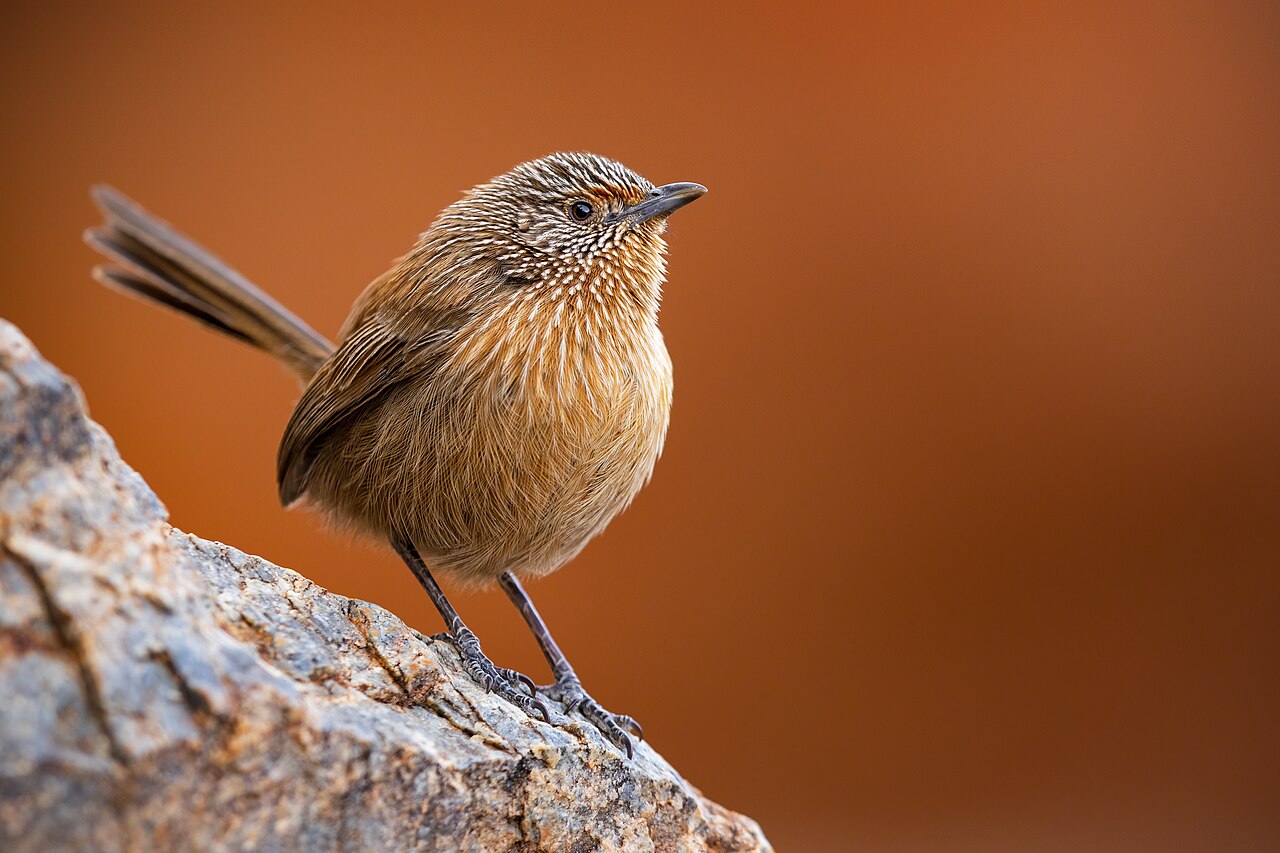
The Dusky Grasswren is the grasswren of the Central Ranges of Australia: a dark reddish-brown, long-tailed bird that lives among spinifex hummocks on scree slopes and in the gorges of the MacDonnell Ranges. It is the darkest and the most faintly streaked of the inland grasswrens, and the only one that occupies the rocky ridges around Alice Springs.
Voice
A high, thin, rapidly reeling song of two to four seconds, usually delivered from the top of a spinifex hummock or from a boulder at the edge of a scree slope; it echoes between the rock walls, which makes the singer hard to place. The contact call is a fine, sharp tsip that pairs keep up all morning as they stay together. In alarm come dry, short chek notes. All of it is pitched high and vanishes quickly in wind.
Recording: Christopher Watson — CC BY-NC-SA 4.0 · Honeymoon Range, Barkly Shire, Northern Territory, Australia · xeno-canto
Identification
Fifteen to eighteen centimetres, of which the tail is about half; running birds carry it raised at an angle. The plumage is dark, warm reddish brown, with fine white shaft streaks on crown, mantle and breast that are much vaguer and narrower than in the sandplain species — at any distance the bird looks plain dark brown. The throat is greyish white and not sharply set off against the breast, and a clear black moustachial stripe is absent. The female has rufous flanks. The legs are long, the bill fine and dark.
Confusion species
Kalkadoon Grasswren (Amytornis ballarae) cannot be told from this species in the field: both are dark and faintly streaked, and in practice the distinction rests entirely on range — ballarae is in the Selwyn Range near Mount Isa, a good thousand kilometres to the north-east, with unoccupied country in between. Short-tailed Grasswren (Amytornis merrotsyi) of the Flinders and Gawler Ranges holds the same kind of rocky spinifex slope but has a sharply defined white throat with a black moustachial stripe and a still shorter tail. Sandhill Grasswren (Amytornis oweni) and Striated Grasswren (Amytornis striatus) are a brighter rufous, far more obviously streaked, and carry that sharp black-and-white throat pattern; they also live in spinifex (spiny, hummock-forming desert grass of the interior) on sand, not on stone. Western Grasswren (Amytornis textilis) is larger, paler and plainer and keeps to acacia and saltbush scrub.
Habitat
Old, dense spinifex hummocks (Triodia) on scree slopes, boulder fields, breakaways (low, crumbling mesa edges of the interior) and gorge walls, almost always with solid rock beneath. The broken ground supplies shade, crevices to slip into and — important in this landscape — a natural firebreak, because fire runs badly across a stony slope. It forages on foot over the bare ground between the hummocks, taking seeds and insects, and nests low inside a hummock. Flat spinifex country without stone is avoided.
Where the bird is most often found, arranged by main group and formation.


Range and movements
The Central Ranges of Australia: the MacDonnell Ranges with the Harts, James and Krichauff Ranges in the southern Northern Territory, and southward the Musgrave, Mann and Everard Ranges of northern South Australia, reaching into adjoining Western Australia. The type specimen comes from Mount Benstead near Alice Springs. It is sedentary and holds fixed territories; the population is divided over separate rock complexes and the birds hardly cross the plains between them.
- Resident
- dark = core range, pale = thinly spread
Where and when to look
Go to the foot of a scree slope in the first hour after sunrise, where the spinifex hummocks stand knee-high and closed — Simpsons Gap, Ormiston Gorge and Trephina Gorge near Alice Springs are the best-known places — and stand still as soon as you hear the thin tsip. Let the birds work towards you rather than crossing the hummocks yourself: flushed, they give you no more than a running brown shape among the stones. Watch the bare ground between the hummocks, not the hummocks themselves.
Conservation
The IUCN lists the species as Least Concern (LC). That it does better than the grasswrens of the sandplains is mainly because its rocky slopes burn badly: the fire that elsewhere takes out whole spinifex fields at a stroke stalls among the boulders. It is not without pressure. Feral cats are numerous in the Central Ranges, and buffel grass (Cenchrus ciliaris), introduced as stock feed, is invading the gorges and creek beds, crowding out the spinifex and carrying a far hotter fire than this landscape is used to.
Scientific name
Amytornis purnelli | (Mathews, 1914)
Gregory Mathews described the bird in 1914 as Diaphorillas textilis purnelli, from a specimen taken at Mount Benstead near Alice Springs; because the species was later placed in another genus, author and date stand in brackets. The epithet purnelli honours the collector Purnell, who in those years gathered material in central Australia for the network Mathews drew on. The genus was first called Amytis, after a Persian princess; as that name was preoccupied, Leonhard Stejneger proposed Amytornis in 1885, with Greek ornis (bird). The English name and the Dutch both point to the dark, dull brown plumage.