All species › Passerines › Fairywrens, grasswrens and emu-wrens › Sandhill Grasswren
Sandhill Grasswren | Amytornis oweni
Duingrassluiper | Maluro desértico
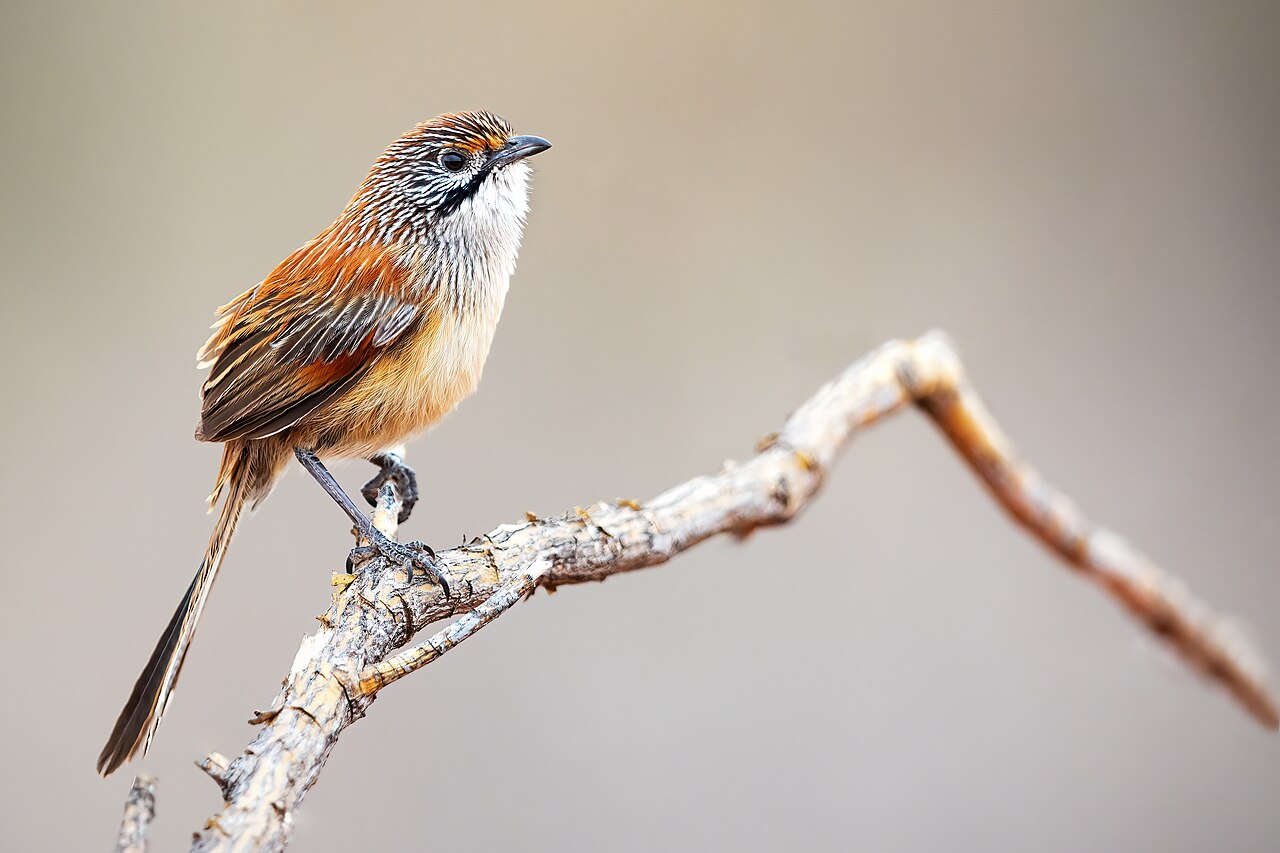
The Sandhill Grasswren is the grasswren of the red sand of the western deserts: a rufous, long-tailed bird with a sharply defined white throat, living among spinifex hummocks on dune flanks, swales and sandplains. It long stood as the western subspecies of the Striated Grasswren and has only recently been recognised as a species of its own; the Red List has not yet assessed it under its own name.
Voice
A high, thin, rapidly reeling song of two to four seconds with a slightly rising close, almost always sung from the top of a spinifex hummock. The contact call is a fine, sharp tsip, followed in alarm by dry chek notes. The whole repertoire is pitched so high that it is quickly lost in the wind that runs over the dunes; in open sand desert, standing still and listening is generally the only workable method.
No recording with a suitable Creative Commons licence has been found for this species yet; what to listen for is described below.
Identification
Fourteen to sixteen centimetres, of which the tail is well over half; running birds carry it straight up. The upperparts are warm reddish brown with fine white shaft streaks each edged in black — clearly striped close to, plain rufous at a distance. The throat is clean white and sharply set off against the breast. The male carries a black moustachial stripe alongside that white throat, the female does not, but has rufous flanks. The bill is fine and dark, the legs long.
Confusion species
Within the striatus group range is the only usable character, and that should be said plainly: Striated Grasswren (Amytornis striatus) of the south-eastern mallee (low, multi-stemmed eucalypt scrub of dry southern Australia), Pilbara Grasswren (Amytornis whitei) and Opalton Grasswren (Amytornis rowleyi) of central Queensland all look much like this species and cannot be separated from it in the field — they simply do not overlap. Against the Pilbara Grasswren the substrate helps as well: that one sits on scree and gorge walls, this one on sand. Eyrean Grasswren (Amytornis goyderi) shares the dunes in the Simpson but has a short, deep, pale finch-like bill and plain white, unstreaked underparts. Dusky Grasswren (Amytornis purnelli) is darker, more faintly streaked, without the sharp throat pattern, and keeps to rock.
Habitat
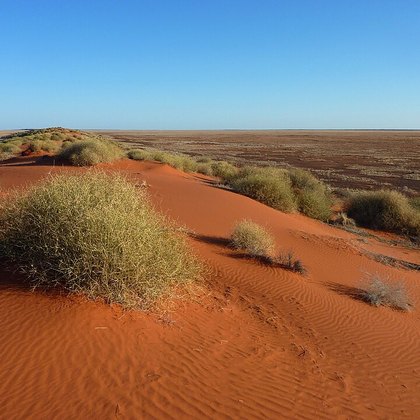
Old, dense spinifex hummocks (Triodia) on red sand: the flanks and swales of long dune ridges and the adjoining sandplains, locally with scattered desert oak or mulga (acacia scrub of the dry interior, dominated by Acacia aneura) above. As with all grasswrens of the spinifex (spiny, hummock-forming desert grass of the interior), the age of the hummocks decides everything — it needs stands that have gone at least ten years without fire, large and closed enough to nest and shelter under. The bare, drifting dune crests are avoided; the weight of the population lies at the dune foot and in the swales.
Where the bird is most often found, arranged by main group and formation.

Range and movements
The western and central interior of Australia: the Great Victoria Desert, the Gibson Desert, the Great Sandy and Little Sandy Deserts, east into the western Northern Territory and north-western South Australia. The type specimen comes from Bore Well, East Murchison, Western Australia. Sedentary, with fixed territories. Because the range was only delimited with the split, and the country is hard to reach, its boundaries on the map are less sharp than for most species in this guide.
- Resident
- dark = core range, pale = thinly spread
Where and when to look
Drive a sand track through dune country and stop where the spinifex hummocks at the dune foot are knee-high and closed and you see no fresh burn. Walk slowly along the edge of a hummock field in the first hour after sunrise and stand still at the first thin tsip. Anyone who walks straight through the hummocks sees no more than a running brown shape. Freshly burnt ground can be skipped; the species is absent from it for years.
Conservation
The IUCN has not yet assessed this species under its own name; on the Red List it still falls under the broadly drawn Striated Grasswren (Amytornis striatus), which is assessed as Least Concern (LC). The range is large and lies mostly in thinly peopled desert without agriculture, which works in its favour. The threat is the one facing all spinifex birds: very large, hot fires that remove hundreds of square kilometres of old hummocks at a stroke, and feral cats, which hunt bare, freshly burnt ground with particular efficiency. Where traditional owners have resumed early, small-scale burning, the birds do better.
Scientific name
Amytornis oweni | Mathews, 1911
Gregory Mathews described the bird in 1911 as Amytornis striatus oweni, from a specimen taken at Bore Well, East Murchison, Western Australia. The epithet oweni honours someone from the circle of collectors and correspondents Mathews drew on. The genus was first called Amytis, after a Persian princess; as that name was preoccupied, Leonhard Stejneger proposed Amytornis in 1885, with Greek ornis (bird). The English name Sandhill Grasswren and the Dutch both point to the sand dunes the species lives in.