All species › Passerines › Fairywrens, grasswrens and emu-wrens › Thick-billed Grasswren
Thick-billed Grasswren | Amytornis modestus
Oostelijke grassluiper | Maluro picogordo
The Thick-billed Grasswren is the twin of the Western Grasswren: the same pale, grey-brown bird with a strikingly heavy bill and a long tail often carried upright, but belonging to the chenopod plains of the central and eastern interior. It is a bird that would rather run than fly, darting mouse-like from one saltbush to the next and rarely showing itself in the open for more than a second. Only on the strength of genetic and morphological work in the 2010s did it regain full species status, and that split is so recent that many databases still file it under Amytornis textilis. Seeing one asks for an early start and a great deal of patience.

Voice
Grasswrens are soft singers and this one is no exception. The song is a short, high, reeling phrase repeated at intervals that carries barely twenty or thirty metres across the plain. Alongside it there is a thin, high contact note passed between members of a group, so faint that many human ears lose it altogether. Remarkably, song differs measurably between the subspecies, and birds respond more strongly to phrases of their own race than to those of a neighbouring one - a sign that the fragmentation of this species runs acoustically deep as well. In practice the first thing you register is usually not song at all but a rustle in the saltbush.
No freely licensed recording has been found for this species yet; what to listen for is described below.
Identification
A large grasswren of seventeen to twenty centimetres, much of it tail, weighing around twenty grams. The upperparts are dull grey-brown, the head and mantle are coarsely streaked white, and the underparts are paler and fawn. The long dark-brown tail is cocked when the bird is excited. The trademark is the bill: short, deep and heavy, grey, far thicker than in any other grasswren - hence the English name. The eye is dark brown, bill and legs dark grey. Sexual differences are subtle: females show a rufous patch on the flank, males have unmarked flanks. The camouflage against grey-green chenopods is extraordinary; a bird that neither calls nor moves will be walked straight past.
Confusion species
The honest answer is that this species cannot be reliably separated in the field from the Western Grasswren (Amytornis textilis). The two are equally pale, equally long-tailed, share the same heavy bill, and even match on wing length to the tenth of a millimetre. The distinction rests entirely on geography: the Western Grasswren occupies Western Australia plus the Eyre Peninsula and Gawler Ranges of South Australia, while this species holds the central and eastern interior - the Lake Eyre basin of South Australia, the far north-west of New South Wales and a relict population in southern Northern Territory. No overlap zone is known, so in practice the map decides. The Short-tailed Grasswren (Amytornis merrotsyi) of the Flinders and Gawler Ranges is smaller, obviously shorter-tailed and much redder in tone, and lives on rocky slopes with spinifex rather than on flat chenopod ground. All the spinifex grasswrens - Striated, Dusky and their relatives - are more boldly marked, finer-billed and do not share the habitat. A bird in low saltbush or bluebush on a plain or along a drainage line leaves only one candidate in that part of Australia.
Habitat
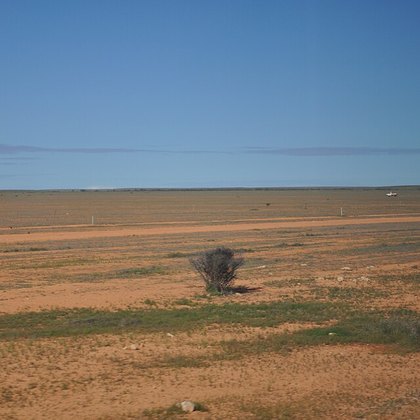
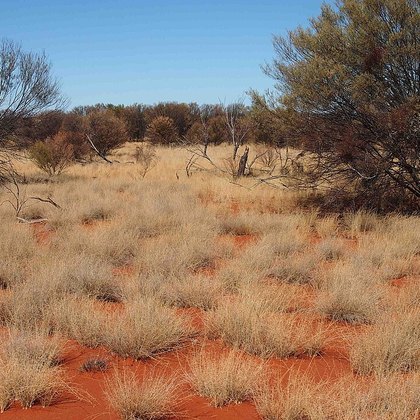
Low chenopod shrubland is the heart of the matter: plains of saltbush (Atriplex) and bluebush (Maireana), especially where the bushes stand taller and denser than the surroundings. As a rule those are the low points - drainage lines, run-on areas and floodplains where a little more water lingers after rain. The species is also found in sandhill canegrass and in the piles of flood debris along dry sandy creek beds, where that debris provides cover and nest sites. Much of this country lies on gibber plain: stony desert pavement with a thin layer of chenopods on top. The constant is not the plant species but the structure - dense, low, continuous shrub through which a bird unwilling to fly can move on foot. Where grazing has opened up the shrub layer, the species disappears.
Where the bird is most often found, arranged by main group and formation.

Range and movements
Endemic to inland Australia, in a fragmented pattern around the Lake Eyre basin in South Australia, with outliers into the far north-west of New South Wales and a small isolated population near Charlotte Waters in southern Northern Territory. Seven subspecies were originally recognised; two are extinct, including the nominate form of the MacDonnell Ranges. Because the bird barely flies, the surviving populations are largely isolated from one another genetically. Across this guide's measurement period the species was recorded in all ten years, with 644 observations - ample for solid resident status, but a thin total for a bird with so large a range, which says most about how hard it is to find. One caveat on the numbers: the split is so recent that the GBIF backbone taxonomy does not yet carry it as a separate species, so the data here were gathered at subspecies level.
- Winter
- dark = core range, pale = thinly spread
Where and when to look
Go in the first hour after sunrise, while the birds are active and the air is still, and walk slowly along a drainage line where the bluebush stands knee-high or taller - the country around Lake Eyre South and the plains between Marree and Lyndhurst are classic. Never chase a running bird; you will always lose. Instead stand still where you last saw movement and wait a few minutes: grasswrens are curious and often hop up onto a bush top of their own accord to see who is there. That single moment is your record.
Conservation
Globally the IUCN lists the species as Least Concern, but that rating conceals an uneasy story. Nationally it is listed as Vulnerable under Australia's EPBC Act, as Critically Endangered in New South Wales, and the north-western subspecies is Critically Endangered in the Northern Territory with fewer than fifty mature birds at four sites. Two of the seven described subspecies have already gone, and a 2018 analysis placed this species eighth on the list of Australian birds most likely to become extinct. The cause is always the same: grazing by stock and rabbits thinning the low shrub layer, combined with drought and overfrequent fire. Where the chenopod shrub layer stays dense, the bird holds on.
Scientific name
Amytornis modestus | (North, 1902)
The genus name Amytornis combines Amytis, a Median princess of antiquity, with Greek ornis, bird - an invention of its describer, who liked to give his Australian birds classical names. The species name modestus means unassuming or inconspicuous, and for once the epithet is well chosen: both the plumage and the behaviour of this bird are a study in restraint. The Dutch name deliberately mirrors that of the Western Grasswren - eastern against western - because range is the only thing that separates the two.