All species › Passerines › Fairywrens, grasswrens and emu-wrens › Short-tailed Grasswren
Short-tailed Grasswren | Amytornis merrotsyi
Kortstaartgrassluiper | Maluro colicorto
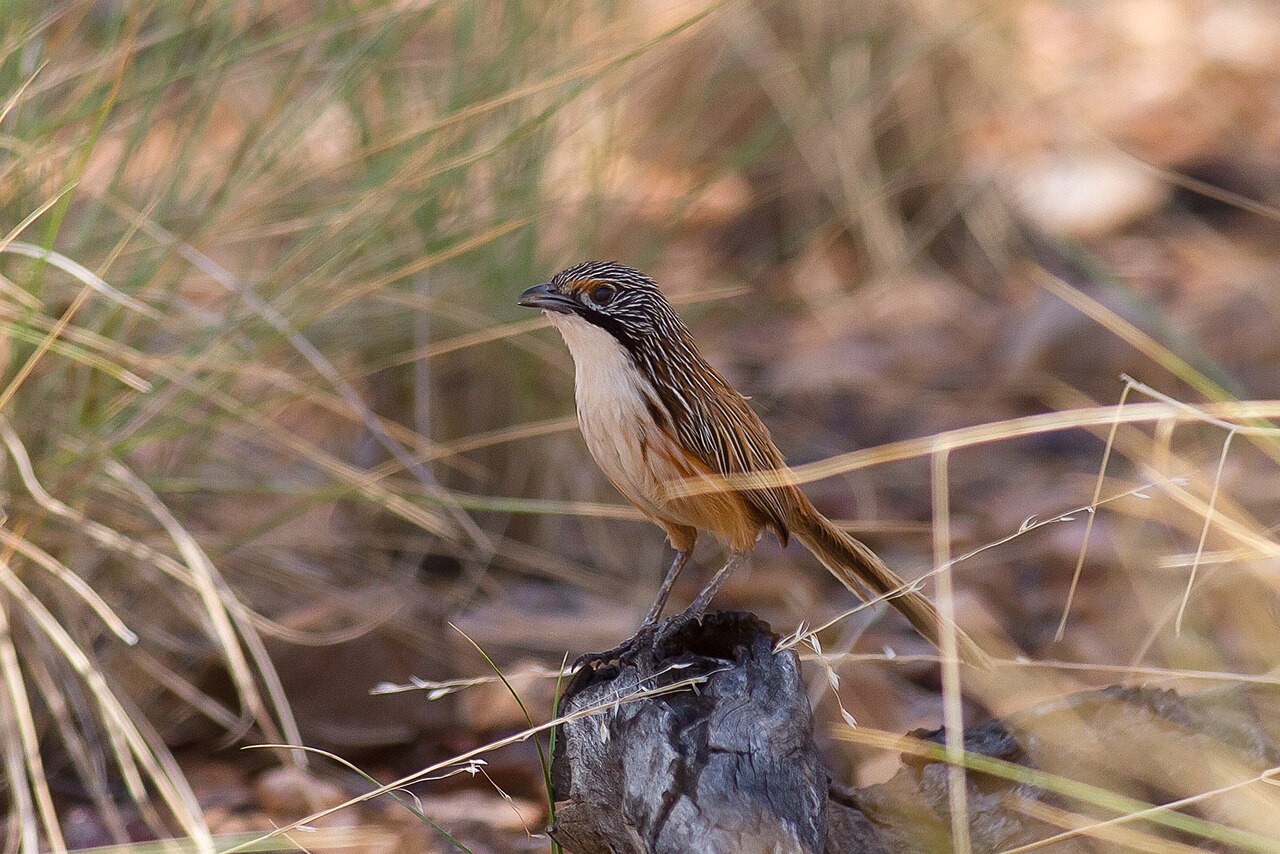
The Short-tailed Grasswren is the grasswren of the rocky ranges of South Australia: a rufous bird with a sharply defined white throat, living among spinifex hummocks on steep scree slopes of the northern Flinders and the Gawler Ranges. It long stood as the southern subspecies of the Striated Grasswren. Its tail really is the shortest in the genus, though that is an awkward character in the field.
Voice
A high, thin, rapidly reeling song of two to four seconds, sung from the top of a spinifex hummock or from a stone, with a slightly rising close. The contact call is a fine, sharp tsip, followed on disturbance by dry chek notes. It is pitched so high that many observers no longer pick it up as they age; in the Flinders gorges it echoes as well, which makes the singer hard to place.
No freely licensed recording has been found for this species yet; what to listen for is described below.
Identification
Fourteen to sixteen centimetres. The tail is clearly shorter than in the other spinifex grasswrens and makes up about half the total length rather than well over half; running birds carry it upright. The upperparts are warm reddish brown with fine white shaft streaks, each edged in black. The throat is clean white and sharply set off against the breast; the male carries a black moustachial stripe alongside it, the female does not, but has rufous flanks. The legs are conspicuously long, the bill fine and dark.
Confusion species
Striated Grasswren (Amytornis striatus), from which this species was split, is all but inseparable from it on plumage; the difference lies in the shorter tail — a difference of a good centimetre, visible in the hand or on a good photograph but unreliable through binoculars — and above all in terrain and range: striatus is in spinifex under mallee on sandy ground, far to the east, and not on scree slopes. Dusky Grasswren (Amytornis purnelli) of the Central Ranges holds the same kind of rocky slope but is darker, much more faintly streaked and lacks the sharp black-and-white throat pattern; their ranges do not meet. On the plains around the Flinders lives Amytornis modestus, which is not in this guide: it is paler and plainer, with a heavier bill, and sits in saltbush rather than in spinifex on rock.
Habitat
Old, dense spinifex hummocks (Triodia) on steep, scree-covered slopes, boulder fields and gorge walls of dry ranges. Almost always slopes with solid rock beneath; flat spinifex country is avoided. As with all spinifex grasswrens it needs hummocks that have gone many years without burning, large enough to shelter and nest under. The long legs suit a bird that spends its life walking over loose stone; it rarely flies more than a few metres.
Where the bird is most often found, arranged by main group and formation.


Range and movements
South Australia only, in two separate areas. In the east the northern Flinders Ranges, with the Gammon Ranges, Arkaroola and the surrounding gorges; the type locality lies north-east of Lake Torrens, at Yudanamutana in the Flinders. In the west the Gawler Ranges, whose birds are distinguished as a separate subspecies. Plains the species does not occupy lie between the two. It is sedentary, holds fixed territories and hardly crosses open ground.
- Resident
- dark = core range, pale = thinly spread
Where and when to look
In the first hour after sunrise work the lower half of a scree slope where the spinifex hummocks stand knee-high and closed; Arkaroola and the Gammon Ranges are the best-known places. Stand still at the first thin tsip and let the birds come to you. You will notice the short tail only when you see the bird settled and side-on — rather trust place and terrain: a grasswren with a sharp white throat on a scree slope in the Flinders or the Gawler Ranges is this species.
Conservation
Near Threatened (NT). The range is small and divided in two, and numbers are modest. The main pressure here too is fire: one large burn can make a whole slope unusable for ten years or more, and because the occupied slopes lie far apart, recolonisation is slow. Grazing by stock, goats and feral donkeys thins the hummocks, and feral cats add to it. Part of the range lies in protected areas — Vulkathunha-Gammon Ranges National Park and the Gawler Ranges reserves — which improves the outlook.
Scientific name
Amytornis merrotsyi | Mellor, 1913
John Mellor described the bird in 1913, from a specimen out of the Flinders Ranges north-east of Lake Torrens; the type locality was later fixed more precisely at Yudanamutana. The epithet merrotsyi honours someone from Mellor's circle, presumably a collector or benefactor; exactly who that was has not been run down in this round and is therefore left open here. The genus was first called Amytis, after a Persian princess; as that name was preoccupied, Leonhard Stejneger proposed Amytornis in 1885, with Greek ornis (bird). The English name Short-tailed Grasswren and the Dutch both cite the short tail, the character that separates the bird from its nearest relative.