All species › Penguins › Penguins › Erect-crested Penguin
Erect-crested Penguin | Eudyptes sclateri
Grote kuifpinguïn | Pingüino de Sclater
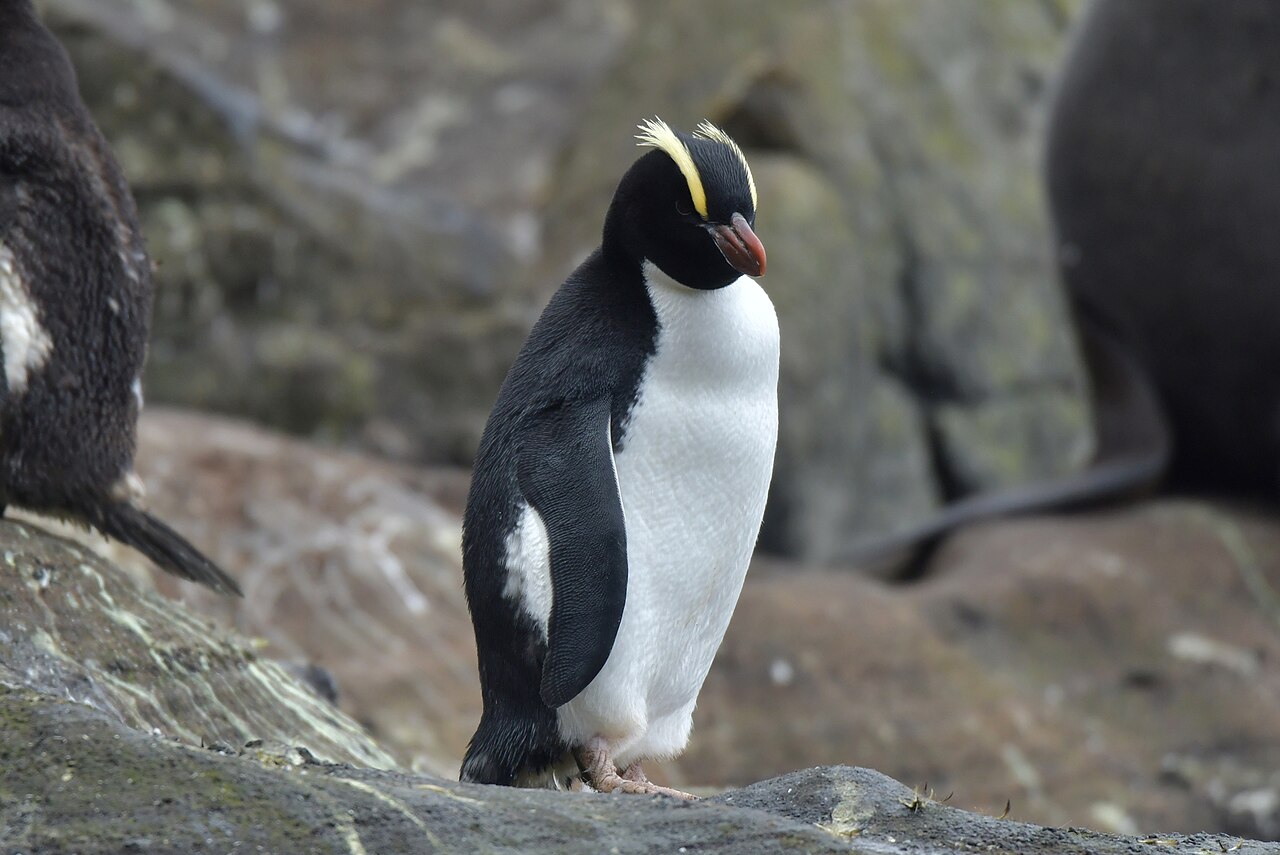
The Erect-crested Penguin (Eudyptes sclateri) is the largest of the New Zealand crested penguins and the only one that can truly raise its crest feathers, as two yellow brushes above the eye. It breeds solely on the Bounty and Antipodes Islands, where it lays an egg without a nest on bare, surf-polished granite.
Voice
At the colony comes a low booming bray, clearly deeper than that of any other crested penguin — it separates the bird by ear from Snares Penguin (Eudyptes robustus), which pulses higher and sharper. The bird spreads its flippers and throws its head back to deliver it. Between neighbours there is short snarling and growling; at sea it is silent.
Recording: Raphaël SANE — CC BY-NC-SA 4.0 · Antipodes island, New Zealand · xeno-canto
Identification
The largest crested penguin of the New Zealand islands, around sixty-five centimetres, with black back, black face and black throat against silky white underparts. The yellow eyebrow stripes begin between the nostril and the gape and rise obliquely over the red-brown eye; unlike its relatives it can hold the crest feathers erect, and seen head-on the two crests run roughly parallel rather than in a V. The large orange-brown bill carries a conspicuous pale blue-white strip of bare skin around the base. Young birds have a smaller, darker bill and near-white eyebrow stripes.
Confusion species
Snares Penguin (Eudyptes robustus) is smaller (about sixty centimetres), with pink rather than blue-white skin at the bill base, a crest beginning nearer the nostril and diverging in a V head-on, and a smaller chin with a flatter crown. Fiordland Penguin (Eudyptes pachyrhynchus) is smaller, has only a thin strip of black skin at the bill base and three to six whitish stripes on the cheek, and breeds on the mainland. Eastern Rockhopper Penguin (Eudyptes filholi) is much smaller, with a thin parallel-sided yellow stripe low on the forehead and a red eye; it breeds on the Antipodes alongside this species, so there size and bill weight are what decide. Royal Penguin (Eudyptes schlegeli) is larger still and has a white to pale grey cheek and chin instead of black, and is confined to Macquarie.
Habitat
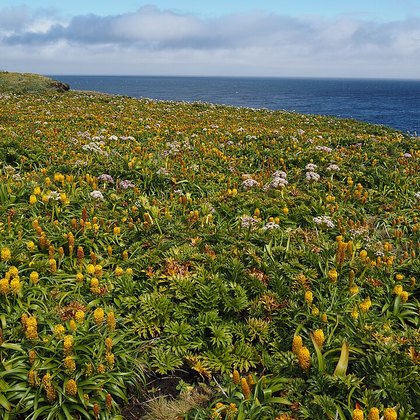
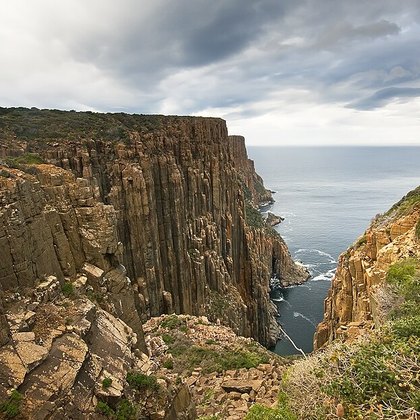
Subantarctic sea, where the birds forage far from the colony on squid and krill. The breeding places are among the roughest of any penguin: on the Bounty Islands there is no soil and no plant, only bare granite washed by the surf, and the egg lies on the rock among sea lions and nesting albatrosses. On the Antipodes the colonies sit on steep coastal slopes and tussock (grassland of loose, tall clump-forming grasses, especially in New Zealand) terraces above the rocky shore.
Where the bird is most often found, arranged by main group and formation.

Range and movements
The Antipodes Islands (three islands) and the Bounty Islands (eight rock islets) only; historically it also bred occasionally on Campbell Island and Disappointment Island in the Aucklands. Outside the breeding season it ranges over the subantarctic sea. Moulting birds come ashore regularly between January and March on the beaches of Otago, Southland and Canterbury, where after Fiordland Penguin this is the crested penguin most often found; in Australian waters it is very rare.
- Resident
- dark = core range, pale = thinly spread
Where and when to look
At the breeding grounds it can be seen only from an expedition ship, for landing on the Bounty Islands is barely possible and on the Antipodes tightly permitted; the Antipodes are visited on subantarctic voyages between November and January. More promising for the ordinary observer is a moulting bird on a southern New Zealand beach in late summer: look then at the pale blue skin strip around the bill and at the crest, which in this species can be held straight up.
Conservation
Endangered (EN). The 2011 count came to about sixty-eight thousand five hundred breeding pairs — forty-two thousand five hundred on the Antipodes and twenty-six thousand on the Bounty Islands — but that is a fraction of the mid-twentieth-century figure, and the New Zealand assessment moved to 'Declining' in 2013. Introduced predators and fisheries bycatch have not been demonstrated here; the finger points at the sea itself, where changing productivity forces the birds to forage further, so fewer chicks are raised. The mice on the Antipodes were eradicated in 2016, to the islands' benefit.
Scientific name
Eudyptes sclateri | Buller, 1888
Walter Buller described the species in 1888 as Eudyptes sclateri, and it has stayed in that genus, so author and year carry no parentheses. The epithet honours the British zoologist Philip Lutley Sclater, secretary of the Zoological Society of London. The genus Eudyptes is Vieillot's, 1816, from Greek eu, 'good', and dyptes, 'diver'. The type locality is given as the Auckland Islands — a place where the species does not breed today, which fits its sharply contracted range. The Maori name tawaki nana hi exists alongside.