All species › Passerines › Fairywrens, grasswrens and emu-wrens › Eyrean Grasswren
Eyrean Grasswren | Amytornis goyderi
Eyremeergrassluiper | Maluro del Eyre
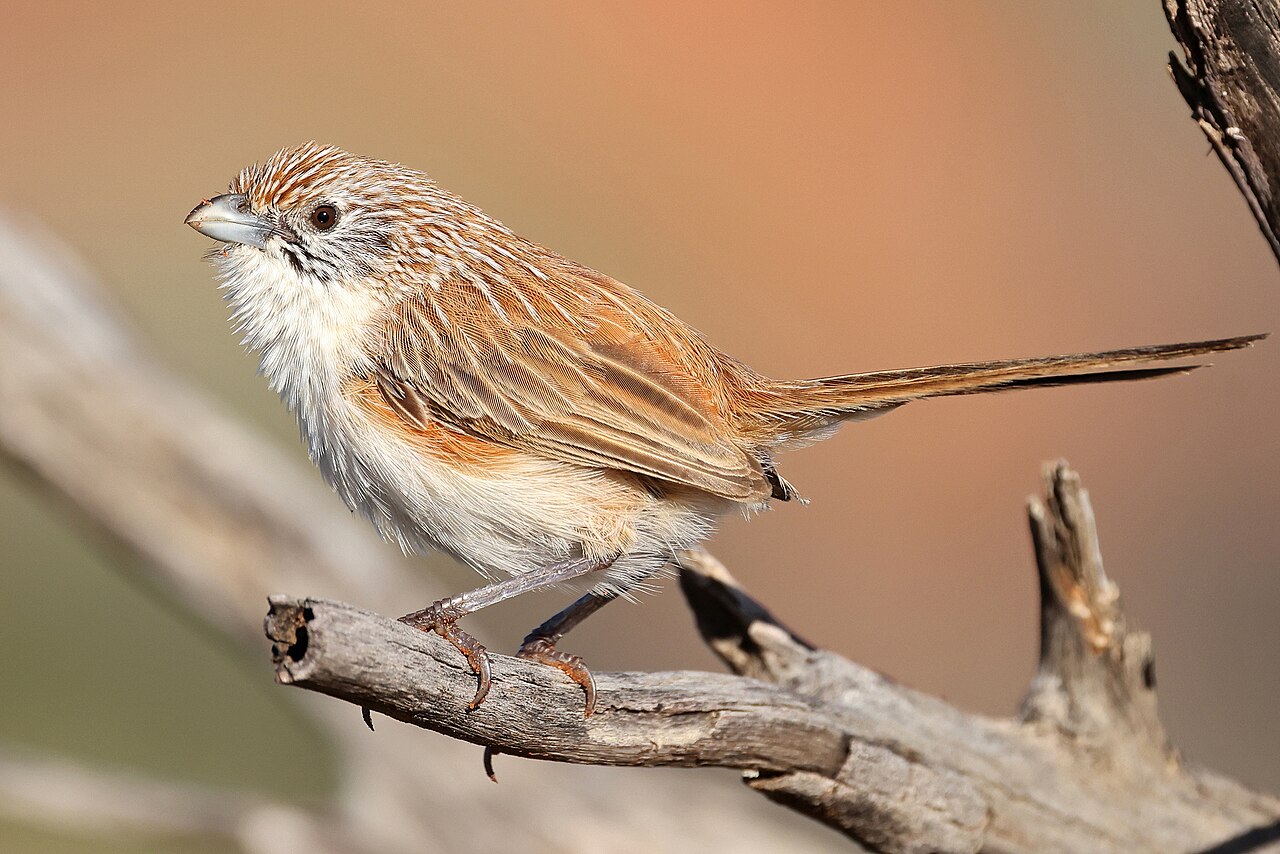
The Eyrean Grasswren is the grasswren of the dune crests of the Simpson Desert, and the only one of the genus you know by its bill: short, deep and pale, almost a finch's, where every other grasswren carries a fine, pointed one. It is also the smallest and lightest of the thirteen. Its history is one of vanishing and returning — for almost a century it was considered possibly extinct.
Voice
A high, thin, rapid song of a few seconds, more tenuous and less reeling than in most of its relatives, usually delivered from the top of a canegrass tussock on a dune crest. The contact call is a fine tsip that pairs exchange constantly as they work through the tussock. In alarm come dry, short notes. In the wind that blows almost permanently across the bare crests, the sound carries only a short way.
Recording: Martin Cake — CC BY-NC-SA 4.0 · Murnpeowie, South Australia, Australia · xeno-canto
Identification
Fourteen to sixteen centimetres, of which the tail is about half; at some seventeen grams the lightest grasswren. The bill decides everything: short, deep and pale horn to blue-grey, distinctly finch-like, separating it at a glance from every other grasswren. The plumage is a pale sandy reddish brown with fine white shaft streaks on crown and mantle; the underparts are clean white and plain, without streaking. The female has rufous flanks. The legs are long and the tail is carried up when the bird runs.
Confusion species
Sandhill Grasswren (Amytornis oweni) is the only species that really shares this dune country with it, but has a fine, pointed dark bill, a sharply defined white throat with a black moustachial stripe in the male, and a clearly streaked breast; it also keeps to the spinifex (spiny, hummock-forming desert grass of the interior) of the dune foot and swales, while this species sits out on the bare crest in the canegrass. Grey Grasswren (Amytornis barbatus) comes close in the Strzelecki corner but is larger, greyer, much longer-tailed and wears a black-and-white patterned face; it also holds to lignum swamps on floodplains rather than dunes. Where a grasswren in this landscape shows a thick pale bill, the identification is settled.
Habitat
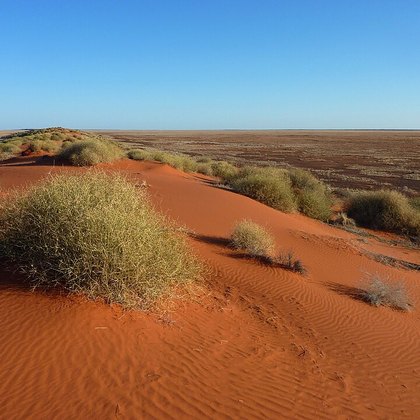
The crests and upper flanks of red sand dunes, grown with canegrass (Zygochloa paradoxa): the tussocky, wiry dune grass that holds on in the loose drifting sand of the crest where spinifex cannot. That is a striking reversal of the other grasswrens, which avoid the bare crests. Locally it also uses spinifex and low shrubs in the swales. It is largely a seed-eater — hence the heavy bill — supplementing that with insects; the nest is placed low in a canegrass tussock.
Where the bird is most often found, arranged by main group and formation.

Range and movements
The dune country of the Kati Thanda-Lake Eyre basin: the Simpson Desert in the south-eastern Northern Territory, the far south-west of Queensland and the north-east of South Australia, reaching into the Strzelecki dunefields. Well-known corners are the country around Goyder Lagoon, the Birdsville Track and the dunefields north of Kati Thanda-Lake Eyre. The type specimen was collected near Lake Eyre. Sedentary, though numbers can swing locally with the seed set after rain.
- Resident
- Winter
- dark = core range, pale = thinly spread
Where and when to look
Climb a dune ridge in the first hour after sunrise and work the crest where the canegrass stands in loose, wiry tussocks — not the spinifex in the swale, which is Sandhill Grasswren ground. Stand still at the first thin call and look for the bird walking on the bare sand between the tussocks. Watch the bill at once: it settles the identification. The best-known places lie along the Birdsville Track and in the western Simpson.
Conservation
The IUCN assesses the species as Least Concern (LC), a more reassuring verdict than its history would suggest. After the type material of the 1870s it went almost ninety years without a certain record and was long held to be possibly extinct; only in 1961 was it refound in the Lake Eyre country, and over the following decades it proved far more widespread across the Simpson dunefields than anyone had supposed. That the bird holds on is because its habitat is all but impossible to clear and because canegrass on drifting sand burns badly. Feral cats are the main continuing pressure, together with grazing by feral camels, which damage the canegrass tussocks on the crests.
Scientific name
Amytornis goyderi | (Gould, 1875)
John Gould described the bird in 1875 as Amytis goyderi, from material out of the Lake Eyre country; because the species was later placed in another genus, author and date stand in brackets. The epithet goyderi honours George Woodroffe Goyder, Surveyor-General of South Australia, after whom Goyder Lagoon in the heart of the range is also named. The genus was first called Amytis, after a Persian princess; as that name was preoccupied, Leonhard Stejneger proposed Amytornis in 1885, with Greek ornis (bird). The English name Eyrean Grasswren and the Dutch both cite Kati Thanda-Lake Eyre, the salt lake the dunefields surround.