All species › Passerines › Honeyeaters › Fuscous Honeyeater
Fuscous Honeyeater | Ptilotula fusca
Brilhoningeter | Mielero fusco
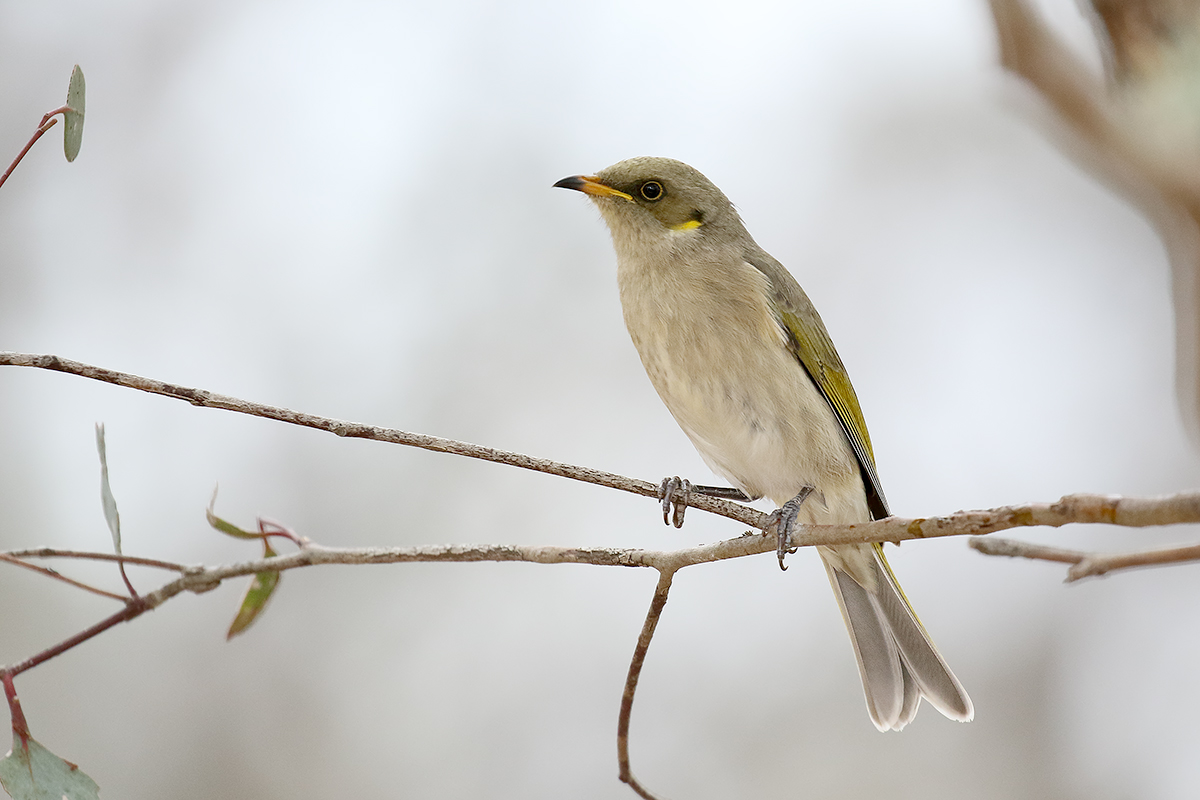
Ptilotula fusca is the plainest member of a plain genus: a medium-sized, uniformly olive-brown honeyeater without streaking, without a conspicuous patch, with little more than a dark ring around the eye and a tiny yellow ear plume narrowly edged black. That dark eye-ring is what gives it its Dutch name, Brilhoningeter, 'spectacled honeyeater'. It is numerous in the dry eucalypt forest behind the Great Dividing Range, lives semi-colonially and makes a constant racket there — once you know it by voice you hear it everywhere.
Voice
The repertoire is larger than the plumage suggests. Characteristic is a rolling, rattling phrase often rendered as arig arig a taw taw, together with a clear, flutey cheer tor cheer that carries far across open woodland. An incessant chip serves as the contact call within the group and is the sound you hear most often. In flight the male gives a deep, metallic flight song. Because the species lives semi-colonially, the whole usually sounds like an untidy chorus coming from one clump of trees.
No freely licensed recording has been found for this species yet; what to listen for is described below.
Identification
A medium-sized honeyeater of thirteen to seventeen centimetres, plain dull grey-brown to olive-brown above and buffy grey below — no streaking, no contrast. The face is all but blank: a dark, slightly smudged ring around the eye and, behind the ear coverts, a small, inconspicuous yellow plume narrowly edged black above and below. The bill is black and gently curved. Young birds and birds outside the breeding season show yellow at the bill base and in the eye-ring, which softens the face. The sexes are alike. The key to this species is therefore negative: the absence of features, combined with the dark eye-ring.
Confusion species
This is the hardest part of the whole Ptilotula group. Yellow-tinted Honeyeater (Ptilotula flavescens) is the nearest relative and closely similar, but is distinctly yellower throughout, has grey-yellow rather than black lores, and lives in tropical northern Australia, where Ptilotula fusca scarcely reaches; in the Queensland Gulf country the two come closest together. Grey-fronted Honeyeater (Ptilotula plumula) and Yellow-plumed Honeyeater (Ptilotula ornata) both carry a much broader, plainly visible yellow ear plume and streaked underparts — both features absent in Ptilotula fusca, which is thereby the flattest-looking of the genus. White-plumed Honeyeater (Ptilotula penicillata) has a white rather than a yellow plume and a yellower face. Finally, note the naming problem: Nesoptilotis flavicollis of Tasmania also carries the Dutch name Brilhoningeter. That species is larger, has a yellow throat and a large white ear patch, and occurs only in Tasmania, so the two never meet in the field.
Habitat
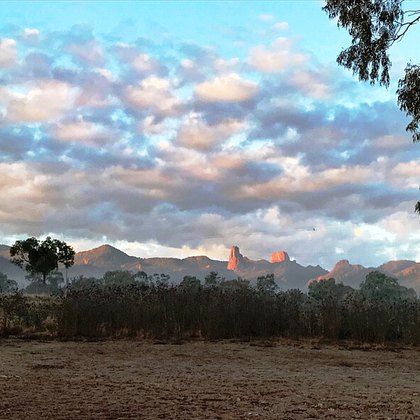
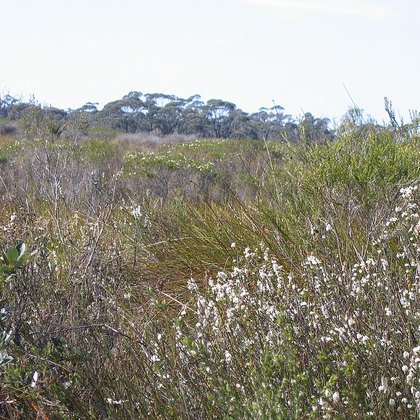
Open, dry eucalypt forest and woodland, mainly on the inland side of the Great Dividing Range, with local occurrence in coastal forest carrying a heathy understorey; also remnant patches on farmland, roadside strips and gardens. It is chiefly insectivorous, foraging actively in the outer and upper foliage, along branches and against eucalypt trunks, and takes nectar opportunistically — from eucalypts and mistletoe, plus lerp and honeydew, the sugary secretions of psyllid bugs. Outside the breeding season it forms parties of up to twenty birds and joins mixed flocks. Breeding runs from August to December; pairs are monogamous and breed semi-colonially, with one to three eggs and an incubation period of about fourteen days.
Where the bird is most often found, arranged by main group and formation.


Range and movements
Endemic to eastern Australia. The range runs from Cooktown and the Atherton Tableland in northern Queensland south through New South Wales and Victoria into eastern South Australia, with its centre of gravity inland of the ranges. In the southeast part of the population shifts altitudinally with the seasons: the lower country fills up noticeably in winter. Otherwise it is resident, with nomadic movements in drought and at times of heavy eucalypt flowering. It is absent from Western Australia, Tasmania and New Zealand.
- Resident
- Winter
- dark = core range, pale = thinly spread
Where and when to look
Work purely by elimination. A medium-sized, entirely plain olive-brown honeyeater in dry eastern eucalypt forest, without streaking and without an obvious plume, is nearly always this species. Then zoom in on the eye: the dark ring around it, against an otherwise blank face, is the positive mark. Voice is quicker: the rolling arig arig and the persistent chip of a semi-colonial party give it away before you have a bird in view. If you are west of the ranges in mallee, you are more likely looking at Yellow-plumed Honeyeater, which does carry a large yellow plume.
Conservation
Least Concern (LC) and common to numerous over most of its range; within Australia it is rated secure federally and in every state. The species persists in narrow strips of remnant woodland and in gardens, which gives it resilience in landscapes that have largely been cleared. Where woodland disappears altogether it does not hold on, and as with other semi-colonial honeyeaters, displacement by Yellow-throated Miner (Manorina flavigula) may play a part in heavily fragmented woodland; no firm figures on that were found for this species.
Scientific name
Ptilotula fusca | (Gould, 1837)
John Gould described the species in 1837 as Ptilotis fusca; author and year stand in parentheses, because it has since moved. For a long time it sat in Lichenostomus, until molecular work in 2011 showed that genus to be polyphyletic: since then it belongs in Ptilotula, a name Gregory Mathews had already proposed in 1912, built from Greek ptilon, 'feather', and ous, 'ear' — the ear plume, with a diminutive ending. The epithet fusca is Latin for 'dusky' or 'dull brown' and sums the plumage up neatly; the English name Fuscous Honeyeater and the Spanish mielero fusco follow it literally. The Dutch name Brilhoningeter picks the dark eye-ring instead. Note that the same Dutch name is also used for Nesoptilotis flavicollis of Tasmania, an entirely different species.