All species › Passerines › Bowerbirds › Great Bowerbird
Great Bowerbird | Chlamydera nuchalis
Grijze prieelvogel | Pergolero grande
The largest bowerbird in the world, and in northern Australia the most visible one too: a slim grey bird that walks about in caravan parks and town gardens and keeps an avenue bower somewhere in a dense shrub, with hundreds of white bones, shells and pebbles laid out in front of it. Anyone staying in Darwin, Katherine or Townsville stands a good chance of having a bower within walking distance.

Voice
A hard, rough and surprisingly loud repertoire: drawn-out hissing, harsh rattles, grinding churrs and a short hoarse call. Over the top of it comes extensive mimicry — other birds, but also car doors, sprinklers and human voices — delivered at the bower in fits and starts and in no recognisable order. The whole performance is meant to keep a female in the avenue and sounds more menacing than beautiful.
No freely licensed recording has been found for this species yet; what to listen for is described below.
Identification
At 33 to 38 centimetres the largest species in the family: slim, long-tailed and strikingly plain. The upperside is grey-brown with a fine pale scalloping that disappears at any distance, so that the bird reads simply as grey — the clearest difference from the two densely spotted inland species. The underparts are pale grey-buff, the head fairly small with a dark crown. The male carries a nape collar of lilac-pink feathers raised only in display and otherwise wholly hidden; females usually lack it. The bill is dark and strong, the tail long and square-cut.
Confusion species
The Spotted Bowerbird (Chlamydera maculata) meets this species' range in central Queensland and is the only real candidate for confusion: smaller, shorter-tailed, and thickly set over the whole upperside with large buff spots, where the Great Bowerbird reads as plain grey. The Western Bowerbird (Chlamydera guttata) of the central interior is smaller still and even more heavily spotted, and does not occur here. The Fawn-breasted Bowerbird (Chlamydera cerviniventris) of Cape York is smaller, clearly fawn on breast and belly, and lacks the lilac nape crest altogether. Large honeyeaters and young butcherbirds are sometimes taken for this bird, but the bill and the flight are quite different.
Habitat
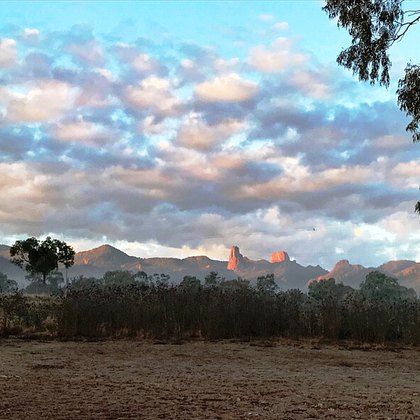
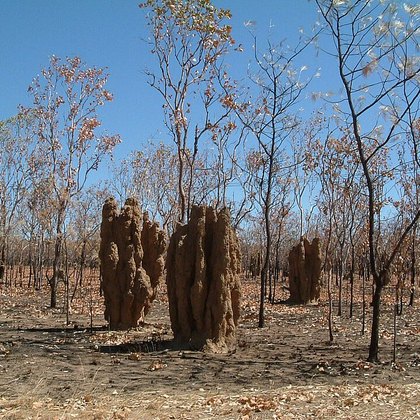
Dry eucalypt forest and open woodland of the monsoon belt, monsoon forest and vine thicket, gallery woodland along creeks and the edges of eucalypt savanna. Beyond that, and very markedly, ground made by people: gardens, parks, campgrounds, mango trees in yards and the shrubby edges of towns, where the bird becomes tame and sets its bower among ornamental shrubs.
Where the bird is most often found, arranged by main group and formation.



Range and movements
Northern Australia in a broad band: from the Kimberley in Western Australia through the Northern Territory and across Cape York, then south along the Queensland coast to about Mackay, and inland into the central Queensland interior. Sedentary; bower sites are fixed and some are used for decades on end.
- Resident
- dark = core range, pale = thinly spread
Where and when to look
The bower is the object of the search. Walk the shrubby edges of a campground or a town park and watch for a pale swept patch with two walls of upright sticks and a display laid out at either end. View that display from within the avenue: the male puts the smallest objects nearest and the largest furthest away, so that from the female's viewpoint in the avenue they all appear the same size — a gradient best described in this species. Early morning is the time; sit down and wait.
Conservation
Least Concern and common across the whole north, with a range that gardens, water points and town plantings have if anything enlarged rather than reduced. The plastic it picks up — bottle caps, shards, foil — has become part of the decoration and does no demonstrable harm, though it draws criticism as an image. The concern lies rather with the monsoon thickets and vine thickets, which are small and under pressure from altered fire regimes and from stock.
Scientific name
Chlamydera nuchalis | (Jardine & Selby, 1830)
Jardine and Selby described the species in 1830 as Ptilonorhynchus nuchalis; because it was later placed in another genus, authors and year stand in parentheses. The type locality was only fixed in 1952, on the Port Darwin district of the Northern Territory. Chlamydera is built from Greek chlamys, 'cloak', and dere, 'neck'; nuchalis is New Latin for 'of the nape', after that same hidden lilac collar. The Dutch name points to the plain grey plumage, the English one to the size.