All species › Passerines › Fairywrens, grasswrens and emu-wrens › Grey Grasswren
Grey Grasswren | Amytornis barbatus
Harlekijngrassluiper | Maluro gris
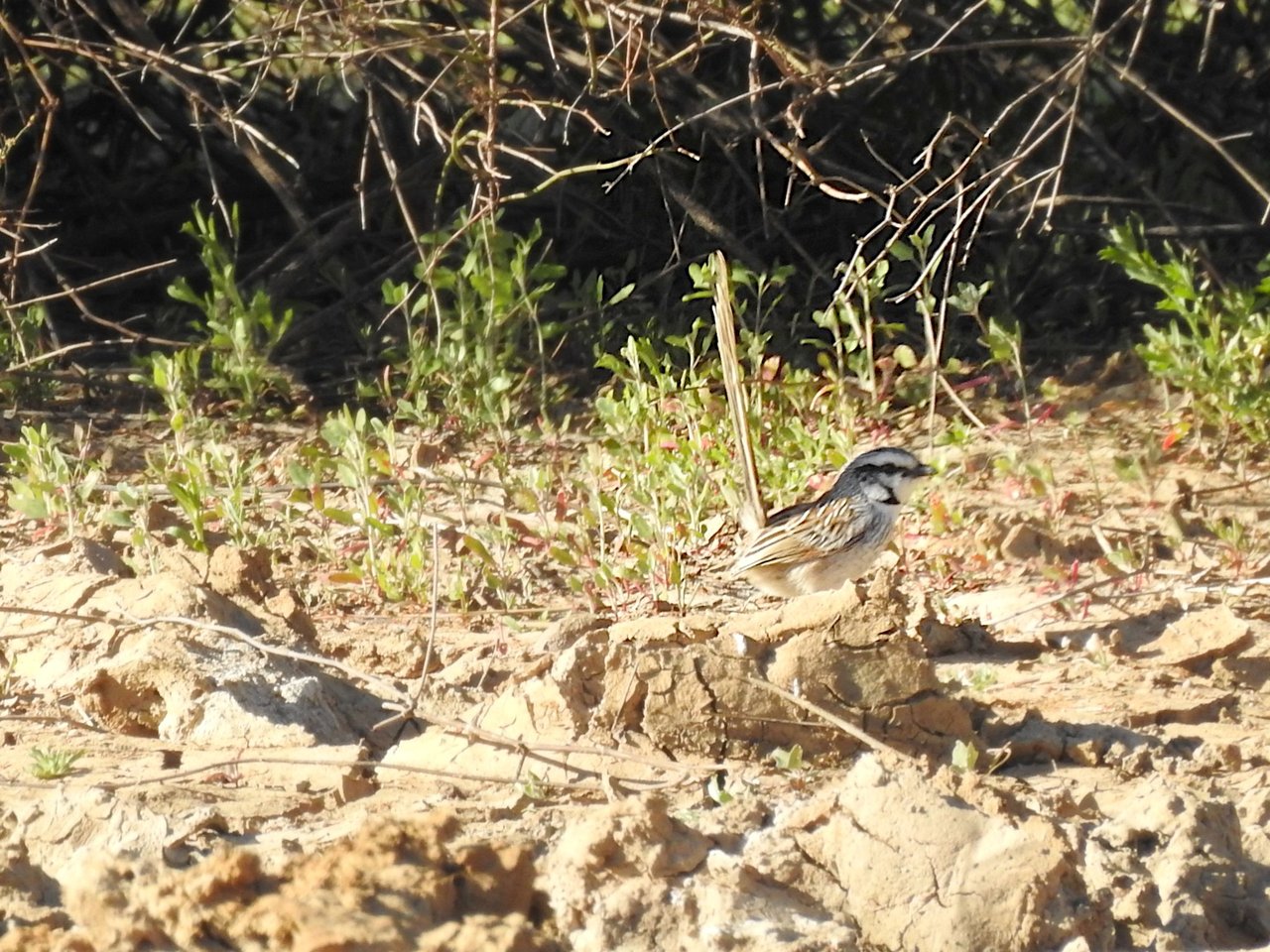
The Grey Grasswren is the oddest of the genus: a pale, greyish-brown, exceptionally long-tailed bird with a black-and-white patterned face, living not in spinifex (spiny, hummock-forming desert grass of the interior) or on rock but in the lignum swamps of the inland floodplains. It was described only in 1968, which makes it one of the last-discovered birds of mainland Australia.
Voice
A high, thin, somewhat grating chatter, less musical and less reeling than the song of the spinifex grasswrens, usually from the heart of a lignum bush. The contact call is a fine tsip with which the birds of a small party keep track of one another inside the dense shrub. In alarm comes a dry rattle. Because it seldom leaves the bush, that sound is often the only sign you get of it.
Recording: Louis Masarei — CC BY-NC-SA 4.0 · Goyder Lagoon, Australia · xeno-canto
Identification
Eighteen to twenty centimetres, of which the tail is more than half — a strikingly long, slender tail, often slightly spread, carried up when the bird runs. The face settles the identification: a white forehead and white cheeks framed by black lines running from the base of the bill through the eye and along the throat, with a black-and-white streaked crown above. Hence the Dutch name. The upperparts are greyish brown with white shaft streaks, the underparts white. It is a pale bird, without the warm rufous of its relatives.
Confusion species
In practice hardly confusable: no other grasswren wears this black-and-white face mask, and no other grasswren lives in lignum. Eyrean Grasswren (Amytornis goyderi) occurs in the same corner of the continent but sits on the bare dune crests, is much smaller and shorter-tailed, warm sandy rather than grey, and has a thick pale bill and a plain face. Western Grasswren (Amytornis textilis) is likewise pale and long-tailed but lacks the face mask entirely and lives in acacia and saltbush scrub, far to the west. A grey, long-tailed grasswren with a black-and-white streaked head in a lignum swamp is this species.
Habitat
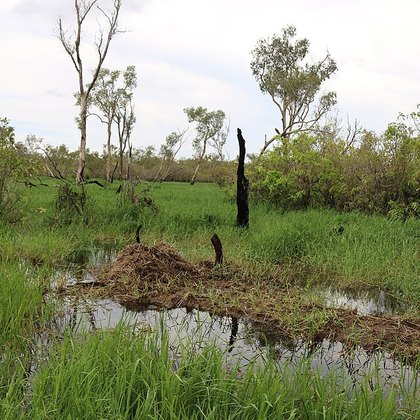
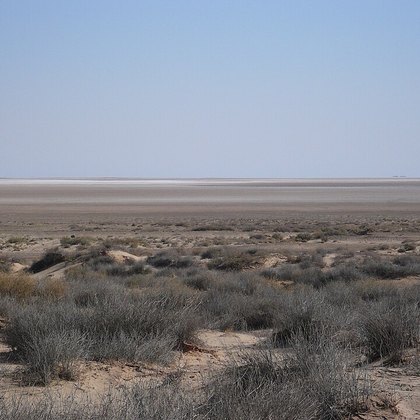
Dense, old lignum thickets (Duma florulenta) and canegrass on the floodplains and overflow country of the inland rivers, often in basins that fill only every few years with water out of Queensland. The thicket must be tall and closed; open, thinned lignum is not occupied. It moves almost entirely within the shrub, walks on the ground beneath it and rarely flies more than a few metres. The nest is placed low in a lignum bush. After a large filling of the plains, numbers rise.
Where the bird is most often found, arranged by main group and formation.
Range and movements
Two separate areas in the dry interior. In the east the Bulloo overflow on the Queensland and New South Wales border, with the type locality Teurika in north-western New South Wales. In the west the plains of the Diamantina and Eyre Creek and Goyder Lagoon, on the Queensland and South Australia border; those western birds are distinguished as a separate subspecies. Unsuitable country lies between the two. Sedentary, but locally much dependent on the flood cycle.
- Resident
- Winter
- dark = core range, pale = thinly spread
Where and when to look
Find a lignum flat where the bushes stand head-high and closed — the best-known places lie around Goyder Lagoon and in the Bulloo overflow — and walk its edge in the first hour after sunrise. Stand still and listen; the birds give themselves away with fine contact calls before you see them. Now and then one climbs briefly into the top of a bush. Expect a long, wet or else dusty drive: this is one of the hardest birds in Australia to reach.
Conservation
The IUCN assesses the species as Least Concern (LC). That verdict rests on a range which, although small and split in two, lies in country good for almost nothing else. The vulnerability is in the water. The lignum flats exist by grace of the water that comes down Cooper Creek, the Diamantina and the Bulloo out of Queensland, and any extraction or damming upstream damages the habitat. Stock and feral pigs eat the lignum out, and large fires in dry years are a real danger. In New South Wales and Queensland the species is listed as threatened under state law, a stricter view than the global one.
Scientific name
Amytornis barbatus | Favaloro & McEvey, 1968
Norman Favaloro and Allan McEvey described the bird in 1968, from material taken at Teurika in north-western New South Wales — a remarkably late discovery for a bird of the Australian mainland. The epithet barbatus is Latin for 'bearded' and refers to the black lines that run like a beard along the white throat. The genus was first called Amytis, after a Persian princess; as that name was preoccupied, Leonhard Stejneger proposed Amytornis in 1885, with Greek ornis (bird). The English name cites the pale grey ground colour; the Dutch name instead likens that black-and-white face to the painted face of a harlequin.