All species › Waders, gulls and terns › Sandpipers and allies › Grey-tailed Tattler
Grey-tailed Tattler | Tringa brevipes
Siberische grijze ruiter | Playero siberiano
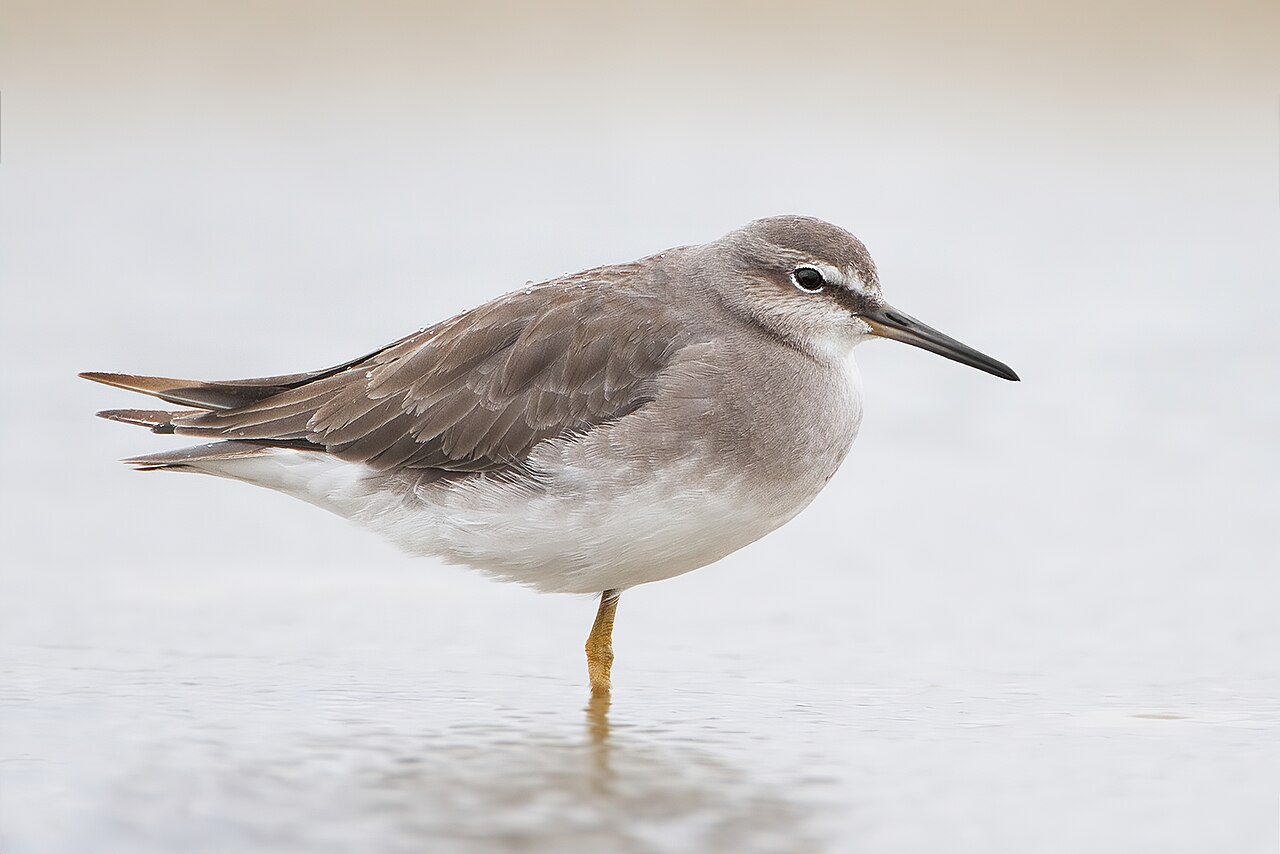
Grey-tailed Tattler is the grey loner among the shanks: a compact, plain slate-grey wader of a quarter of a metre, with short yellow legs, a straight dark bill and no trace of white on back or rump. On the north and east coasts of Australia it is one of the commonest waders, and it often stands on boulders, coral platforms and mangrove roots where the other shanks stay away.
Voice
The call is a short, clear, upslurred whistle of usually two syllables: too-wheet, sometimes with a third note added, given on take-off and between birds at a roost. That two-part rising whistle is the decisive difference from Wandering Tattler, which gives a rippling trill of six to ten notes. Among feeding birds it stays at soft, clipped contact notes. The English name tattler comes from this noisy alarm-calling.
No freely licensed recording has been found for this species yet; what to listen for is described below.
Identification
A compact shank of about twenty-five centimetres and a hundred and ten grams, plain mid-grey above and on the underwing without any pattern, white below. The bill is straight, dark and dull yellow at the base, with a nasal groove running less than half its length. The legs are short and yellow, so that the bird looks low-slung. Over the eye runs a bold white supercilium that clearly extends behind the eye. Breeding birds carry fine grey barring on breast and flanks, but the belly stays white; in non-breeding plumage the underparts are nearly plain. In flight the wing is plain dark grey without a wingbar, and back and rump stay as grey as the rest.
Confusion species
Wandering Tattler (Tringa incana) is the great identification problem and differs on four points: it is slightly larger, darker and longer-winged, its supercilium is short and does not run behind the eye but often meets its partner on the forehead, the nasal groove runs more than half the length of the bill, and in breeding plumage the barring continues onto the belly and undertail coverts. The call settles it fastest: two rising notes against a rippling trill. Common Greenshank (Tringa nebularia) and Marsh Sandpiper (Tringa stagnatilis) both carry a white wedge up the back that is completely absent here. Terek Sandpiper (Xenus cinereus) is equally dumpy and also has short orange-yellow legs, but its bill is long and clearly upturned. Nordmann's Greenshank (Tringa guttifer) also has short yellow legs, but is larger, far whiter and shows the white back wedge.
Habitat
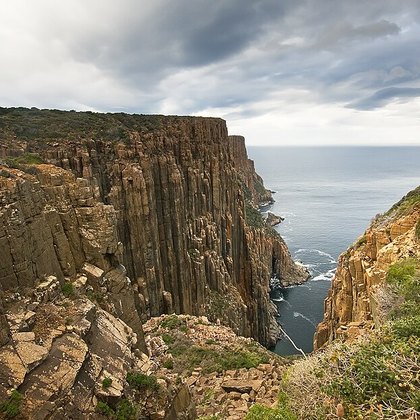
Harder and rockier than the other shanks choose: coral platforms and rocky shorelines, reefs that dry at low water, jetties, breakwaters and the root systems and mud banks of mangrove creeks. It also uses ordinary intertidal mud and sandflats of estuaries, where it walks and picks for crabs, worms and molluscs. At high water it roosts in mangrove tops, on posts and on boulders, often in small, tightly packed parties.
Where the bird is most often found, arranged by main group and formation.



Range and movements
Numerous along the whole north and east coast of Australia, from the Kimberley and Broome through the Top End and the Gulf of Carpentaria to the coral cays of the Great Barrier Reef and Moreton Bay, and in smaller numbers south along the east coast; in the south and west it is uncommon. Birds arrive from August and leave in March and April, with immatures oversummering at many sites. It reaches New Zealand annually in small numbers, usually five to ten birds, scattered from Parengarenga Harbour in the north to Awarua Bay in the south, as overflow from the Australian population.
- Resident
- dark = core range, pale = thinly spread
Where and when to look
Look where the rock meets the water: a breakwater, a jetty or a drying coral platform is more likely to produce a tattler than a bare mudflat. Once you have one in view, follow the supercilium with the telescope and see whether it runs behind the eye; if in doubt wait for the call, because the two-part rising too-wheet rules out Wandering Tattler faster than any plumage mark can.
Conservation
Least Concern (LC), but that verdict rests on a species with a restricted breeding range: it nests only along mountain streams in northeastern Siberia, and virtually the whole world population winters in Australasia. On migration it depends on the same intertidal flats of the Yellow Sea that are the bottleneck for the other waders of this flyway, and counts on Australian flats show a falling trend for this species. Because here it partly withdraws to rocky shores and mangrove rather than open mud, it is less visible in count series than, say, Bar-tailed Godwit.
Scientific name
Tringa brevipes | (Vieillot, 1816)
Vieillot described the species in 1816 as Totanus brevipes, with Timor as the type locality; because of the later move to Tringa, author and year stand in parentheses. The epithet is built from Latin brevis, 'short', and pes, 'foot': short-legged, exactly the feature by which the two tattlers stand apart from the other shanks. The genus name Tringa goes back through Neo-Latin to Aristotle's trungas. The English name refers to the grey tail and to the noisy alarm-calling; the Dutch name names the bird's Siberian origin.