All species › Waders, gulls and terns › Jaegers and skuas › Long-tailed Jaeger
Long-tailed Jaeger | Stercorarius longicaudus
Kleinste jager | Págalo colilargo
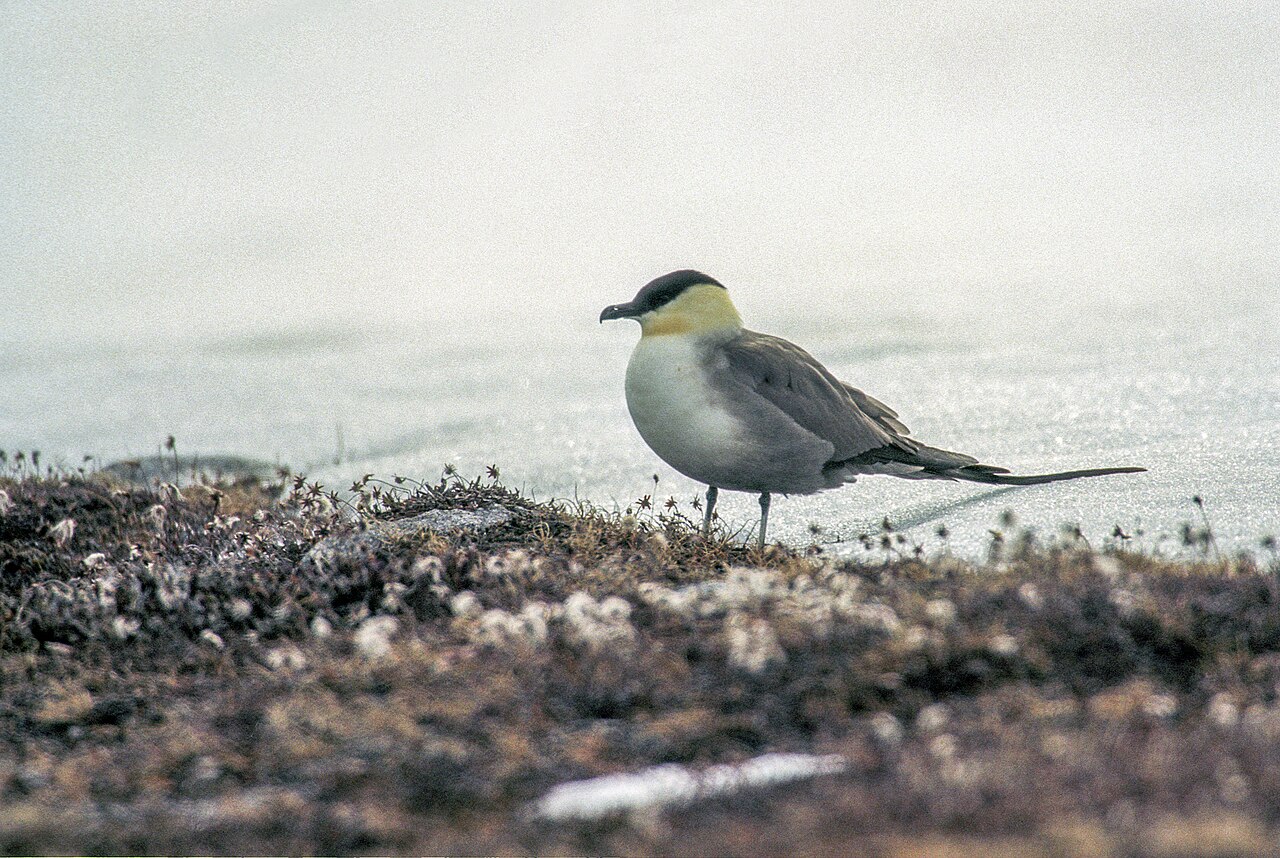
The Long-tailed Jaeger is the most elegant of the family: a light, tern-like bird with narrow wings, a small head and a short bill, which seems to spring off the waves rather than beat over them. The adult carries two thin, flexible tail streamers projecting more than twenty centimetres beyond the tail and rippling in flight. It breeds in the high Arctic and in the Australian summer reaches the outer continental shelf, staying further offshore than its two relatives.
Voice
At sea in this region it is silent; only in a skirmish does a hard, hoarse kree-ah escape it. The territorial call it gives on the Arctic breeding grounds is a monotonous repeated whine, joined by yodelling and rattling notes over the nest site. Anyone seeing it on a pelagic trip should not count on sound: this is a bird to be found by eye.
No freely licensed recording has been found for this species yet; what to listen for is described below.
Identification
A slender, lightly built jaeger that with streamers reaches about half a metre, but at two hundred and thirty to three hundred and fifty grams weighs less than half a Pomarine Jaeger. The wings are narrow and pointed, the head small and the bill short and fine — together they give a tern-like look, and the flight is light and buoyant, with long glides. The upperparts are colder and greyer than in the other jaegers and contrast clearly with the blackish flight feathers, giving a dark trailing edge. The head carries a sharply cut black cap above a white throat and breast; the belly and undertail are washed greyish, and there is no real breast band. The wing flash matters most: only two or three primary shafts are white, so barely any pale patch shows — in the other jaegers that patch is conspicuous. In this region almost every bird is of the pale morph; dark and intermediate birds are rare here.
Confusion species
Parasitic Jaeger (Stercorarius parasiticus) is the closest: warmer brown above, with a faint grey breast band, broader wings, a clear white wing flash and pointed but far shorter tail feathers; its flight is fast and falcon-like rather than buoyant. Pomarine Jaeger (S. pomarinus) is about twice as heavy, barrel-chested, with a thick bill, a heavy wingbeat and, in the adult, twisted spoon-shaped tail feathers. Brown Skua (S. antarcticus) and South Polar Skua (S. maccormicki) are great skuas in an altogether different weight class, with a short wedge tail and a large white wing patch. Juveniles are the hardest: a young Long-tailed is colder grey than a young Parasitic, slimmer, longer-winged and has blunt rather than pointed tail tips. At long range an adult with streaming tail can suggest a tern or even an Oriental Pratincole; the black cap and the sharp kink in the wing then help.
Habitat
In this map window it lives wholly at sea, and further out than the other jaegers: the deep part of the continental shelf and above all the shelf break beyond it, where the water suddenly drops away. Only after heavy storms or persistent onshore wind does it come inside the surf, and exceptionally inland — New Zealand has a single record from Lake Taupo. It breeds on dry upland Arctic tundra, living largely off lemmings; that is far outside this region.
Where the bird is most often found, arranged by main group and formation.


Range and movements
Breeds in the high Arctic of Eurasia and North America and leaves that ground completely. In Australia it is not a vagrant but a regular migrant: records run from September to April with a peak around December and January, along the east coast from about 21 degrees south in Queensland to 38 degrees in Victoria, with scattered reports from Darwin, Michaelmas Reef, south of Tasmania and the middle of the Tasman Sea. In good years fifteen to twenty birds a day have been counted over the shelf break. In New Zealand it is far scarcer — nought to five birds a year, mainly from November to February and almost only off the North Island, at Northland, Auckland, Wellington and the Kapiti Coast. At Norfolk it appears in most years.
- Breeding (summer)
- dark = core range, pale = thinly spread
Where and when to look
You have to go to sea for this one: it is the jaeger you will usually miss from the beach. Book a pelagic trip out to the shelf break between November and February and watch the open horizon rather than the coast, because it often hangs alone over deep water, hunting storm-petrels and flying fish. Recognise it by its flight before looking for characters: light, buoyant, with long glides and a narrow pointed wing profile. A jaeger with no obvious white wing flash is almost certainly this bird.
Conservation
Least Concern (LC) and by far the most numerous jaeger in the world; its breeding grounds lie in thinly peopled Arctic country where direct human pressure is slight. As with the Pomarine Jaeger, breeding success swings with the lemming cycle, so the numbers reaching the southern hemisphere differ from year to year. In the longer run the warming of the tundra is the concern, because it alters both the lemming cycle and the vegetation of the breeding grounds. In Australian and New Zealand waters it is not counted; the picture comes from pelagic trips, and it was for that very reason long taken here for a vagrant.
Scientific name
Stercorarius longicaudus | Vieillot, 1819
Vieillot described the species in 1819 as Stercorarius longicaudus, in the Nouveau Dictionnaire d'Histoire Naturelle; because it has stayed in that genus, author and year carry no parentheses. The epithet is built from Latin longus, 'long', and cauda, 'tail', after the streamers of the adult — exactly the character the English and Spanish names carry too, while the Dutch name points instead at weight: of the three small jaegers this is the lightest. The genus Stercorarius was introduced by Brisson in 1760, after Latin stercus, 'dung', from the old sailors' belief about what jaegers took from their victims.