All species › Passerines › Woodswallows, bellmagpies and allies › Masked Woodswallow
Masked Woodswallow | Artamus personatus
Maskerspitsvogel | Artamo enmascarado
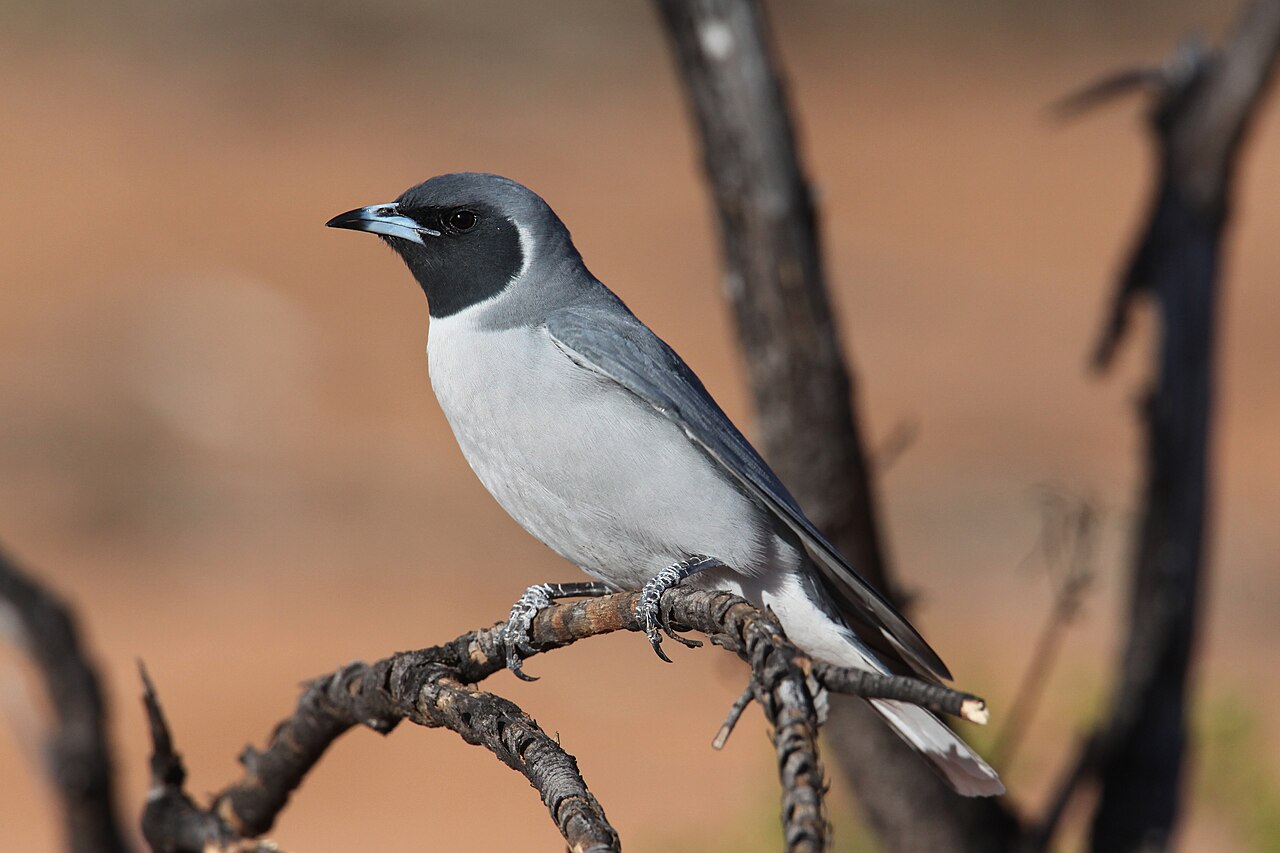
The Masked Woodswallow is a wanderer of the dry interior that truly lives nowhere. It appears in hundreds, sometimes thousands, wherever rain has fallen, breeds in haste, and a season later is gone without trace. The male is unmistakable: a blue-grey bird with a jet-black face mask covering the whole forehead, cheeks and throat, sharply outlined by a thin white line. It travels almost always in the company of the White-browed Woodswallow, and it is exactly that habit which makes it difficult.
Voice
A soft, nasal chep-chep or vit as a contact note, which from a travelling flock comes out of the sky as a continual thin murmur and is often the first thing an observer notices. The song is a soft, almost whispered chattering of scratchy and squeaky notes, laced with imitations of other birds; it carries only at close range. The alarm is a sharper, repeated rattle. The contact note is practically inseparable from that of the White-browed Woodswallow, so a mixed flock cannot be untangled by voice either.
No freely licensed recording has been found for this species yet; what to listen for is described below.
Identification
The male is the simplest of all woodswallows: upperparts blue-grey, underparts pale grey, and between them a wholly black face mask taking in forehead, lore, cheek, chin and throat as one even hood, set off from the grey neck by a narrow, pure white dividing line. That is not a patch or a stripe but a closed mask, and in it lies the chief distinction from every other species. The wings are grey with dark primaries, the tail grey with a white tip, the bill blue-grey with a black tip. The female is a much plainer bird: grey-brown above, dull buff below, with the mask reduced to a dark, vaguely bounded wash around eye and chin. Both sexes show the characteristic triangular wing and the short-tailed, broad silhouette in the glide.
Confusion species
Let the face pattern decide. Male White-browed Woodswallow (Artamus superciliosus) also has a dark face, but above it a broad, pure white brow which this species wholly lacks, and deep chestnut underparts instead of pale grey. Black-faced Woodswallow (Artamus cinereus) has no closed mask but only a black loral patch, and its head is a less sharply bounded cap running into the grey of the neck. Dusky Woodswallow (Artamus cyanopterus) is browner and carries the white wing edge this species does not have. The genuinely hard birds are the females: a female Masked and a female White-browed are both dull brown, indistinct birds, and then the pale, greyish underparts of the first against the warmer cinnamon of the second must settle it — a difference often invisible at soaring height. Since the two species fly in the same flock, the honest conclusion is that a proportion of the birds in a large mixed flock cannot be assigned to species at all.
Habitat
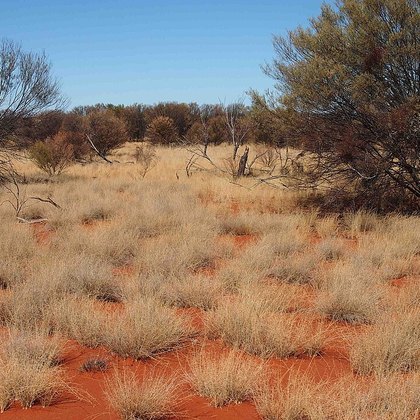
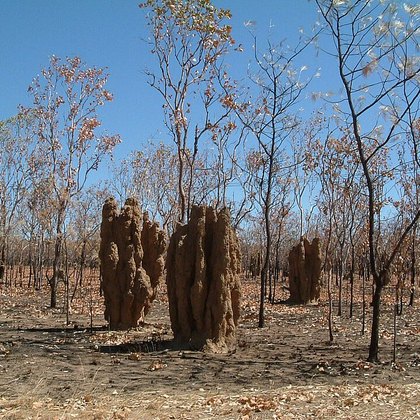
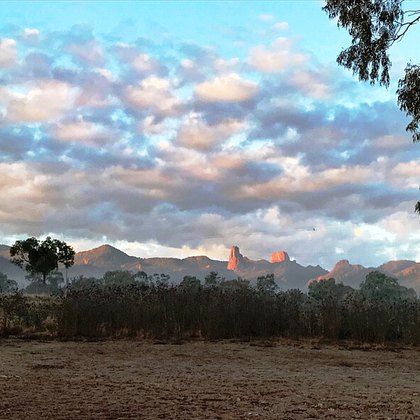
Arid and semi-arid interior: mulga and acacia scrub, mallee, savanna with scattered eucalypts and open dry eucalypt woodland. The species follows the rain and with it the sudden abundance of insects that comes after; in dry years it pushes towards the coast and the south-east. It hunts on the wing, soaring high on outstretched wings, often in large loose parties that work through an insect swarm together. The nest is a flimsy cup of twigs in a fork, a shrub or a fence, and breeding colonies may form somewhere in one season and be entirely absent the next year.
Where the bird is most often found, arranged by main group and formation.

Range and movements
The whole Australian mainland except Tasmania, with the centre of gravity in the dry interior. There is no fixed migration pattern of the ordinary kind: the movements are unpredictable and follow the weather. In good years flocks push far into the south-east and south-west, where the species then breeds in spring and summer before withdrawing to the interior again. Vagrants rarely reach Tasmania.
- Resident
- Breeding (summer)
- Passage
- dark = core range, pale = thinly spread
Where and when to look
Look up when you hear a thin, persistent piping in the interior: the flock is often so high that it only registers on a second glance. Put the binoculars on the males and read the head alone — black face without a white brow and pale grey belly means this species, black face with a white brow and rufous belly means White-browed Woodswallow. Expect both in the same flock, and accept that the females will often stay undecided.
Conservation
The species is listed as Least Concern (LC), with a very large range and a numerous population. Its wandering existence makes it less vulnerable to local damage than the resident woodswallows: it simply avoids a bad year by moving on. That is precisely why trends are hard to establish, since the number of birds counted in a given area says mostly something about rainfall and little about the population as a whole. There is no reliable long-term series.
Scientific name
Artamus personatus | (Gould, 1841)
John Gould described the bird in 1841 as Ocypterus personatus, from material from 'southern and western Australia', in practice York in Western Australia. The epithet personatus is Latin for 'masked', from persona, the actor's mask, and describes exactly the closed black face mask of the male; the Dutch maskerspitsvogel, the English Masked Woodswallow and the Spanish artamo enmascarado all say the same. The genus name Artamus comes from Greek artamos, 'butcher', after the kinship with the butcherbirds.