All species › Passerines › Thornbills, scrubwrens, gerygones and allies › Mountain Thornbill
Mountain Thornbill | Acanthiza katherina
Athertondoornsnavel | Acantiza montana
The Mountain Thornbill is the thornbill of the tropical mountain rainforests of north-eastern Queensland: a greenish-grey bird of barely eight grams that lives high in the canopy of the Wet Tropics and occurs nowhere else on earth. It is also the only thornbill on the red list — the species is retreating into ever higher, cooler mountain forest, and that is why it now counts as Vulnerable.
Voice
A surprisingly rich voice for so small a bird: trills, fussy squeaks and churrs interspersed with a zizzing buzz, the bird shifting rapidly between high and low frequencies. Recordings span roughly a thousand to nine thousand hertz. The finest element is a rapidly ascending series of bubbly notes. To an unprepared ear it sounds more like electronic chatter than like birdsong.
No freely licensed recording has been found for this species yet; what to listen for is described below.
Identification
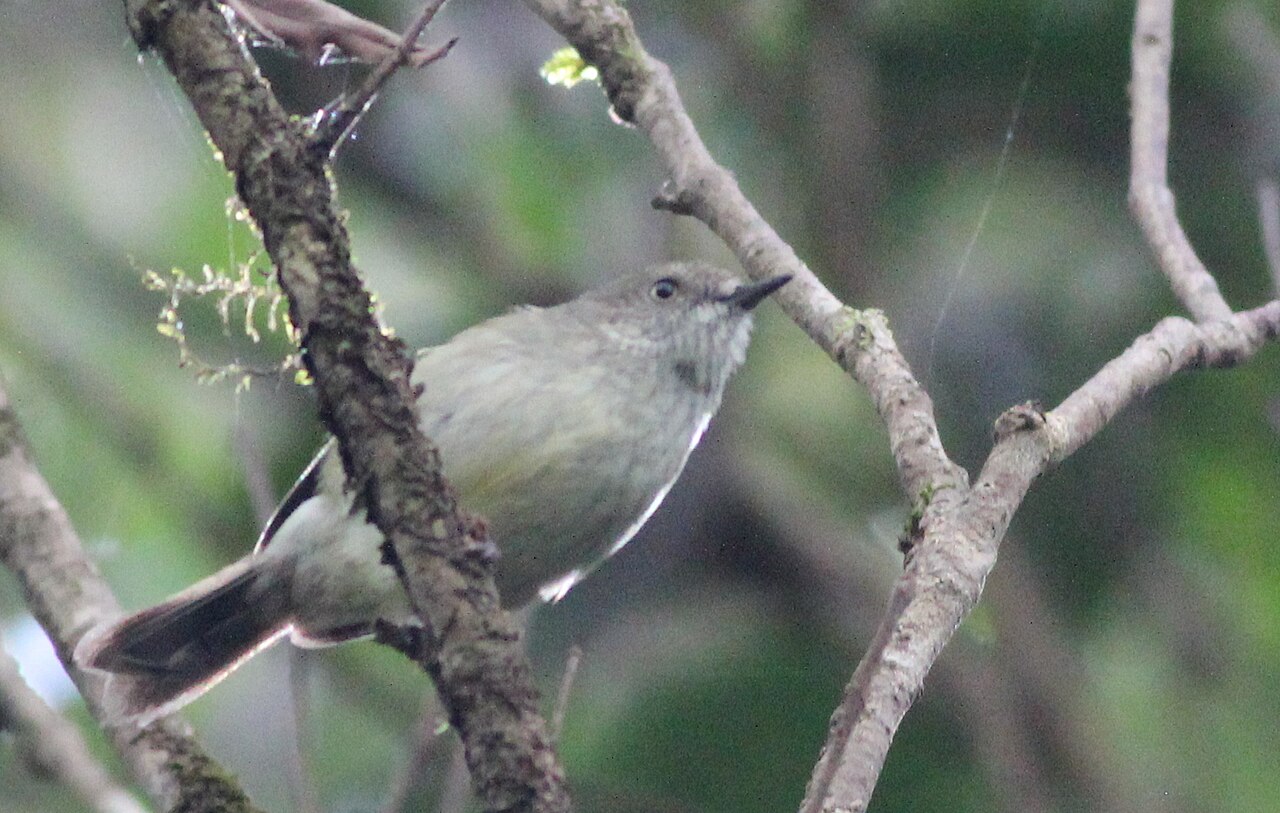
A tiny, restless bird of ten centimetres with greenish-grey to olive-green upperparts, pale underparts faintly streaked on the chest, and buff-yellow flanks. The eye is creamy white to pale cream and, in good light, is the decisive character. The forehead carries a fine pale speckling on a grey ground, much weaker than the clear scalloping of most relatives. The bill is thin and slightly hooked at the tip. There is no contrasting rump: back and rump run into one another, which is unusual within the genus.
Confusion species
The chief candidate is Brown Thornbill (Acanthiza pusilla), which occurs in the same region at lower elevations: that species has a warm rufous forehead with clear scalloping, a dark red iris and a rufous rump that stands out against the back — three characters the Mountain Thornbill lacks. Brown Gerygone (Gerygone mouki) shares both the rainforest and the slight build, but has a red iris, a conspicuous white brow and an unspeckled forehead. Yellow Thornbill (Acanthiza nana) reaches north-eastern Queensland but is distinctly yellow below and dark-eyed. Buff-rumped Thornbill (Acanthiza reguloides) is also pale-eyed, but has a buff-yellow rump that does contrast with the back and inhabits dry woodland rather than rainforest — habitat separates the two outright.
Habitat
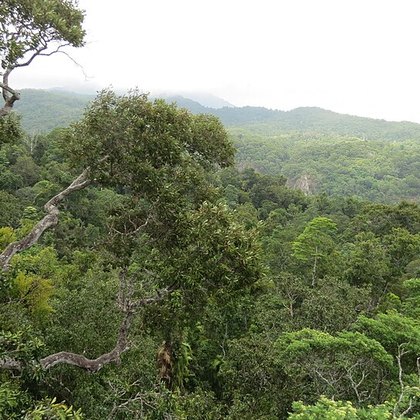
Tropical upland rainforest of the Wet Tropics, almost always above four hundred and fifty metres and up to sixteen hundred. The bird forages mainly in the canopy and the upper half of the trees, gleaning insects and spiders from the leaves, usually in pairs or loose parties and regularly attached to mixed flocks. It is largely absent from the lowland rainforest at the foot of the ranges, where Brown Thornbill takes over.
Where the bird is most often found, arranged by main group and formation.
Range and movements
Endemic to a narrow band of north-eastern Queensland between Cooktown in the north and Townsville in the south — the country known as the Wet Tropics. Well-known sites include the Atherton Tableland, Mount Lewis, the Bellenden Ker Range and Paluma. The total range is small and fragmented across the separate massifs. There is no migration, but the species is shifting: recent observations point to a concentration in the higher, cooler parts and a withdrawal from the lower margins.
- Resident
- dark = core range, pale = thinly spread
Where and when to look
Look for the species in the canopy of mountain rainforest above roughly six hundred metres, and check the eye first: pale and creamy here, dark red in Brown Thornbill. Because the birds forage high and against the light, that iris often needs binoculars and patience; the voice is then the quicker route. Work quietly along forest edges and canopy gaps, where the birds come lower.
Conservation
Vulnerable (VU). The species is confined to one small, fragmented upland region and is therefore exceptionally exposed to climate change: heatwaves cause direct mortality and prolonged drought reduces the supply of insect prey. Counts indicate a decline of thirty to fifty per cent over the past decade and a shift into higher, cooler forest — a movement that on a mountain eventually runs out of room. Much of the ecology remains unknown, including juvenile dispersal and how often the species breeds cooperatively; that knowledge is precisely what management needs.
Scientific name
Acanthiza katherina | De Vis, 1905
Charles Walter De Vis described the species in 1905. The genus Acanthiza was introduced in 1827 by Nicholas Vigors and Thomas Horsfield and combines Ancient Greek akantha ('thorn') with zaō ('to inhabit'), hence 'dweller in the thorn-brake'. The epithet katherina is a Latinised woman's name; De Vis did not explain whom he was honouring, and the question has never been settled. The English name Mountain Thornbill takes the altitudinal range, the Dutch Athertondoornsnavel the best-known part of the range, the Atherton Tableland, and the Spanish acantiza montana follows the English.