All species › Waterfowl › Ducks, swans and geese › Musk Duck
Musk Duck | Biziura lobata
Australische lobeend | Malvasía papuda
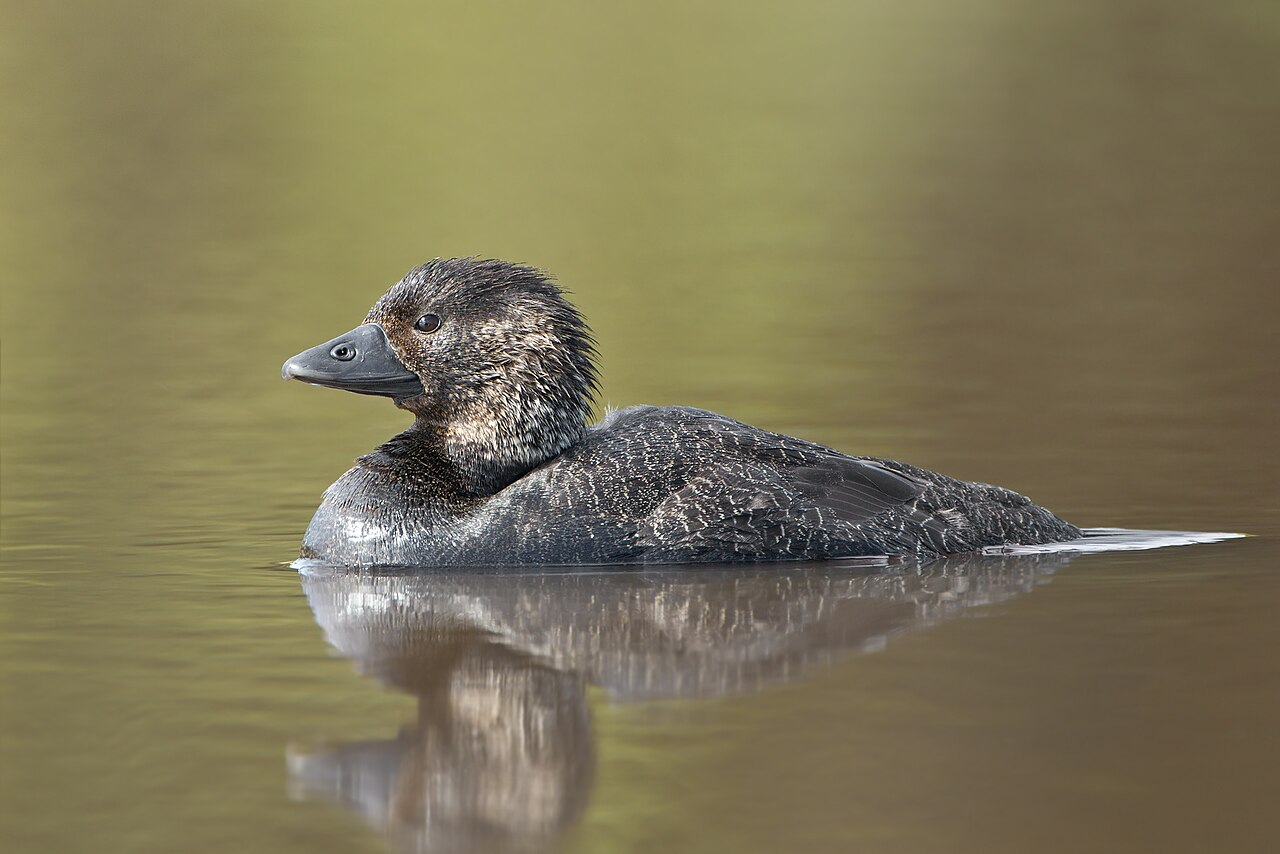
The Musk Duck is the oddity among Australia's waterbirds: a heavy, sooty-brown diving duck that lies so low that only the back and head break the surface. The male carries a large leathery lobe under the bill, weighs half as much again as the female, and in the breeding season gives off a penetrating musk smell from a gland on the rump.
Voice
The displaying male produces one of the strangest sound sequences in the guide: first a dull slapping splash as he kicks the water sideways with both feet at once, ker-plonk, and immediately after a high, sharp, far-carrying whistle, fwee-ee. He repeats that sequence for hours on end, day and night, and it carries a kilometre across open water. Outside display the species is all but silent; the female gives at most a low grunt. A hand-reared male at Tidbinbilla, named Ripper, replaced that whistle with a slamming door and a run of syllables that sounds like you bloody fool — recordings from 1987, published only in 2021, showing that the species can learn sounds.
No freely licensed recording has been found for this species yet; what to listen for is described below.
Identification
A bulky, wholly sooty-brown duck with fine pale brown barring and a finely speckled head, paler towards the belly and nearly white there. The tail is of long stiff feathers, usually trailing flat on the water but cocked as a fan over the back in display. The male is enormous — up to 73 cm and over two kilos — with a black pendant skin lobe under the bill that swells in spring; the female is barely more than half his weight and has only a small knob. Bill dark grey, eye dark brown. It flies seldom and with great labour; the picture is of a bird that dives the moment you notice it.
Confusion species
Blue-billed Duck (Oxyura australis) lies just as low in the same reedbeds and also cocks its tail, but is far smaller, warm chestnut, and the male has a bright blue bill and no lobe. At range a diving Musk Duck can suggest Australasian Grebe (Tachybaptus novaehollandiae) or Little Pied Cormorant (Microcarbo melanoleucos); look then at the heavy head, the broad flat bill and the total absence of white. A second species of the genus, the New Zealand Musk Duck (Biziura delautouri), lived on both New Zealand main islands but is extinct, so there is no living relative left in the guide area.
Habitat
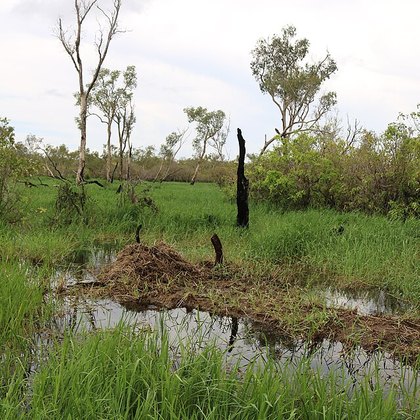
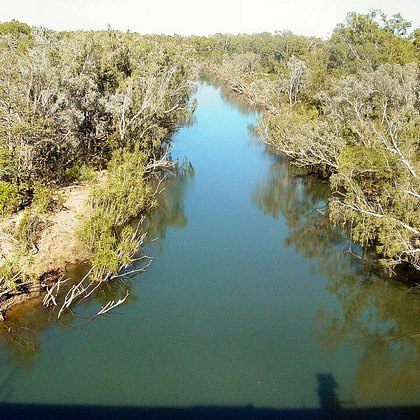
Deep permanent freshwater lagoons and lakes with dense reed and rush margins, where it can dive all year; beyond that also large reservoirs, slow rivers and even estuaries and sheltered coastal bays, above all in winter, when birds from dried-out inland swamps fall back to the coast. The nest is a large cup of trampled vegetation, hidden deep in the reeds.
Where the bird is most often found, arranged by main group and formation.


Range and movements
Australia only. The range runs from north-western Western Australia through the south and east to southern Queensland, Tasmania included, and reaches several hundred kilometres inland in places. The densest populations are in south-western Western Australia and in the south-east; inland birds wander with water levels. It does not occur in New Zealand.
- Resident
- dark = core range, pale = thinly spread
Where and when to look
Work a large deep lake with a reed margin and scan the open water for a dark, almost shapeless streak that does not look like a duck; keep watching, because after the dive it will surface tens of metres away. In spring the male gives himself away: stand by the reed edge at dawn or in the dark and listen for the splash followed by the whistle.
Conservation
Least Concern globally (LC), but the state lists tell another story: vulnerable in Victoria, rare in South Australia and declining in south-western Western Australia. The species needs deep permanent water with dense fringing vegetation and vanishes as soon as swamps are drained or turn saline. Add drowning in set fishing nets, disturbance of breeding reedbeds, and the failure of good breeding years through long dry runs.
Scientific name
Biziura lobata | (Shaw, 1796)
Shaw described the bird in 1796 as Anas lobata, among the ducks, with a plate titled 'The Lobated Musk Duck'; because it later moved to another genus, author and year stand in parentheses, and the type locality is fixed no more precisely than 'New Holland'. The genus Biziura was introduced by Stephens in 1824, who gave no explanation for it; the origin of the word is unknown and probably invented. lobata is Latin for 'lobed', for the skin lobe under the male's bill. The English name points instead at the musk smell, and the Spanish at the throat lobe.