All species › Waterfowl › Ducks, swans and geese › New Zealand Scaup
New Zealand Scaup | Aythya novaeseelandiae
Nieuw-zeelandse topper | Porrón maorí
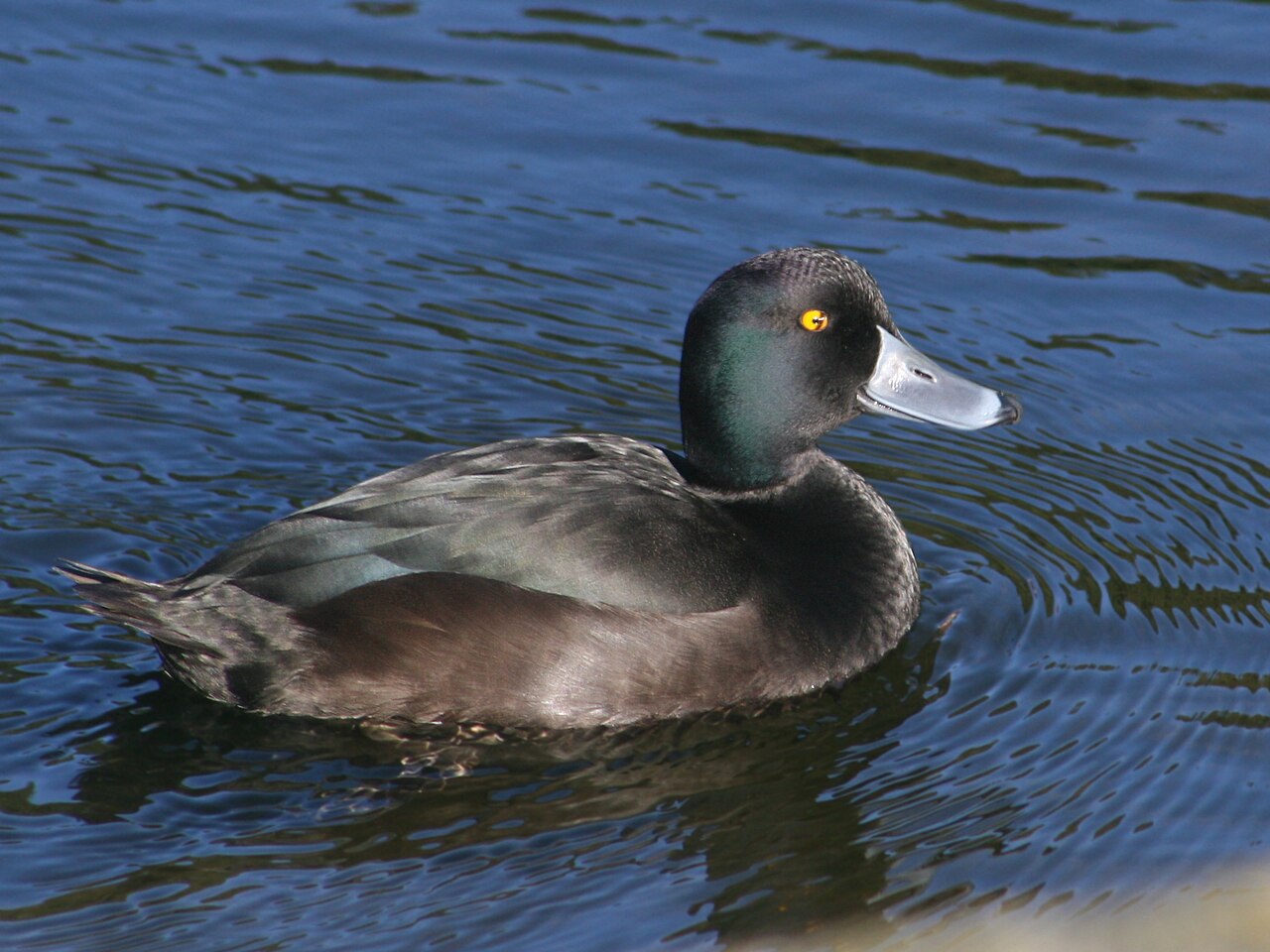
The New Zealand Scaup, pāpango in Maori, is the only diving duck that breeds on the New Zealand mainland: a small, compact, almost black duck that sits in dense rafts on deep lakes and disappears under water every other minute. The male gives himself away at a distance by a bright yellow eye set in an otherwise jet-black head.
Voice
Mostly a silent bird. In display the male gives a high, thin whistle, wheee weo-weo weo-weooo, which carries surprisingly far over still water. The female answers with a low, rasping wack-wack — more a growl than a quack — and uses it to keep her ducklings together. Often the only sound is the small plop as a bird goes under.
No freely licensed recording has been found for this species yet; what to listen for is described below.
Identification
A small duck of about forty centimetres, some sixty across the wings, riding low in the water with a short neck and a rounded head. The male is dark blackish-brown with blue-green gloss over head and wings, a striking yellow eye and a blue-grey bill with a black nail. The female is dull chocolate brown with paler underparts, a brown eye and usually a white patch or narrow vertical band at the base of the bill. When a bird flushes, a broad white bar runs almost the full length of the wing: the surest mark of all.
Confusion species
Hardhead (Aythya australis), a rare visitor to New Zealand, is larger and a warmer red-brown, the male with a white eye, a white band across the bill tip and a white belly that flashes as it surfaces. Australasian Grebe (Tachybaptus novaehollandiae) dives in the same water but is smaller still, with a pointed bill, a fluffy rear end and no white wing bar. Eurasian Coot (Fulica atra) also dives, but is larger, sooty black, and carries a white frontal shield and a white bill.
Habitat
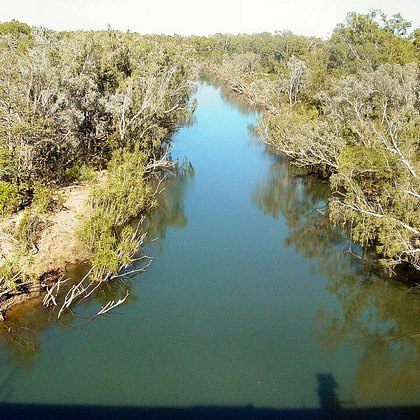
Deep, clear freshwater lakes are the core: crater lakes, glacial lakes and reservoirs, where it dives to two or three metres for water snails, small mussels, insect larvae and plant material. A dive usually lasts fifteen to forty seconds. In recent decades it has increasingly used shallow lowland lakes, slow rivers and park ponds as well. It avoids fast-flowing water and very shallow swamp.
Where the bird is most often found, arranged by main group and formation.

Range and movements
Endemic to New Zealand and spread across both main islands. The largest concentrations are on the Rotorua and Taupō lakes, in the Waikato, on lakes Wanaka, Wakatipu and Te Anau and around Christchurch; it is also common in Northland, Hawke's Bay and on the West Coast. In Canterbury it has been expanding since predator control began. It does not occur in Australia, and is absent from the Chathams and the subantarctic islands.
- Resident
- dark = core range, pale = thinly spread
Where and when to look
Look in winter, when the big lakes hold dense rafts of tens to hundreds of birds, often right off a jetty or a campground. A party that takes turns vanishing and bobbing up again is almost certainly scaup; time how long they stay under, since a quarter to half a minute is normal. On the Rotorua lakes and in the lakefront park at Queenstown they swim to within a few metres.
Conservation
Least Concern (LC), with an estimated twenty thousand birds. The species fell away sharply in the late nineteenth century through shooting and the loss of lowland lakes; since full protection in 1934 it has recovered and in many places increased, not least in Canterbury, where control of stoats and rats spares the nests. Declining water quality in lowland lakes and botulism in hot summers remain the concerns.
Scientific name
Aythya novaeseelandiae | (Gmelin, 1789)
Gmelin described the species in 1789 as Anas novae-seelandiae; because it later moved to the genus Aythya, author and year are bracketed. That genus was introduced by Boie in 1822 and goes back to Greek aithuia, an unidentified seabird in Aristotle. novaeseelandiae simply means 'of New Zealand'. The type locality is Dusky Sound on the South Island: the description rests on a watercolour Georg Forster made there in 1773 on Cook's second voyage, now held as the holotype in the Natural History Museum in London. The Maori name pāpango is in common use in New Zealand, where the bird is also known as black teal.