All species › Tubenoses › Albatrosses › Northern Royal Albatross
Northern Royal Albatross | Diomedea sanfordi
Noordelijke koningsalbatros | Albatros real del norte
The Northern Royal Albatross is a great albatross of over three metres wingspan, ninety-nine per cent of which breeds in the Chatham Islands. The rest sits at Taiaroa Head near Dunedin: the only albatross colony in the world on an inhabited mainland, and so the place where this bird can be watched at close range.
Voice
At sea it is virtually silent; at most a croaking, gurgling note when birds squabble around a fishing vessel. At the colony sound belongs to display: a loud braying aaah with the bill pointed at the sky, drawn-out clappering of the mandibles and a low groaning during mutual preening. A chick begging for food gives a high, persistent piping that carries across the whole cliff.
Recording: Oscar Thomas — CC BY-SA 4.0 · Taiaroa Head, Dunedin City, Otago Region, New Zealand · xeno-canto
Identification
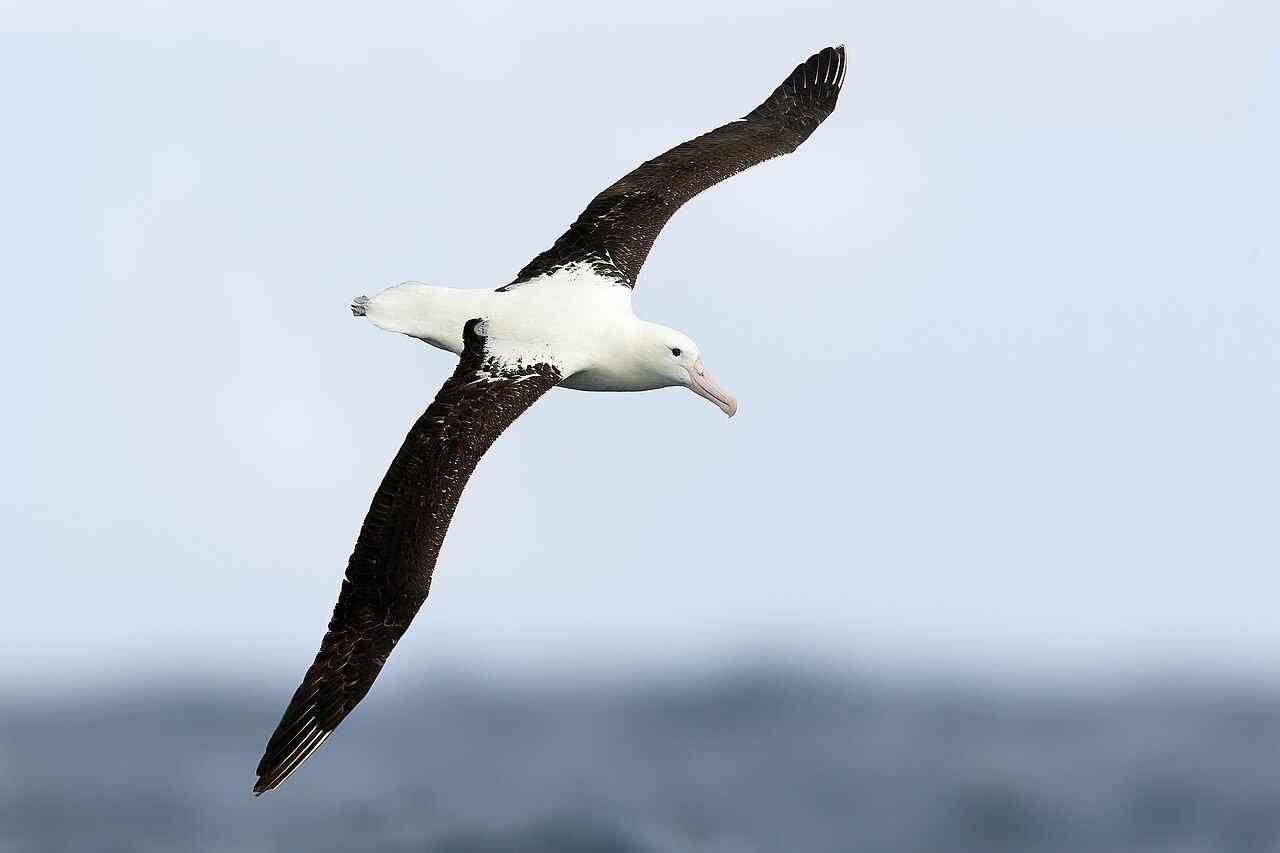
An albatross of 115 centimetres and six to nine kilos, with an entirely white body and white mantle, and an upperwing that stays black from youth to old age. The underwing is white with a narrow black leading edge and black tip; the bill is pale pink with a sharp black cutting edge along the upper mandible, the legs flesh-coloured. That black cutting edge is visible at range and is the best single feature of the species. Young birds resemble the adults but show dark flecking on the crown and some black at the tail tip. In flight it glides low over the water on stiff, narrow wings and flaps only when getting airborne.
Confusion species
Southern Royal Albatross (Diomedea epomophora) is the first mistake: its upperwing whitens with age from the leading edge inwards, so old birds have almost white wings — the Northern keeps its black. The great albatrosses of the D. exulans group likewise gain white in the upperwing and lack the black cutting edge on the bill. From below all of these look much alike, so judge the upperwing and the bill rather than the underwing. Young Southern Royals have a black upperwing just as Northern do, and at sea many cannot be named with certainty.
Habitat
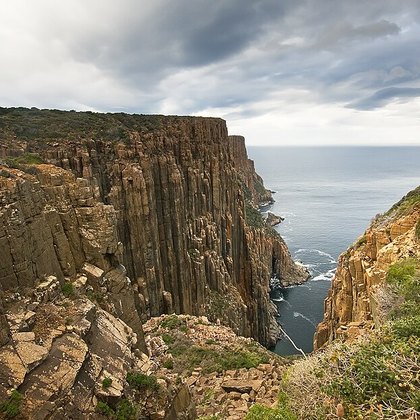
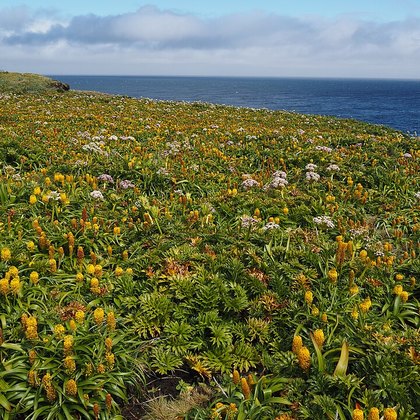
Subtropical and subantarctic ocean, favouring the shelf edge, upwellings and the grounds where trawlers work. Breeding takes place on windy cliff edges and in the tussock of the Chathams, and at Taiaroa on a grassy head above Otago Harbour. It avoids sheltered, shallow inshore water and comes to land only to breed.
Where the bird is most often found, arranged by main group and formation.


Range and movements
The breeding sites are The Sisters and The Forty-Fours in the Chathams, with a handful of pairs on Enderby and nearly thirty pairs a year at Taiaroa Head. Outside the breeding season birds ride the westerlies across the Pacific to the waters off Chile and Peru; the type material accordingly came from off Corral in Chile. Breeding is biennial: the egg is laid from late October to late November, the chick hatches in late January or early February and fledges after some two hundred and forty days in September. The Taiaroa colony dates only from the 1920s and grew under strict management.
- Resident
- Breeding (summer)
- dark = core range, pale = thinly spread
Where and when to look
The Royal Albatross Centre at Taiaroa Head near Dunedin is the surest site in the world for this species; go on a day with a firm northeasterly, when birds pass low around the head instead of staying far offshore. To see it at sea, take a boat from Kaikoura or sail off the Chathams, and check the black cutting edge of the bill on every great albatross first.
Conservation
Endangered (EN), with six thousand five hundred to seven thousand breeding pairs and some seventeen thousand mature birds. At sea bycatch in longline and trawl fisheries is the main cause of death; on The Sisters and The Forty-Fours storms have stripped soil and vegetation from the breeding sites, leaving birds to nest on bare rock. At Taiaroa Head heat stress and an introduced blowfly kill chicks, and the colony has been managed by hand for years.
Scientific name
Diomedea sanfordi | Murphy, 1917
Murphy described the bird in 1917 as Diomedea (Rhothonia) sanfordi, from a specimen off Corral in Chile; author and year stand without parentheses, since it remains in the same genus. Diomedea was introduced by Linnaeus in 1758, after Diomedes, whose companions were said to have been turned into birds. sanfordi honours Leonard C. Sanford, physician and patron of the American Museum of Natural History. The Maori name toroa covers the great albatrosses together.