All species › Tubenoses › Albatrosses › Snowy Albatross
Snowy Albatross | Diomedea exulans
Grote albatros | Albatros viajero
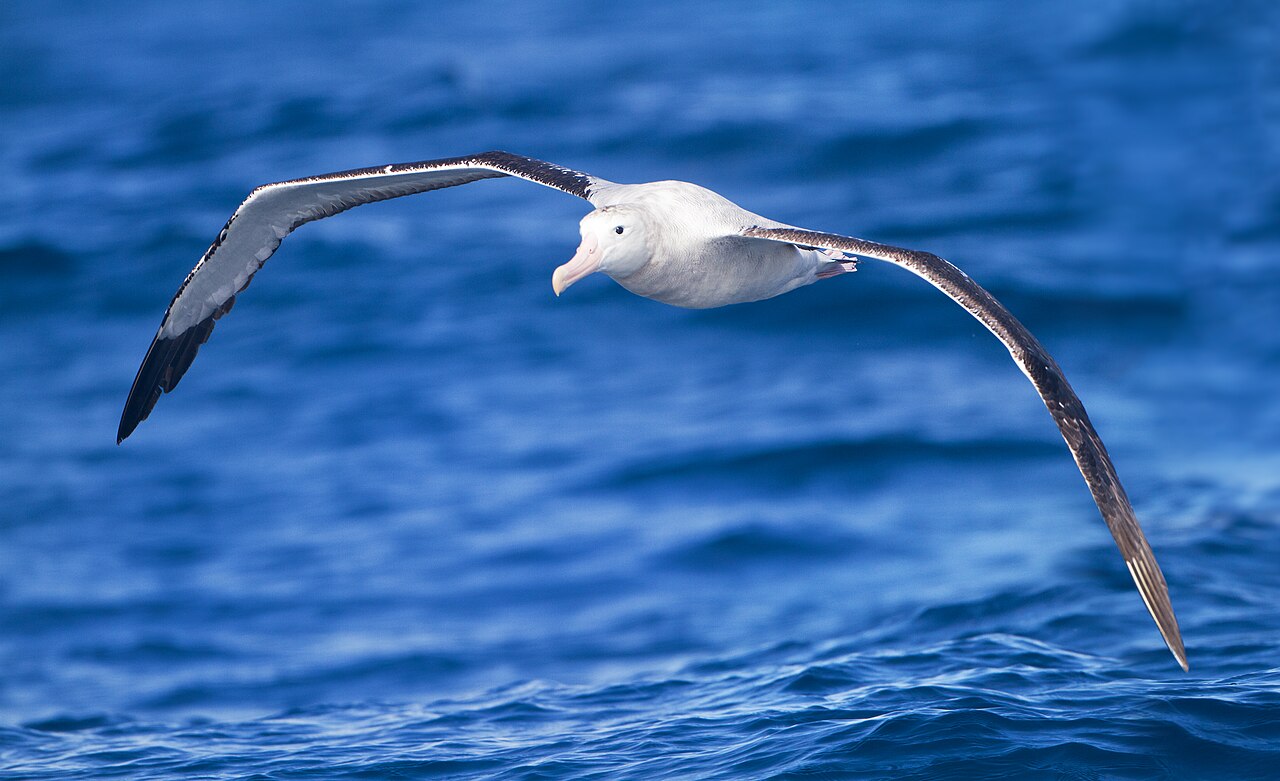
No living bird spans its wings wider than the Snowy Albatross: measured birds reach 3.5 metres, and exceptionally more. In this region it is the whitest of the great albatrosses — old males are nearly all white with only black wingtips — but it is also far scarcer here than its New Zealand counterpart, the Antipodean Albatross.
Voice
At sea it is all but mute; behind a fishing boat there is at most a guttural growl and a clatter of bills over scraps. At the colony, courtship carries a high trumpeting bray across the slopes, broken by groans, rattles and a dry clicking of the bill, while the bird circles its mate with head raised and wings spread wide.
No freely licensed recording has been found for this species yet; what to listen for is described below.
Identification
About 120 cm long, span usually 3.0 to 3.1 m and weight 8 to 10 kg; males are clearly larger than females. The bill is enormous and pink to salmon, without a black cutting edge. Young birds are chocolate brown with a white face; with the years the body turns white and the white spreads from the back out along the upperwing, until in old males only the wingtips and trailing edge remain black. Fine dark vermiculations stay visible on the body, and many birds carry a peach smudge behind the ear. The underwing is white with a narrow black rim.
Confusion species
Antipodean Albatross (Diomedea antipodensis) is the real problem, and the literature is clear that by no means every bird at sea can be named. Antipodensis averages smaller (around 110 cm) with a lighter bill, and never whitens this far: even the whitest male keeps black over the outer two-thirds of the upperwing, and females stay brown with a white face for life. So do not go on 'brown or white' alone but on plumage stage together with size, and be ready to leave a bird unnamed. Southern Royal Albatross (Diomedea epomophora) and Northern Royal Albatross (Diomedea sanfordi) never have a brown body, lack the peach ear patch and carry a black cutting edge along the upper mandible; the royals also look bulkier and fly with the head drawn in. All mollymawks, from Shy Albatross (Thalassarche cauta) to Black-browed Albatross (Thalassarche melanophris), are far smaller, with a dark upperwing and a dark bill marked with yellow.
Habitat
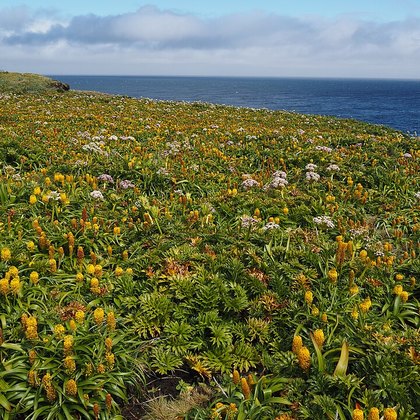
The open Southern Ocean between roughly 28 and 60 degrees south, favouring water with steady wind: it soars on the lift off the swell with barely a wingbeat. Food is chiefly squid and fish, much of it taken at the surface at night, plus carrion and offal behind ships. It breeds on open tussock and herbfield slopes of subantarctic islands.
Where the bird is most often found, arranged by main group and formation.


Range and movements
Within the map window it breeds only on Macquarie Island, in a tiny colony of at most a few dozen birds; the large colonies lie outside this window, on South Georgia and the Indian Ocean islands. At sea expect it in the southern Tasman Sea and in subantarctic water south of New Zealand, including off Kaikoura, and further out on deep-water trips off Tasmania and South Australia. Everywhere here it is outnumbered by the Antipodean Albatross.
- Resident
- Breeding (summer)
- Winter
- dark = core range, pale = thinly spread
Where and when to look
The best chances lie on a deep-water trip towards the south of the region — Eaglehawk Neck in Tasmania, or the southern New Zealand waters — and off Kaikoura, where the birds come in right behind the boat. Watch the upperwing: only in this species does the white run from the back out along the inner wing and far beyond. Look too for the peach ear patch, which Antipodean and the royals lack.
Conservation
Vulnerable (VU), with some 8,050 breeding pairs worldwide and numbers falling on most islands. Longline mortality is the chief cause: the bird dives for the baited hooks and drowns. The Macquarie Island colony has dwindled to a handful of pairs and hangs by a thread, even though the introduced cats, rats and rabbits there have since been eradicated. Plastic fed to chicks and the slow life cycle — a pair rears at most one chick every two years — make any recovery slow.
Scientific name
Diomedea exulans | Linnaeus, 1758
Linnaeus described the species in 1758 as Diomedea exulans, and it has stayed in that genus, so author and year carry no parentheses. exulans is Latin for 'exile' or 'wandering' and refers to its endless crossings of the ocean. Linnaeus gave the locality as the open sea within the tropics, after a plate by Edwards; the type locality is in practice placed at the Cape of Good Hope. The genus Diomedea is named for Diomedes, the Greek hero whose companions were said to have been turned into seabirds.