All species › Waders, gulls and terns › Plovers and lapwings › Oriental Plover
Oriental Plover | Anarhynchus veredus
Steppenplevier | Chorlito asiático grande
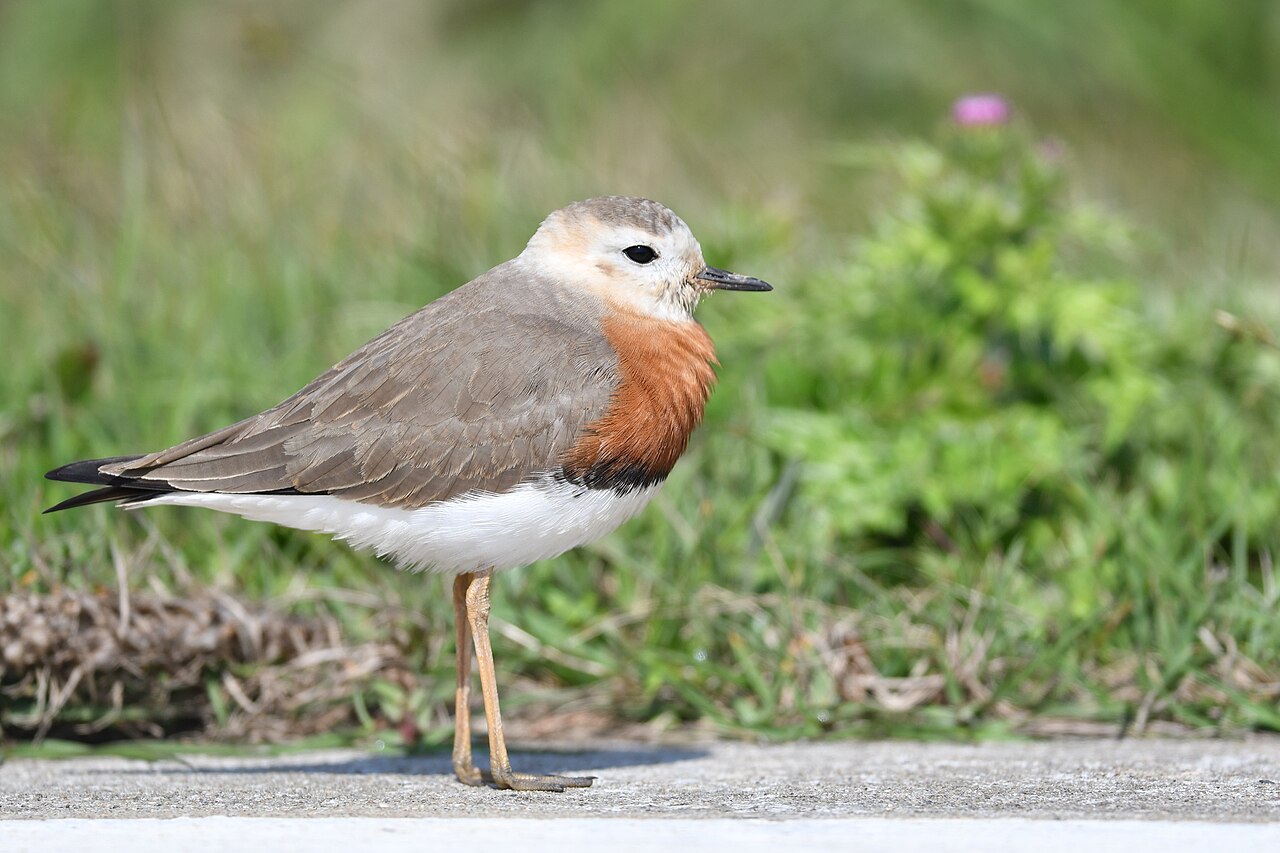
The Oriental Plover is the plover of the interior: a slim, long-legged bird that spends the Australian summer not on tidal flats but on bare, closely grazed plains. It breeds on the steppes of Mongolia and Manchuria, and roughly nine out of every ten birds in the world winter in Australia.
Voice
The call is strikingly quiet for so large a plover: a short, irregularly repeated peet or tink that in a big flock sounds more like rustling than calling. On take-off a quick, high chip-chip-chip is sometimes given. It does not sing on the non-breeding grounds.
No freely licensed recording has been found for this species yet; what to listen for is described below.
Identification
A slenderly built plover of twenty-two to twenty-five centimetres with a small head, a short fine black bill and remarkably long, pale yellow to dull yellow legs, on which it stands bolt upright. In non-breeding plumage it is plain sandy-olive to grey-brown above, with a broad off-white eyebrow and a dull buff wash across the breast. Breeding males, still to be seen in Australia in March and April, have a white forehead, face and throat and an orange-chestnut breast band with a black lower border. The decisive feature is in flight: there is no white wingbar, and the underwing is dark grey-brown.
Confusion species
Greater Sand Plover (Anarhynchus leschenaultii) is the species it is most often confused with: that bird has a heavier, dark bill with a bulbous tip, grey-green legs, a clear white wingbar and a largely white underwing, and stands on the tide rather than in grass. Siberian Sand Plover (Anarhynchus mongolus) is smaller and shorter-legged and also shows a wingbar. Double-banded Plover (Anarhynchus bicinctus) is shorter-legged and carries two bands. Pacific Golden Plover (Pluvialis fulva) shares the grassland habitat but is gold-spangled above and has shorter, dark legs. Australian Pratincole (Glareola isabella) walks the same inland grass, but has long pointed wings, a forked tail and a floating, swallow-like flight.
Habitat
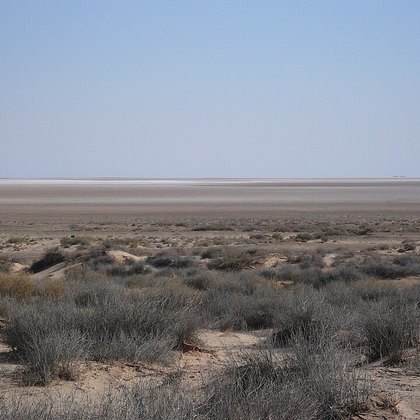
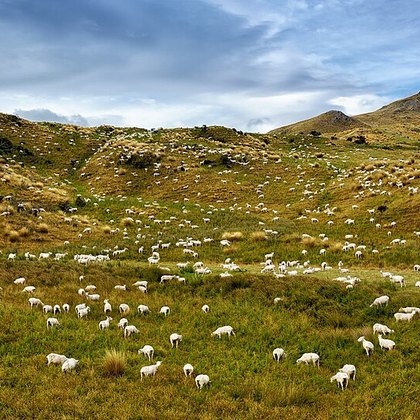
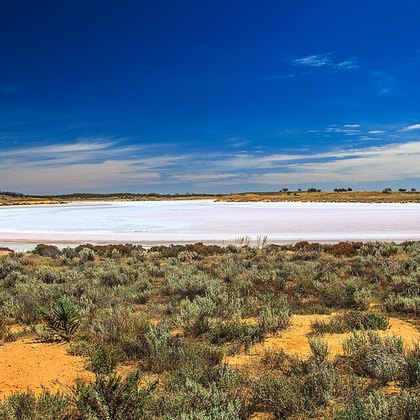
Flat, closely grazed or freshly burnt grassland, claypans, dried saltpans and hard, all but bare ground, including airstrips, cattle camps and playing fields. It stays notably clear of water: unlike almost every other wader in this round it needs no muddy edge and eats almost nothing but insects, above all grasshoppers and beetles. On the coast it uses the grass plains behind the mangroves, seldom the flat itself.
Where the bird is most often found, arranged by main group and formation.

Range and movements
It arrives from about August in the tropical north, in the Kimberley, the Top End and the Gulf of Carpentaria, then spreads through the interior as far as South Australia and Western Australia; every state has records. In February and March the largest flocks gather again in the northwest before departure, and by April it has all but gone. In New Zealand it is a true vagrant, with fewer than twenty accepted records since 1908, among them Port Waikato in 2013 and the Ohiwa estuary in 2016.
- Breeding (summer)
- dark = core range, pale = thinly spread
Where and when to look
Do not look for it on the mudflat but on dry ground: drive past closely grazed grassland or a recently burnt plain in the north in late afternoon and watch for the upright, long-legged silhouettes that run a few paces at a time. In doubt, do not flush the birds but wait until the flock shifts of its own accord; the plain wing without a bar and the dark underwing decide.
Conservation
Least Concern (LC), with a world population put at some hundred and sixty thousand birds and no clear decline established. Because almost the whole species winters in Australia its fate does hang on one country: changes in grassland management in the north and the loss of staging grounds along the East Asian–Australasian Flyway are the risks named.
Scientific name
Anarhynchus veredus | (Gould, 1848)
Gould described the species in 1848 as Charadrius veredus in the Proceedings of the Zoological Society of London; because it was later moved to another genus, author and year now stand in parentheses. veredus is the Latin word for a swift post-horse or courser, and refers to its running. The genus Anarhynchus was introduced by Quoy and Gaimard in 1830, from Greek ana, 'back', and rhunkhos, 'bill', after the sideways-bent bill of the Wrybill; since 2022 a whole series of plovers has been transferred into it. The type locality is northern Australia.