All species › Waders, gulls and terns › Plovers and lapwings › Red-capped Plover
Red-capped Plover | Anarhynchus ruficapillus
Roodkopplevier | Chorlitejo capirrojo
The Red-capped Plover is the smallest and by far the most numerous plover in Australia: a pale, sand-coloured bird of barely fifteen centimetres that can turn up on any beach, any tidal flat and any drying salt lake on the continent. The male wears a bright rufous crown and nape; the female is greyer and duller. It is the yardstick against which every other small plover here is measured.

Voice
The contact call is a soft, quickly repeated wit-wit-wit that keeps a scattered flock together. In alarm comes a sharp, metallic twink, growing faster and higher as an intruder closes and usually a sign that a nest or chick is nearby. The flight call is a short rolling prrrt, low and dry, which carries surprisingly far across an empty beach.
No freely licensed recording has been found for this species yet; what to listen for is described below.
Identification
A very small, pale plover of fourteen to sixteen centimetres and about thirty-seven grams, light grey-brown to sandy above and clean white below, with a short, straight, all-black bill and black legs — that leg colour rules out a whole series of confusions at a glance. In breeding plumage the male has a bright rufous crown and nape edged black above, a white forehead, a small black loral stripe and a black patch at the side of the breast; the female is built the same but has a pale rufous to grey-brown crown and almost no black. A broad white collar runs round the hindneck. In flight a clear white wing bar and white outer tail feathers show, and the bird keeps low over the sand.
Confusion species
Kentish Plover (Anarhynchus alexandrinus), a vagrant in this region, is the hardest: slightly larger, with a longer and thinner bill and longer dark grey rather than black legs, and on the male the rufous is confined to the rear crown and nape, with a black bar across the forehead in front of it and a black stripe through the eye — on Red-capped the whole crown is rufous and that pattern is absent. Siberian Sand Plover (Anarhynchus mongolus) and Greater Sand Plover (Anarhynchus leschenaultii) are far bulkier, longer-billed and have grey to grey-green legs. Double-banded Plover (Anarhynchus bicinctus) is larger and darker above with olive-yellow legs; unbanded juveniles of that species are the commonest mistake. Common Ringed Plover (Charadrius hiaticula) and Semipalmated Plover (Charadrius semipalmatus) have a complete dark breast band and orange or yellow legs. From the other, Thinornis subgroup: Black-fronted Dotterel (Thinornis melanops) has a red black-tipped bill and a black V on the breast, and Hooded Plover (Thinornis cucullatus) is much larger with a full black hood and a red eye-ring — both unmistakable once the head is in view.
Habitat
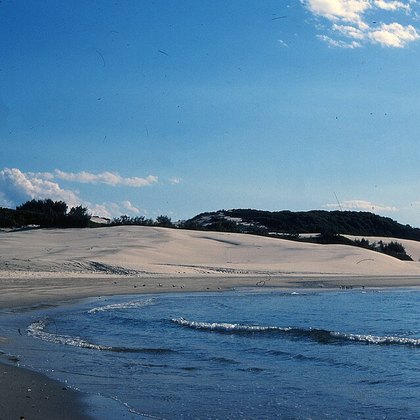
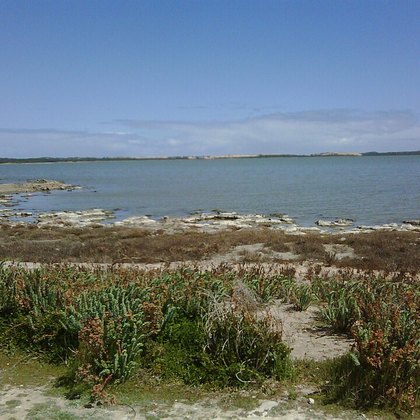
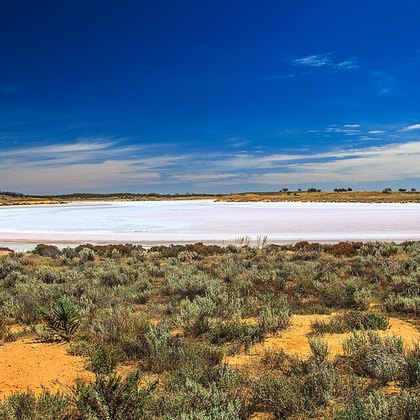
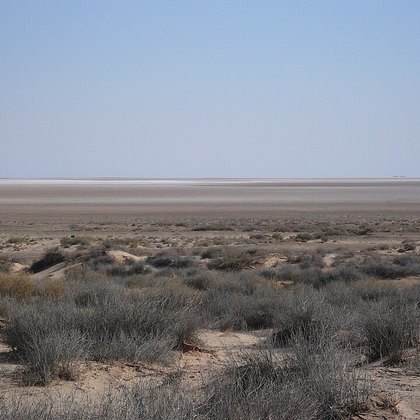
On the coast, sandy beaches, tidal flats, estuaries, saltmarsh and the bare margins of coastal lagoons and saltworks. Inland, the shores of salt lakes and saltpans, drying claypans, ephemeral lakes and stock dams, right into the driest country. It wants bare, flat, open ground with little or no vegetation, and works between the salt crust and the strandline.
Where the bird is most often found, arranged by main group and formation.


Range and movements
Widespread over nearly the whole of Australia, along the entire coastline and through the interior, where it appears at any suitable salt or brackish water and breeds after rain right into the heart of the continent. It is resident in the broad sense: it stays in the region but shifts with the water, so that a salt lake may hold hundreds of birds one year and none the next. In New Zealand it is a vagrant: the first record was near Waikanae in 1878, it bred there in small numbers between 1950 and 1980, and the last report is of a bird at Lake Ellesmere in January 1981.
- Resident
- dark = core range, pale = thinly spread
Where and when to look
Walk a beach or a mud edge at low tide and watch the smallest, palest birds running ahead of you: they are almost always Red-capped Plovers, and they give you the reference image for any rarer plover among them. In the breeding season watch where you put your feet — the nest is a scrape in bare sand and the eggs are invisible. If a bird suddenly circles with a drooping wing, walk away from it rather than towards it: it is feigning injury to draw you off a chick.
Conservation
Least Concern (LC), with a very large range and a population in the hundreds of thousands showing no clear decline. The secret is versatility: the bird can live on a busy city beach flat or on a desert saltpan and does not depend on one chain of staging sites as the migrant shorebirds do. Locally, though, foxes, feral cats, loose dogs and beach vehicles do press on breeding success, above all along the crowded coasts of the south-east.
Scientific name
Anarhynchus ruficapillus | (Temminck, 1821)
Temminck described the species in 1821 in his Nouveau recueil de planches coloriées d'oiseaux as Charadrius ruficapillus; because AviList now places it in Anarhynchus, author and year stand in parentheses. The type locality was later fixed near Port Jackson, at Botany Bay in New South Wales. ruficapillus is Latin for 'red-haired', from rufus, 'red', and capillus, 'hair of the head' — exactly the image taken up by the Dutch, English and Spanish names alike.