All species › Waders, gulls and terns › Plovers and lapwings › New Zealand Plover
New Zealand Plover | Anarhynchus obscurus
Rosse plevier | Chorlito maorí de Isla Sur
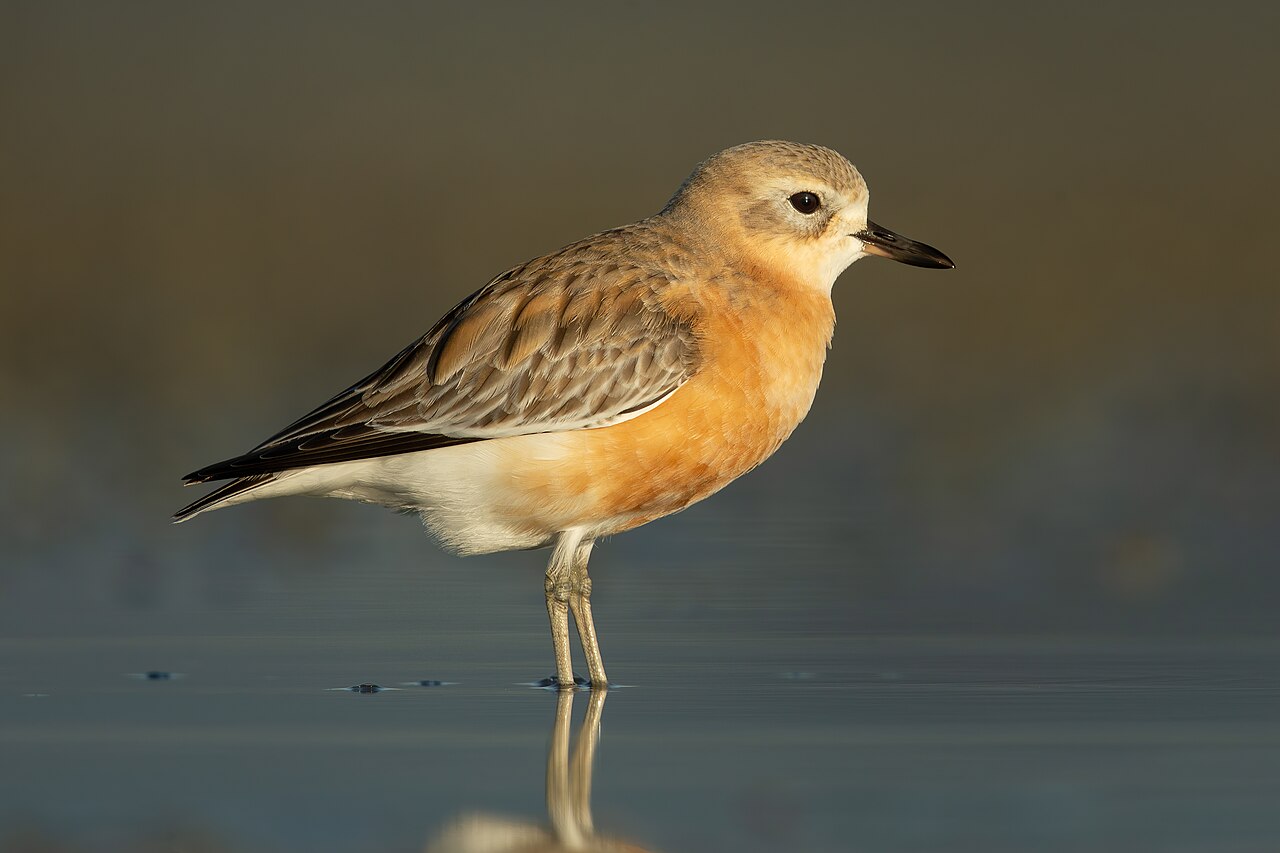
The New Zealand Plover is the largest and heaviest plover in New Zealand and one of several endemic to it: a thickset bird of twenty-five centimetres with a big round head, large dark eyes, a heavy black bill and grey legs. From late autumn the underparts turn a warm orange-red, and it is then recognisable at long range on an empty beach. Of its two forms the northern population is holding on only with hard work; the southern one, on Stewart Island, has shrunk to a little over a hundred birds.
Voice
The usual call is a sharp, penetrating chip, repeated endlessly by a disturbed bird and carrying the length of a beach. For the chicks there is a high, thin tseep, the warning at which they drop flat onto the sand. Against intruders and neighbours it becomes a rattling churr, and in boundary disputes a short, snapped werr-wit. A pair taking flight calls on and on.
No recording with a suitable Creative Commons licence has been found for this species yet; what to listen for is described below.
Identification
A large, heavy plover of twenty-five centimetres and around a hundred and fifty grams, with a strikingly big, round head, large dark eyes, a thick black bill and fairly long grey legs. The upperparts are brown with pale feather edges, darker on southern birds than on northern ones. The underparts are off-white in summer and early autumn and colour up from May into a warm orange-red across breast and belly, deeper on the male than on the female. Juveniles are scaled above and lack the red entirely. In flight a white wing bar shows; the bird runs in short bursts and stands bolt upright between them, the heavy head held noticeably high.
Confusion species
Double-banded Plover (Anarhynchus bicinctus) often stands in the same flock and is the first check: at twenty centimetres it is noticeably smaller and slimmer, with a short thin bill, olive-yellow legs and, in breeding plumage, two sharply bounded breast bands, while this species is a grey-legged, heavy-billed bird with unbroken red and no bands. Greater Sand Plover (Anarhynchus leschenaultii), a scarce visitor to New Zealand, is slimmer, smaller-headed and longer and paler in the leg. Wrybill (Anarhynchus frontalis) is small, plain blue-grey above and has the bill bent to the right. From the Thinornis group, Shore Plover (Thinornis novaeseelandiae) and Hooded Plover (Thinornis cucullatus) are ruled out at once by their black hood or mask and orange-red bill. Outside the plovers, Pacific Golden Plover (Pluvialis fulva) comes closest in size and in golden-brown tone, but it is finer-billed, spangled gold on the back and stands taller and slimmer.
Habitat
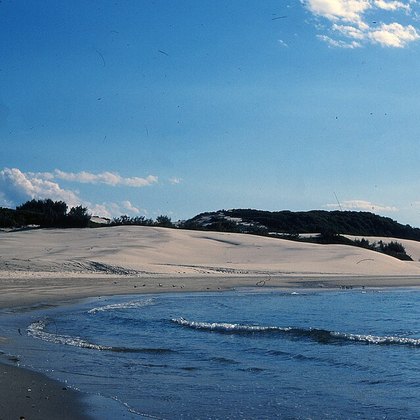
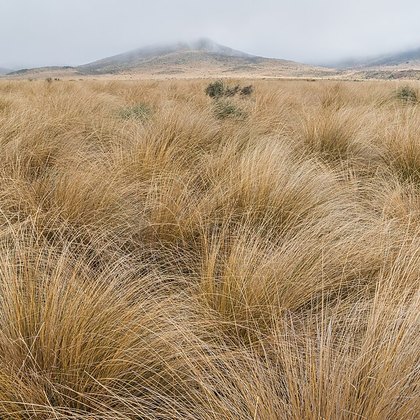
Northern birds nest on sandy beaches, dune feet, shell banks and sand spits at estuary mouths, and feed on the adjoining tidal flats and mud. Southern birds do something no other plover in the world does: they breed high in the bare herbfields and on the windswept tussock (grassland of loose, tall clump-forming grasses, especially in New Zealand) summits of Stewart Island, kilometres inland and hundreds of metres above the sea, and only drop to the coast after breeding. Outside the breeding season both are birds of estuaries, sandflats and harbours.
Where the bird is most often found, arranged by main group and formation.


Range and movements
The northern form holds the coast of the northern North Island, centred on the east coasts of Northland, Auckland, Coromandel and the Bay of Plenty and their offshore islets; small numbers reach south to Hawke's Bay and Taranaki. The southern form now breeds only on Stewart Island and winters on the coasts and estuaries of the far south of the South Island, such as Awarua Bay and the estuary at Invercargill; it disappeared as a South Island breeder around 1900. The species occurs nowhere outside New Zealand; Australian reports concern exceptional vagrants.
- Resident
- dark = core range, pale = thinly spread
Where and when to look
Walk a broad sandy beach or an estuary mouth in the northern North Island between November and February and look for a large, heavily built plover standing and watching you rather than running off — that is almost always this species. If a pair calls continuously and circles around you, walk straight back to the waterline: you are standing at a nest or a chick. Come back in May or June to see the full orange-red, because in the southern summer the underparts are pale.
Conservation
Critically Endangered (CR). That category applies to the southern form, which the IUCN Red List assesses as a separate species and which breeds only on Stewart Island: a hundred and one birds were counted in April 2024, and although the species can live twenty to twenty-five years, average life expectancy there is under five, because feral cats empty the nests on the open summits. The northern form is in better shape: years of managed breeding beaches — fencing, trapping, volunteers at the nests — have brought it back from about thirteen hundred birds in 1989 to more than twenty-five hundred now, though it too remains wholly dependent on that management. For both forms, disturbance by beach vehicles and loose dogs, and nests washed out by storm tides, are leading problems.
Scientific name
Anarhynchus obscurus | (Gmelin, 1789)
Gmelin described the species in 1789 in the thirteenth edition of the Systema Naturae as Charadrius obscurus, after the 'Dusky Plover' that Latham had described four years earlier; because it is now placed in Anarhynchus, author and year stand in parentheses. obscurus is Latin for 'dark' or 'dusky', and the type locality fits neatly: Dusky Sound on the south-west coast of the South Island. The species has two subspecies, northern aquilonius and the nominate obscurus of Stewart Island. The Maori name is tuturiwhatu.