All species › Waders, gulls and terns › Plovers and lapwings › Siberian Sand Plover
Siberian Sand Plover | Anarhynchus mongolus
Kleine woestijnplevier | Chorlitejo mongol chico
The Siberian Sand Plover is a stocky, short-billed sand plover from north-eastern Siberia that spends the Australian summer on the coast. In breeding plumage it is unmistakable, with a deep chestnut breast and a black mask, but most birds here wear dull winter grey and then have to be picked apart from Greater Sand Plover with care. Since the former Lesser Sand Plover was split in 2023 this is the Siberian species, the only one of the two that travels this way.

Voice
The flight call is a short, hard, rolling trill, drrit or chirrup, often broken in two as chi-tik, and that dry rattle is the best separation from the softer, more whistled call of Greater Sand Plover. A flock lifting off a roost sets up a wave of overlapping short trills. Feeding birds are all but silent.
No freely licensed recording has been found for this species yet; what to listen for is described below.
Identification
A compact, short-necked plover of twenty centimetres with a relatively large, round head and a short, fine black bill: that bill is about as long as the distance from its base to the back of the eye, and of all measurements this is the most useful. The legs are dark grey to blackish-grey, sometimes with an olive cast, and the tibia above the joint is short, so the bird looks low and squat. In non-breeding plumage it is grey-brown above and white below, with a white supercilium, dark lores and ear-coverts, and a grey-brown patch at each side of the breast that rarely meets in a full band. In breeding plumage a deep, broad chestnut band crosses breast and upper belly, usually with a black upper border, and the face is black with a white forehead. In flight there is a narrow white wing bar and the toes barely project beyond the tail tip.
Confusion species
Greater Sand Plover (Anarhynchus leschenaultii) is the problem, and it often stands in the same flock: it is larger, twenty-two to twenty-five centimetres, with a clearly longer and heavier bill showing an angled gonys and a blunt swollen tip, longer and paler legs — grey-green to yellow-grey rather than blackish-grey — and a longer rear end, so that in flight the toes do project beyond the tail. In breeding plumage the chestnut band of Greater is narrower and paler and usually lacks the black upper border. Double-banded Plover (Anarhynchus bicinctus) has olive-yellow legs and stands more upright. Oriental Plover (Anarhynchus veredus) is longer-legged, longer-necked and browner, has almost no white wing bar, and stands on dry inland plains rather than on tidal flats. Red-capped Plover (Anarhynchus ruficapillus) is much smaller and paler with black legs, and Kentish Plover (Anarhynchus alexandrinus) is paler with a white collar on the hindneck. Common Ringed Plover (Charadrius hiaticula) and Semipalmated Plover (Charadrius semipalmatus) have a complete dark breast band and orange or yellow legs.
Habitat
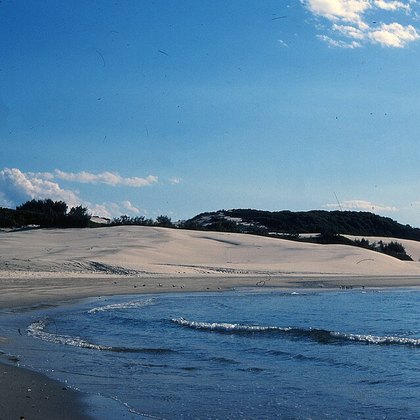
Tidal flats and mud in estuaries and bays for feeding, with adjoining sandy beaches, shell banks and sandbars for roosting over high water. Also coral platforms and rocky shelves in the north and, less often, the edges of saltworks and sewage farms. It is an emphatically coastal bird and hardly ever goes inland.
Where the bird is most often found, arranged by main group and formation.

Range and movements
Winters along nearly the whole Australian coast but is clearly commonest from the Queensland coast into New South Wales: the largest counts come from the Burdekin River delta, from Moreton Bay and from the Mackay district, each holding one to two thousand birds. The Australian non-breeding population is put at about twenty thousand, out of some twenty-six thousand for the whole flyway. Birds arrive from August and September, stay through the Australian summer and head north again in March and April; immatures often stay a full year and so can be seen in the Australian winter too. In New Zealand it is a vagrant, with one or two birds most years, chiefly in Kaipara and Manukau Harbours.
Where and when to look
Work at high tide, when the sand plovers stand packed together on a beach or shell bank and the two species are side by side: the difference in bill length and leg colour then reads at once. Take the bird in flight as well: toes projecting beyond the tail tip means Greater Sand Plover. And listen — the short dry rattle drrit belongs to this species and not to the larger one.
Conservation
Endangered (EN), and listed as threatened under Australian legislation as well. The cause is not in Australia but halfway along the journey: the tidal flats of the Yellow Sea, where these birds must fatten on passage in both directions, have been reclaimed on a large scale within a few decades for ports, industry and aquaculture, and the bird cannot skip that link. Add disturbance of high-tide roosts by beach vehicles and dogs, and degradation of the breeding tundra in north-eastern Siberia. Within Australia the most useful measure is simply keeping the known roosts quiet.
Scientific name
Anarhynchus mongolus | (Pallas, 1776)
Pallas described the species in 1776 in the third volume of his Reise durch verschiedene Provinzen des Russischen Reichs as Charadrius mongolus; because AviList now places it in Anarhynchus, author and year stand in parentheses. The type locality is the salt lakes towards the Mongolian border, narrowed to Kulussutai on the Onon in Siberia. mongolus means 'of Mongolia' in the broad eighteenth-century sense of the word — somewhat misleading, since the species does not breed in present-day Mongolia but in north-eastern Siberia. Until 2023 it was lumped with the Tibetan Sand Plover; since then its English name points at Siberia.