All species › Waders, gulls and terns › Plovers and lapwings › Greater Sand Plover
Greater Sand Plover | Anarhynchus leschenaultii
Woestijnplevier | Chorlitejo mongol grande
The Greater Sand Plover is the largest of the sand plovers that winter here: a solid, long-legged bird with a strikingly heavy bill, standing on Australian tidal flats from August to April. Its name refers to its breeding grounds in the semi-deserts of Central Asia, not to the country where you see it here.

Voice
The call is a soft rolling trill, trrreet or drrrit, much lower and drier than the clear whistle of the golden plovers, usually given on take-off. On the flat it is silent. In a mixed flock it draws attention by the way it walks rather than by its voice.
No freely licensed recording has been found for this species yet; what to listen for is described below.
Identification
A substantial sand plover of twenty-four centimetres, grey-brown above and white below, with a broken grey-brown breast band in non-breeding plumage and a faint pale eyebrow in an otherwise brown face. The bill is the main feature: long, dark and heavy, with a distinctly swollen, bulbous tip, and about as long as the distance from the bill base to the rear of the eye. The legs are long and grey-green to greenish-brown. In breeding plumage, taken on in March and April, the breast is orange-chestnut and the face black with a white forehead. In flight there is a clear white wingbar and a largely white underwing.
Confusion species
Siberian Sand Plover (Anarhynchus mongolus) is the hardest case and often stands in the same flock: smaller, shorter-legged, with a shorter and finer bill without a bulbous tip and dark grey rather than grey-green legs; on a lone bird the bill-to-eye proportion decides. Oriental Plover (Anarhynchus veredus) has pale yellow legs, lacks the white wingbar and has a dark underwing, and in any case walks inland grass. Double-banded Plover (Anarhynchus bicinctus) is smaller and more compact and in breeding plumage carries two bands. In New Zealand, New Zealand Plover (Anarhynchus obscurus) is a shade larger but shorter-legged and washed rusty below.
Habitat
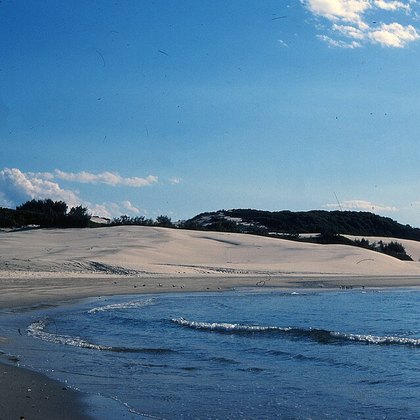
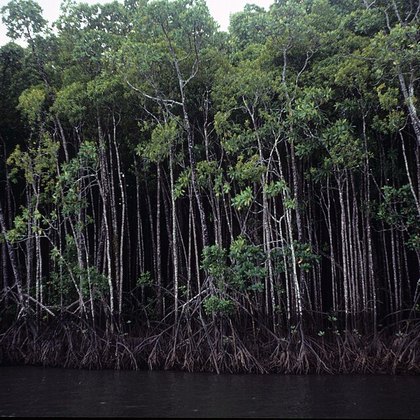
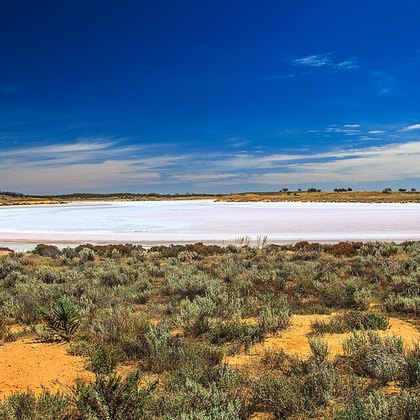
Mudflat, sandflat and the broad intertidal plains of estuaries and bays, with a preference for a firm, sandy substrate on which it can use its run-and-stop method. Beyond that, coral platforms, sandy beach, mangrove edge and saltworks. It eats crabs, worms and molluscs, levered out of the flat with that heavy bill; at high water it moves up to the communal roost on beach or saltmarsh.
Where the bird is most often found, arranged by main group and formation.

Range and movements
It is above all a bird of the northern and western coast of Australia: the largest concentrations are at Eighty Mile Beach and Roebuck Bay near Broome, with further flocks along the Kimberley coast, the Gulf of Carpentaria and the Queensland coast; southward it thins out quickly. It arrives from August and September and leaves in March and April, with some immatures staying through the Australian winter. In New Zealand only one or two birds arrive most summers, recorded from the Far North to Southland.
- Resident
- dark = core range, pale = thinly spread
Where and when to look
Stand on a sandy flat on a rising tide and pick out the plover with the heaviest bill standing highest on its legs; compare it at once with the Siberian Sand Plovers beside it, because the distinction is one of proportion, not colour. Watch how it moves as well: a long run, an abrupt stop, and then one powerful stab into the flat.
Conservation
Least Concern (LC) worldwide, but in Australia the species is nationally listed as threatened after counts at the main tidal sites fell clearly. The cause lies mostly outside this region: reclamation of the tidal flats of the Yellow Sea has removed the staging grounds where the birds must refuel both going north and coming south. Disturbance of high-tide roosts along the Australian coast adds to it.
Scientific name
Anarhynchus leschenaultii | (Lesson, 1826)
Lesson described the species in 1826 as Charadrius leschenaultii, in the Dictionnaire des sciences naturelles; because it now sits in another genus, author and year stand in parentheses. The epithet honours Jean-Baptiste Leschenault de la Tour, the French botanist who travelled the Australian coast with Baudin's expedition and later worked in British India. The type locality is accordingly Pondicherry in southern India. The genus Anarhynchus was introduced by Quoy and Gaimard in 1830, from Greek ana, 'back', and rhunkhos, 'bill'.