All species › Waders, gulls and terns › Plovers and lapwings › Wrybill
Wrybill | Anarhynchus frontalis
Scheefsnavelplevier | Chorlitejo piquituerto
The Wrybill is the only bird in the world with a bill bent sideways, and always to the right. Beyond that it is a modest, pale blue-grey plover of twenty centimetres with white underparts and a narrow black breast band. It breeds only on the bare gravel beds of the braided rivers of the eastern South Island and winters almost to the last bird on a handful of mudflats in the northern North Island.
Voice
The usual call is a short, high chip, given by a bird that has noticed something. A bird chasing an intruder delivers a fast rattling churr-r-r. To the chicks there is a soft, grating contact note that fades within a few metres. A flock lifting off the flats sets up an excited high chattering that travels across the mud like a wave when hundreds of birds go up together.
Recording: Sander Lagerveld — CC BY-NC-SA 4.0 · Mount Cook, Mackenzie District, Canterbury, New Zealand · xeno-canto
Identification
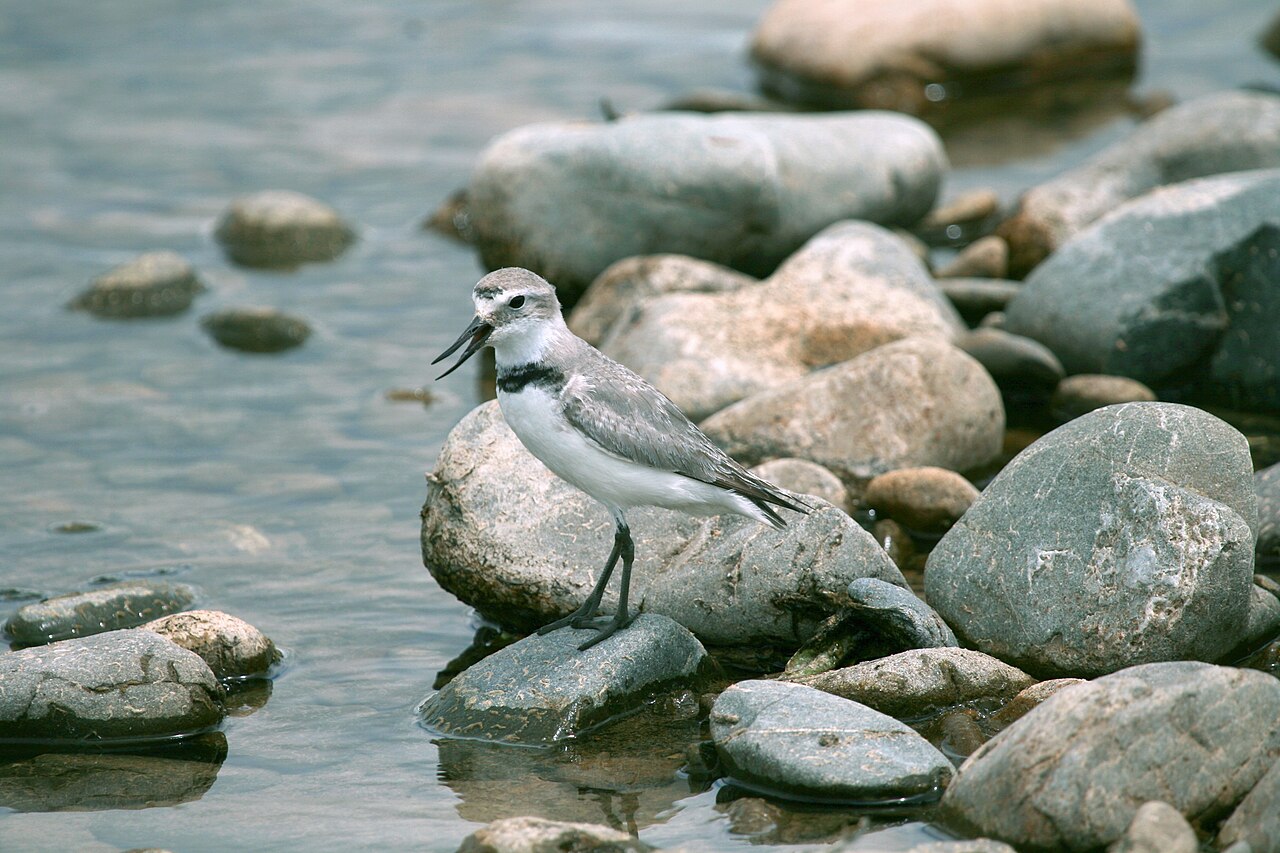
A small, rounded plover of twenty centimetres and fifty-five grams, plain pale blue-grey above — paler and colder in tone than any other plover here — and clean white below, with dark grey to black legs. The bill is long for a plover, black, and over its last centimetre bent to the right, by twelve to twenty-six degrees; on a bird seen head-on or from directly behind that kink is unmistakable, from the side it is often invisible. Adults carry a narrow black band across the breast, broader on the male in the breeding season, which then also shows a black bar above the white forehead; outside the breeding season and on juveniles the band is narrow and faint. In flight a fine white wing bar shows against the pale grey upperwing.
Confusion species
Double-banded Plover (Anarhynchus bicinctus) is the species it mixes with on the riverbed and on the flats: brown rather than blue-grey above, with a short straight bill and olive-yellow legs, and in breeding plumage two bands instead of one. New Zealand Plover (Anarhynchus obscurus) is much larger and heavier-billed, with grey legs and rusty underparts. Siberian Sand Plover (Anarhynchus mongolus) and Greater Sand Plover (Anarhynchus leschenaultii) are browner above, have an ordinary straight bill and lack the complete band. Sanderling (Calidris alba) is as pale and shares the sandflats, but has a short straight bill, no breast band and the well-known running along the surf line. Terek Sandpiper (Xenus cinereus) also has a curved bill, but it curves upward and not sideways, and its legs are bright orange-yellow. From the other subgroup: Shore Plover (Thinornis novaeseelandiae) has a black mask and an orange bill and is not confusable with this bird.
Habitat
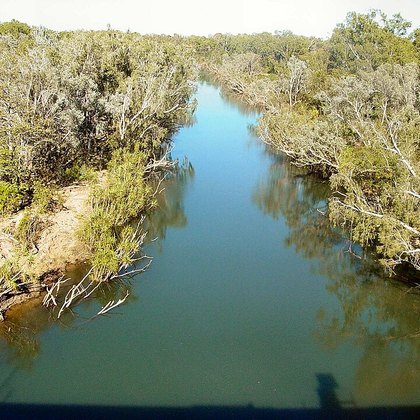
In the breeding season the bare, wide gravel beds of braided rivers, where it works among the rounded stones and sweeps its bent bill in under them for mayfly larvae. Outside the breeding season the soft mudflats of shallow estuaries and harbours, where the same bill scythes sideways through the surface layer. In both cases it asks for open, flat, unvegetated ground and for quiet at high water.
Where the bird is most often found, arranged by main group and formation.


Range and movements
Breeds only on the braided rivers of the South Island east of the main divide, centred on Canterbury: the Waimakariri, Rakaia, Rangitata, Ashley and Waitaki, and the rivers of the Mackenzie Basin such as the Tekapo and the Ohau. From December and January on, virtually the whole population moves north to the North Island and spends the southern winter on a small number of estuaries: the Firth of Thames and Manukau Harbour hold most of it, with smaller numbers in Kaipara and Tauranga Harbours. In July and August it goes south again. The species does not reach Australia.
- Resident
- Breeding (summer)
- dark = core range, pale = thinly spread
Where and when to look
In the New Zealand winter go to a high-tide roost on the Firth of Thames on a rising tide: thousands of Wrybills then stand in one dense pale mass that turns like smoke when it lifts. To see the bill, find a feeding bird and wait until it walks straight towards you or straight away — from the side the bill looks simply straight. On a gravel river in October, stay on the track or the bank: the nest is a scrape among the stones and is literally invisible.
Conservation
Vulnerable (VU), with a population of about five thousand to five and a half thousand birds; within New Zealand it is rated as increasing, but numbers swing widely from year to year. The pressure is almost entirely on the breeding rivers: introduced predators — feral cats, stoats, ferrets, rats and hedgehogs — take clutches and chicks, while Kelp Gulls and Swamp Harriers have become far more numerous than naturally through human land use. On top of that the gravel banks are closing over with lupin, willow and broom, so the open bed disappears, and hydro schemes and abstraction alter the flood regime that keeps the river bare in the first place. Vehicles and jet boats on the bed and summer flood tides do the rest.
Scientific name
Anarhynchus frontalis | Quoy & Gaimard, 1832
Quoy and Gaimard described the species in 1832 in the zoological part of the account of the voyage of the Astrolabe as Anarhynchus frontalis, and it has stayed in that genus, so authors and year carry no parentheses; they erected the genus for this very bird, of which it is the type species. They gave the type locality as 'Baie Chouraki', the Hauraki Gulf near Auckland — so the species was described from a wintering bird and not from one on its gravel river. Anarhynchus is formed from Greek ana-, 'backwards', and rhunkhos, 'bill'; frontalis is Latin for 'of the forehead', after the black bar above the white forehead of the breeding male. The Maori name is ngutu pare, 'bent bill'.