All species › Waders, gulls and terns › Plovers and lapwings › Double-banded Plover
Double-banded Plover | Anarhynchus bicinctus
Dubbelbandplevier | Chorlitejo bicinchado
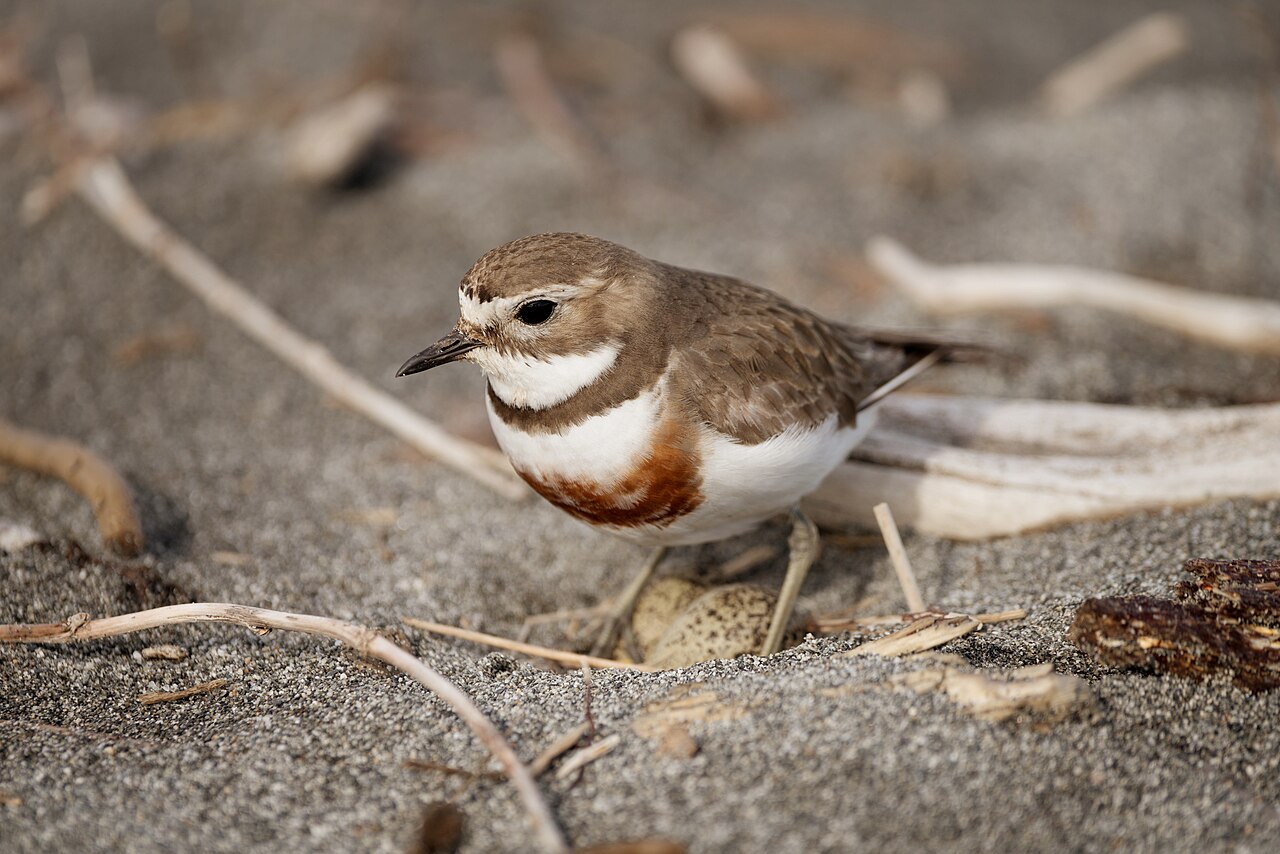
The Double-banded Plover is the only plover in this region that wears two bands across the breast in breeding plumage: a thin black one high on the neck and a broad chestnut one below it. It breeds only in New Zealand, above all on the gravel beds of the braided rivers of the South Island, and then crosses the Tasman Sea in numbers to winter in Australia — a direction of travel at right angles to that of almost every other shorebird here.
Voice
The usual call is a short, high, staccato pit, sometimes twice in quick succession but more often as a single note at intervals of up to half a minute; a bird calling from a standstill jerks head and body slightly upward at every note, as though it had hiccups. A flock on the flats keeps up a thin, continuous chatter that carries across the mud. On territory comes an emphatic chee-aree-aree, delivered with the breast feathers puffed out.
No freely licensed recording has been found for this species yet; what to listen for is described below.
Identification
A compact, upright plover of twenty centimetres and sixty grams, plain grey-brown above and white below, with a short straight black bill and fairly long legs that are olive to yellow-green — that leg colour is the most useful mark in any plumage. In breeding plumage the male has a white forehead, a dark mask, a narrow black band low on the neck and a broad chestnut breast band beneath it; the female is the same but duller and narrower. In non-breeding plumage both bands all but vanish, leaving a dull grey wash at the sides of the breast. Juveniles lack the bands entirely and are scaled above. In flight a narrow white wing bar shows, with white outer tail feathers and long pointed wings.
Confusion species
In breeding plumage there is no doubt: no other plover in Australia or New Zealand has two breast bands. In non-breeding plumage the work begins. Siberian Sand Plover (Anarhynchus mongolus) and Greater Sand Plover (Anarhynchus leschenaultii) are the real pitfalls: both have grey to grey-green or grey-black legs instead of olive-yellow, a longer and heavier bill, a whiter face and a flatter, more forward-leaning stance, while the Double-banded stands taller and more upright and often still shows a shadow of the two bands. Red-capped Plover (Anarhynchus ruficapillus) is much smaller and paler with black legs. Kentish Plover (Anarhynchus alexandrinus) is paler, has a white collar on the hindneck and dark legs. Wrybill (Anarhynchus frontalis) is plain blue-grey above with a single black band and has the bill bent to the right. New Zealand Plover (Anarhynchus obscurus) is much bulkier, heavier-billed and grey-legged. Common Ringed Plover (Charadrius hiaticula) has one complete black band, orange legs and an orange bill base. Outside this cluster: Black-fronted Dotterel (Thinornis melanops) has a red black-tipped bill, a black mask and a black V on the breast, and is not confusable with this species.
Habitat
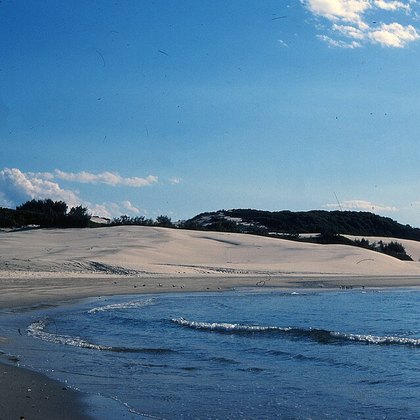
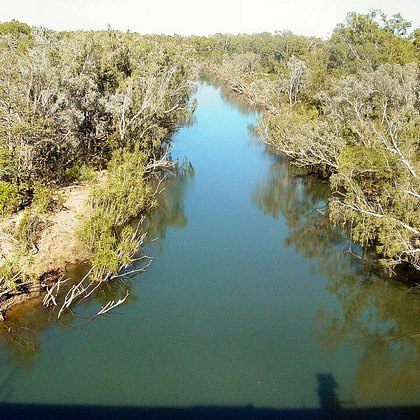
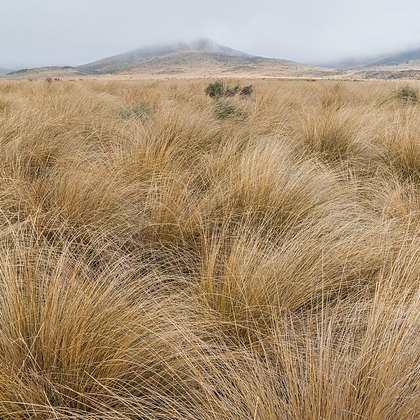
In the breeding season the bare gravel beds of braided rivers, also stony river margins, sandy coasts and dune edges, and in places short subalpine tussock grassland and bare plateaux well above the treeline. Outside the breeding season it is a bird of estuaries, tidal flats, sandy beaches, settling ponds and sewage farms, and of closely grazed paddocks and ploughed fields near the coast.
Where the bird is most often found, arranged by main group and formation.


Range and movements
Breeds through most of New Zealand, in greatest numbers on the braided rivers of Marlborough, Canterbury, Otago and Southland, also on the shingle beds of Hawke's Bay, the Manawatu plains and the Wairarapa, in the high country around Tongariro, on the Chatham Islands and, as a separate subspecies, on the Auckland Islands. From January onwards a large part of the high-country population crosses the Tasman Sea east to west — a journey of sixteen hundred kilometres or more — to Tasmania, Victoria, South Australia and the New South Wales coast, where the birds stay from February to July or August. On Norfolk Island it is a regular passage bird. Return passage runs from June to September; coastal breeders in New Zealand often stay in the country all year.
- Winter
- dark = core range, pale = thinly spread
Where and when to look
Look for it in Australia in the southern winter: from March to July it stands on estuaries the Siberian migrants have just left, and a plover with two faint bands then stands out at once. Always check the legs first — olive to yellow-green rules out the sand plovers at a glance. In New Zealand, walk a shingle river in October and November and watch for a bird that runs a short way and stops: the nest is a scrape among the pebbles and is invisible, so keep to the formed tracks.
Conservation
Near Threatened (NT) on the world list, with a population of about fifty thousand birds that is falling; within New Zealand the species is classed as declining. The losses are almost all on the breeding grounds: introduced predators — feral cats, stoats and ferrets, rats and hedgehogs — take eggs and chicks, and the bird has no defence against them, because its camouflage and distraction display are pitched at native raptors. On top of that the braided rivers are choking up with lupin, willow and broom, so that the bare gravel banks disappear, and hydro schemes and abstraction change the river regime. On the coast, disturbance of nesting birds by beach vehicles and loose dogs plays its part.
Scientific name
Anarhynchus bicinctus | (Jardine & Selby, 1827)
Jardine and Selby described the species in 1827 in their Illustrations of Ornithology as Charadrius bicinctus; because AviList now places it in Anarhynchus, authors and year stand in parentheses. The type locality is given as New Holland, restricted to New South Wales — so the species was described from a bird wintering in Australia and not from New Zealand, where alone it breeds. bicinctus is Latin for 'twice girdled', after the two breast bands, an image carried by the Dutch and Spanish names as well. The Maori name is pohowera.