All species › Waders, gulls and terns › Plovers and lapwings › Kentish Plover
Kentish Plover | Anarhynchus alexandrinus
Strandplevier | Chorlitejo patinegro
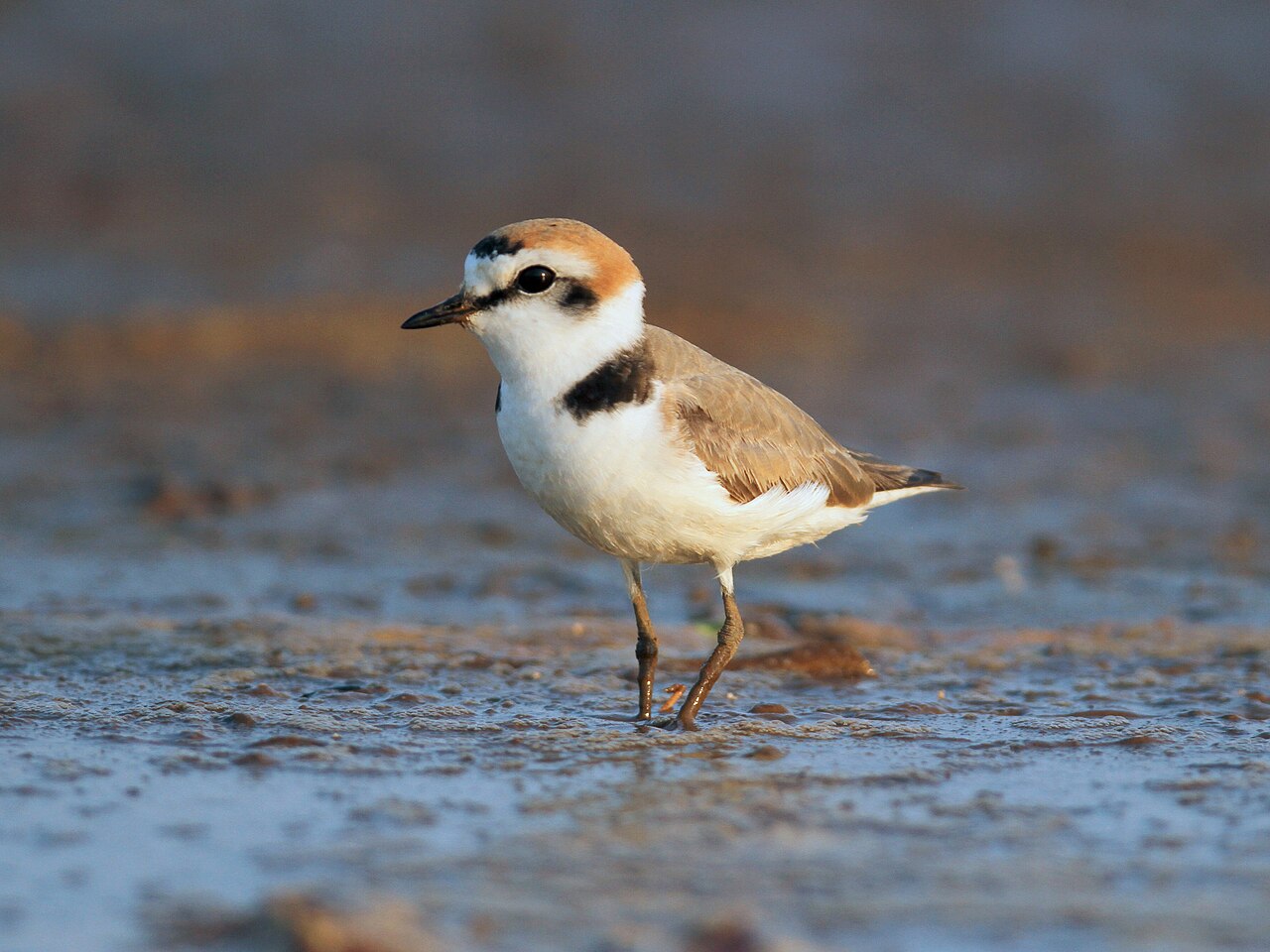
The Kentish Plover is the pale, short-legged ringed plover of salty coasts that breeds right across Eurasia and Africa but turns up in this map window only as a vagrant. What marks it out is what it lacks: the dark breast band is always broken, leaving a loose patch on either side of the white breast.
Voice
The best known call is the alarm, a short rolling kit-up given both on the ground and in flight. Alongside it comes a soft, high pit as a contact note, and a quickly repeated rattle when the bird is uneasy. A vagrant here is usually silent and is found on looks, not on voice.
No recording with a suitable Creative Commons licence has been found for this species yet; what to listen for is described below.
Identification
A small, pale plover of fifteen to eighteen centimetres, sandier above than most of its relatives and clean white below, with a fine, wholly black bill and dark grey-black legs. The breeding male has a black forehead bar, a black ear patch and a rufous rear crown; the female carries the same pattern in brown. Decisive in every plumage is the breast band: it is always broken and stands as two dark side patches. In flight there is a clear white wingbar and the white sides of the tail show well.
Confusion species
Red-capped Plover (Anarhynchus ruficapillus) is the great trap here, since the two were long treated as one species: in Red-capped Plover the rufous runs over the whole crown and into the nape and a black line crosses the eye, while in Kentish Plover only the rear crown is rufous and the forehead carries a black bar. Double-banded Plover (Anarhynchus bicinctus) is larger, darker brown and in breeding plumage carries two complete bands. Siberian Sand Plover (Anarhynchus mongolus) is stockier, with longer dark grey legs and a heavier bill. Common Ringed Plover (Charadrius hiaticula) and Semipalmated Plover (Charadrius semipalmatus) are also rare here, but both have orange legs, an orange bill base and a complete breast band.
Habitat
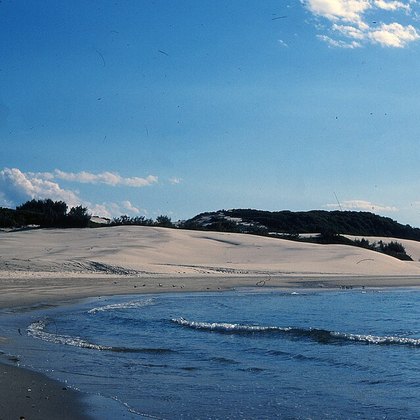
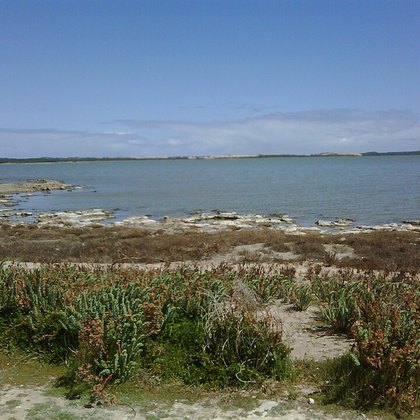
Flat, saline coasts: sandy beach, the bare margins of saltpans and saltworks, brackish lagoons and the upper levels of estuaries, and inland the shores of alkaline lakes. It avoids dense vegetation and feeds on the dry, grainy part of the flat, in the standard plover manner of run, stop and peck.
Where the bird is most often found, arranged by main group and formation.


Range and movements
Within the map window of this guide the Kentish Plover is not an annual visitor but a vagrant, with only a handful of records, almost all on the northwest coast of Australia; its normal wintering range lies in South and Southeast Asia, where the migration usually stops. Every Australian or New Zealand claim therefore needs hard documentation, because the abundant Red-capped Plover generates many mistaken reports.
- Breeding (summer)
- Winter
- dark = core range, pale = thinly spread
Where and when to look
Look for it in the northwest among the parties of Red-capped Plovers on saltpans and saltworks, and with every pale small plover check the crown first: if the rufous runs on into the nape, it is a Red-capped Plover. Photograph the head in profile and head-on, because without images a record will not be accepted here.
Conservation
Least Concern (LC), thanks to a very large range across Europe, Asia and Africa, but with a globally declining trend; in Britain it has not bred since 1979. The pressure comes from recreation on breeding beaches, coastal building and the drying out or conversion of salt lakes. For this region the species carries no conservation task of its own: here it is only a chance visitor.
Scientific name
Anarhynchus alexandrinus | (Linnaeus, 1758)
Linnaeus described the species in 1758 as Charadrius alexandrinus; because it now sits in another genus, author and year stand in parentheses. alexandrinus refers to Alexandria: Linnaeus worked from a description of an Egyptian bird by his pupil Fredrik Hasselquist, and Egypt is accordingly the type locality. The English name Kentish Plover goes back to specimens John Latham collected near Sandwich in Kent around 1801. The genus Anarhynchus was introduced by Quoy and Gaimard in 1830, from Greek ana, 'back', and rhunkhos, 'bill'.