All species › Waders, gulls and terns › Oystercatchers › Variable Oystercatcher
Variable Oystercatcher | Haematopus unicolor
Nieuw-zeelandse zwarte scholekster | Ostrero variable
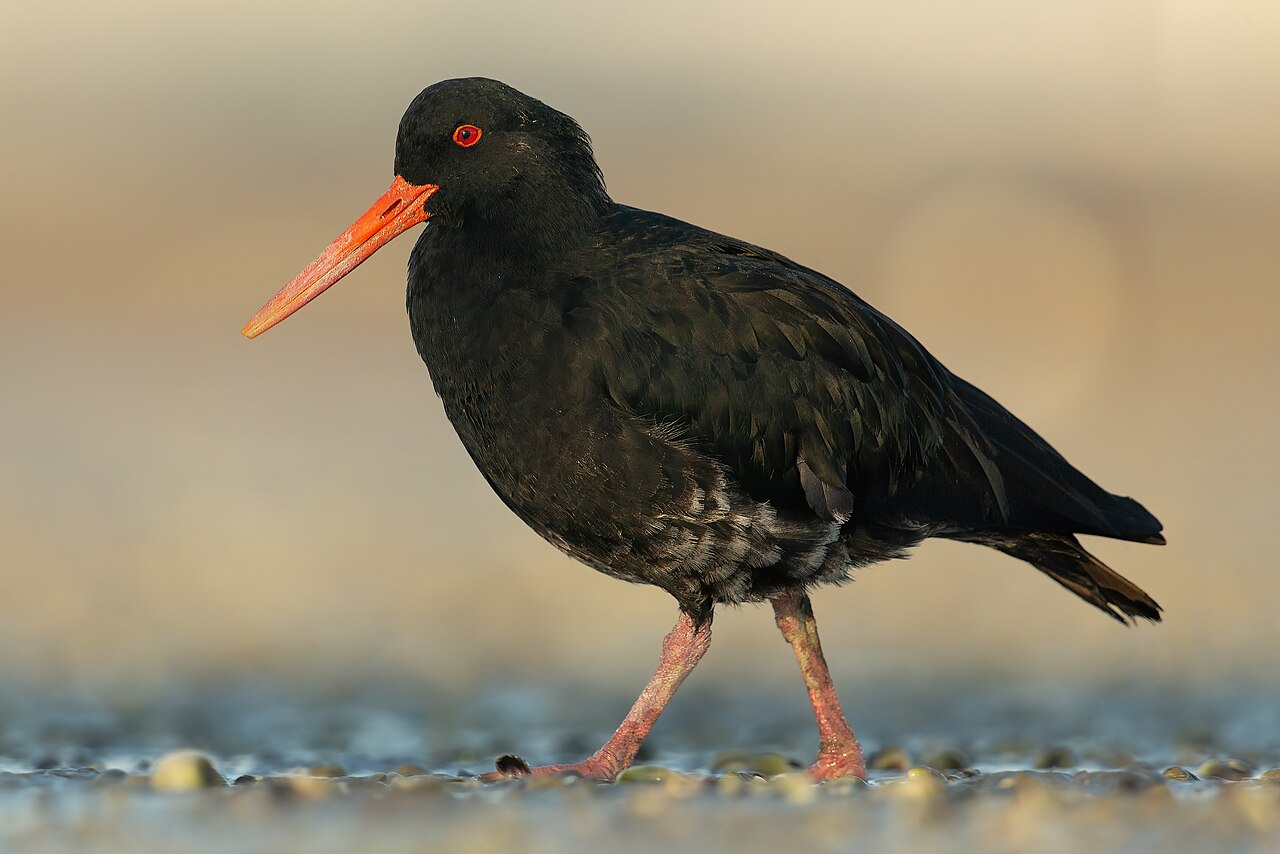
Variable Oystercatcher is the heavy, thickset oystercatcher of the New Zealand coast, nearly always all black in the south and often black and white in the north. Between those extremes runs a series of smudgy intermediates, and it is that variation that gave the species its scientific name. It stays on its stretch of coast all year and is never found more than about thirty kilometres inland.
Voice
Very vocal. At an intruder a pair switches to loud, rapidly repeated piping, an accelerating series of high notes given with the bill angled down while both birds walk forward side by side. In flight comes the same sharp kleep as other oystercatchers. To warn chicks the parents use a short hard chip or click, at which the young flatten themselves on the sand at once.
No freely licensed recording has been found for this species yet; what to listen for is described below.
Identification
A heavy oystercatcher of some forty-eight centimetres with a long, straight, bright orange bill — clearly longer in the female — thick coral-pink legs, a red eye and an orange eye-ring. The plumage comes in three forms: all black, a pied form with a white belly, and smudgy birds in between where the white bleeds dirty grey into the black. In the pied form the black-and-white border is never clean, the lower back is black, and no white wedge pushes up. Young birds are browner, with a dark-tipped bill and greyish legs.
Confusion species
South Island Oystercatcher (Haematopus finschi) is the main confusion with the pied form: slimmer, smaller and finer billed, with a dead straight black-and-white border and a white wedge running from the rump up the back — exactly what is missing here. It also walks on paddocks and river shingle, while this species keeps to the coast. Chatham Islands Oystercatcher (Haematopus chathamensis) is close in build and bill thickness to the pied form, but stays on the Chatham Islands. Sooty Oystercatcher (Haematopus fuliginosus) has one New Zealand record; in practice every all-black oystercatcher on a New Zealand shore is this species.
Habitat
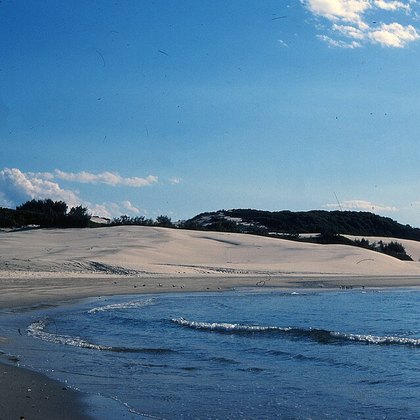
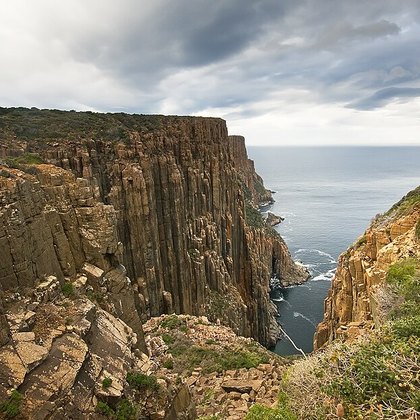
The coast, and next to nothing else: sandy beach and dune foot, rock platforms and shell banks, and the tidal flats of harbours and estuaries. It nests in a scrape above the tideline among dune grass, shells or boulders, and feeds on mussels, cockles and other bivalves, which it hammers or prises open with the chisel bill. Now and then it walks into an adjoining paddock.
Where the bird is most often found, arranged by main group and formation.

Range and movements
Endemic to New Zealand, along the whole coastline of the North, South and Stewart Islands and their offshore islands. About two thirds of the population is on the North Island. The share of all-black birds rises southwards: in the north most are pied, in Otago and Southland black predominates, and on Stewart Island every bird is black. The species occurs nowhere outside New Zealand.
- Resident
- dark = core range, pale = thinly spread
Where and when to look
Look for it on a sandy beach with dunes, not on a mudflat full of South Island Oystercatchers. If a pair keeps circling you on the beach in summer, calling hard, you are almost certainly inside a breeding territory — walk away towards the tideline and keep dogs on the lead. On every pied bird check the edge between black and white: dirty and bleeding means this species, clean and straight means South Island Oystercatcher.
Conservation
Not threatened globally (LC); within New Zealand it is rated Recovering. After the shooting pressure of the nineteenth and early twentieth centuries only some two thousand birds were left around 1970. Since full protection that has climbed to an estimated six to seven thousand, and the increase continues. Losses now come from feral cats, stoats and rats on the nesting beach, from four-wheel drives and loose dogs, and from continuing building on the coastal dunes. It is a long-lived bird — one individual of at least thirty-seven years is known — so a well-protected pair can produce many young over a lifetime.
Scientific name
Haematopus unicolor | Forster, 1844
Forster described the species as Haematopus unicolor; his notes from Cook's second voyage were only published in 1844, so that year counts as the date of publication. It has stayed in that genus, so author and year carry no parentheses. The genus Haematopus was introduced by Linnaeus in 1758, from Greek haima, 'blood', and pous, 'foot'. unicolor means 'of one colour' and refers to the all-black form the description rested on — a name that fails precisely for the pied birds of the north. The type locality is New Zealand; the Maori name is torea pango, 'black torea'.