All species › Waders, gulls and terns › Oystercatchers › Pied Oystercatcher
Pied Oystercatcher | Haematopus longirostris
Australische bonte scholekster | Ostrero pío australiano
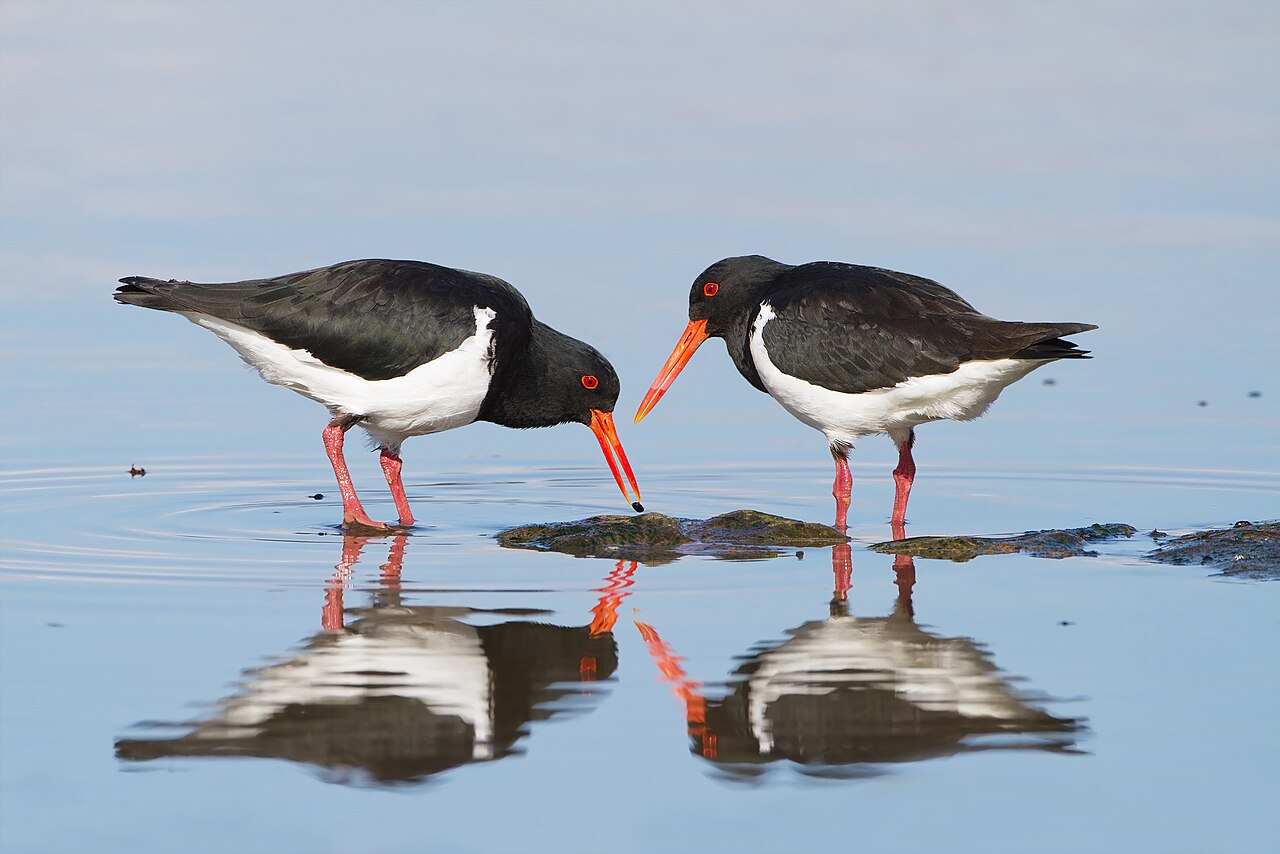
The Pied Oystercatcher is the oystercatcher of sandy beaches and tidal flats: black above, sharply cut off white below, with a long orange-red bill and pink legs. It is the only oystercatcher in Australia with white in the plumage, and pairs hold the same stretch of shore year after year.
Voice
It is mostly silent while feeding. On taking off or when uneasy comes a shrill, far-carrying pleep or pee-pa-peep, which can run into a long series. In border disputes a pair walks side by side with bills angled down and launches a piping display: an accelerating trill that swells into a sharp wail and is answered from the far bank.
No freely licensed recording has been found for this species yet; what to listen for is described below.
Identification
A heavy wader of nearly half a metre, jet black from head to breast, with pure white from the lower breast down meeting the black along a straight, clean line. The bill is long, straight, laterally flattened like a chisel and orange-red; it is longer and finer in the female than in the male. Legs are short and pink to dull rose, the eye red with an orange-red ring. In flight a broad white wingbar shows, plus a white rump. Young birds are brown-black rather than black, with a dull dark-tipped bill and greyish legs.
Confusion species
Sooty Oystercatcher (Haematopus fuliginosus) is the same size but all black and works rock platforms rather than sand; against the light a pied bird looks black, and the white belly settles it as soon as the bird lifts. South Island Oystercatcher (Haematopus finschi) from New Zealand turns up in small numbers each year along the east coast of Australia and is the harder call: it is smaller, carries a white wedge running from the rump up the back, shows more white in the wing, and has the black-and-white border set further forward on the breast. At distance a standing bird can also suggest Beach Stone-curlew (Esacus magnirostris), but that one is pale and streaked instead of black and white.
Habitat
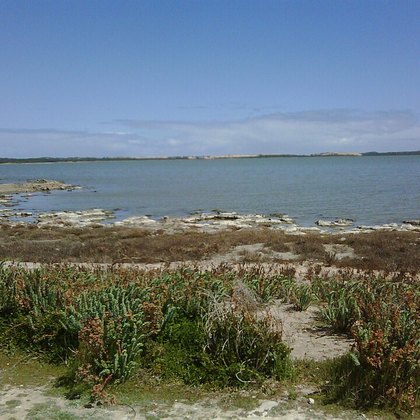
Tidal flats, estuaries and sandbanks are the core: it hunts bivalves and worms on the mud, and roosts at high water on a sandbank or shell ridge. Beyond that it works the wide sand of open ocean beaches and visits saltmarsh and the edge of mangroves. It uses rocky shore far less than its sooty relative. The nest is a scrape in sand or among shells, just above the tideline or in the foredunes.
Where the bird is most often found, arranged by main group and formation.


Range and movements
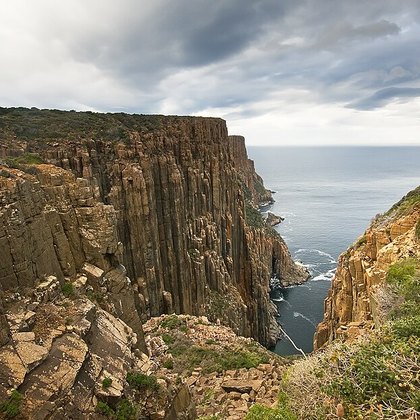
Nearly the whole Australian coastline, broken at the cliffs of the Great Australian Bight where there is neither beach nor flat. The largest concentrations are in Tasmania, in Corner Inlet and Western Port in Victoria, along the South Australian coast and in the bays of south-east Queensland such as Moreton Bay. There is a single record for New Zealand.
- Resident
- dark = core range, pale = thinly spread
Where and when to look
Walk an estuary on a falling tide and search the edge of the mudflat: pairs stand far apart, because each defends some two hundred metres of shore. If you come too near a breeding territory one of the two will walk ahead of you calling loudly; turn back then, because the nest sits open on the sand and the eggs are all but invisible.
Conservation
Not threatened globally (LC), but the Australian population is put at some ten thousand birds, which is few for a whole continent. In New South Wales the species has been on the state threatened list since 2010. The problem is not food but the breeding beach: nests and small chicks are lost to foxes and feral cats, to four-wheel drives and loose dogs, and to summer holiday crowds in exactly the months the birds have young. Where beaches are fenced off in the breeding season and foxes are controlled, breeding success lifts at once.
Scientific name
Haematopus longirostris | Vieillot, 1817
Vieillot described the species in 1817 as Haematopus longirostris, and it has stayed in that genus, so author and year carry no parentheses. The genus Haematopus was introduced by Linnaeus in 1758, from Greek haima, 'blood', and pous, 'foot', for the red legs. longirostris means 'long-billed' and says exactly what you see. For provenance Vieillot gave only 'Nouvelle-Hollande', the Australia of his day.