All species › Waders, gulls and terns › Oystercatchers › Sooty Oystercatcher
Sooty Oystercatcher | Haematopus fuliginosus
Australische zwarte scholekster | Ostrero negro australiano
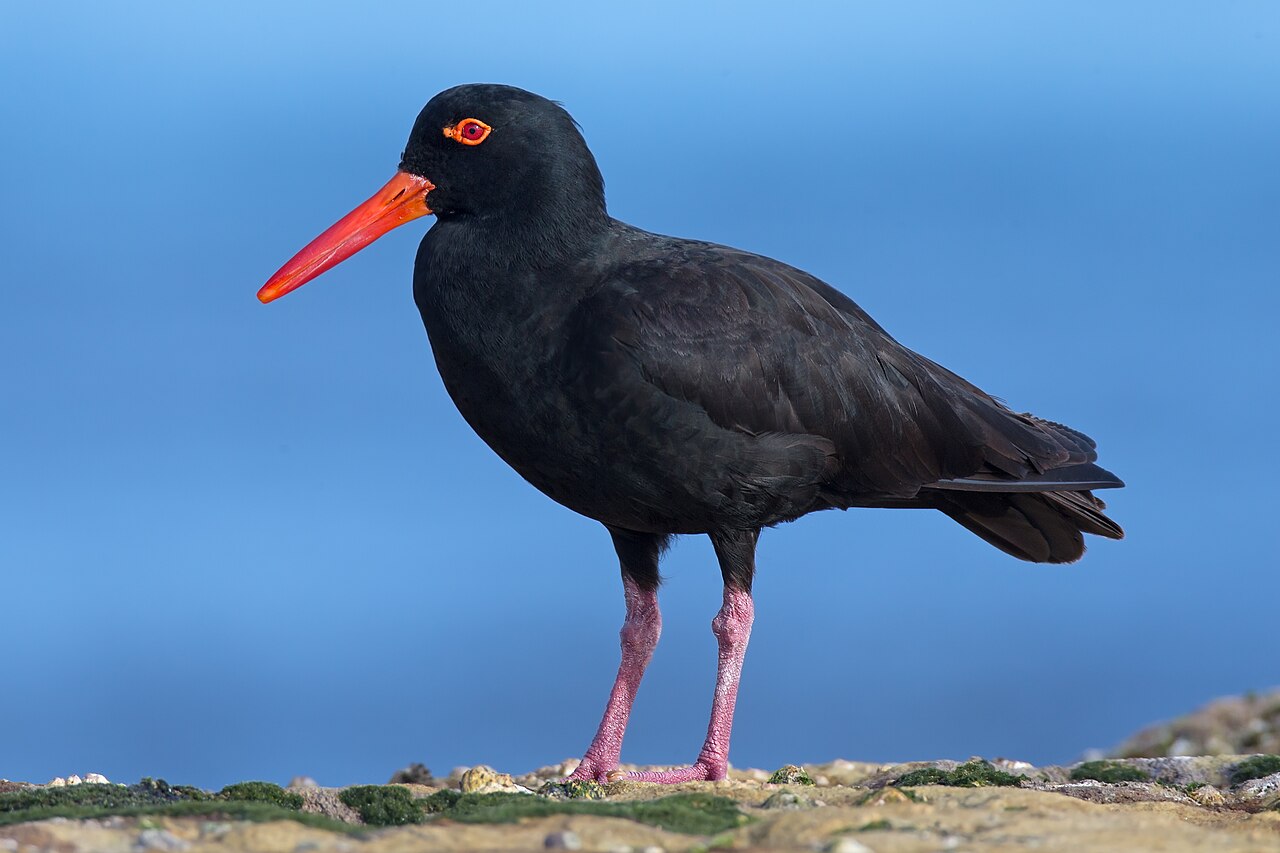
The Sooty Oystercatcher is the oystercatcher of rocky shores: entirely black, with a long orange-red bill, a red eye in a red ring and flesh-coloured legs. It is nowhere numerous, holds a stretch of rock platform in pairs, and occurs in Australia and nowhere else.
Voice
The call is a sharp, far-carrying kleep, usually as the bird takes off. On the rock platform pairs and small groups run through a piping display: an accelerating series of high notes that runs into a trill, bill down and head bowed. A walker coming close draws a persistent, penetrating piping that wakes the whole platform.
No freely licensed recording has been found for this species yet; what to listen for is described below.
Identification
An oystercatcher of forty-two to fifty-two centimetres, wholly black in every plumage. Bill and eye-ring are scarlet to orange-red, the iris is red, the legs pink to flesh-coloured. The female is larger and has a longer, thinner bill — a nineteen per cent difference on average, the greatest in the family and visible in the field on a pair. Immatures are brownish black, with grey-brown legs and a brown eye; only in the second year does everything turn red. The northern form is smaller and has a yellower eye-ring.
Confusion species
The Pied Oystercatcher (Haematopus longirostris) is the same length but black and white, and works sandy beach and mudflat rather than rock; against the light a pied bird can look black, after which the white belly settles it as soon as it flies. In New Zealand any black oystercatcher on a rocky shore is the black form of the Variable Oystercatcher (Haematopus unicolor), shorter and thicker in the bill; the Australian species has been recorded there once. An immature with a dull bill is taken for a cormorant in a hurried view.
Habitat
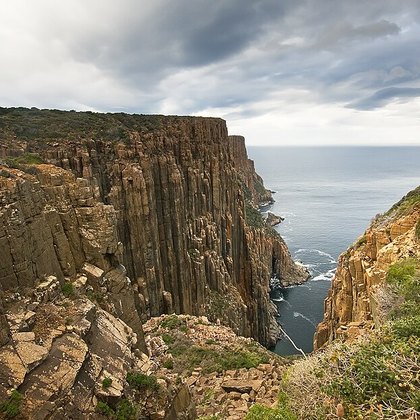
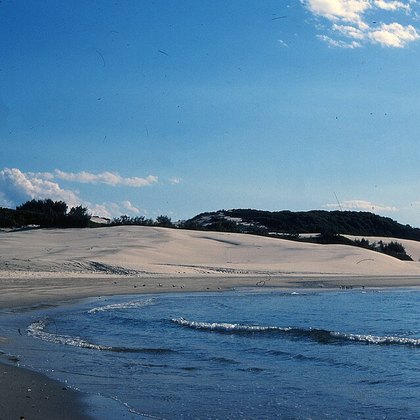
Rocky coasts, reef platforms and stony islets where mussels, abalone and turban shells are exposed at low water; it feeds at the edge of the surf, in the two hours either side of low tide. For roosting and nesting it uses rock platforms, low clifftops and uninhabited islands close inshore. It uses sandy beach and estuary less, and hardly at all while rock platform is available.
Where the bird is most often found, arranged by main group and formation.


Range and movements
Endemic to Australia and spread around almost the whole coast, from southwestern Western Australia round the continent into Queensland, densest around Tasmania and on the Bass Strait islands. The northern form runs from the Kimberley to Mackay in central Queensland, the southern form below that. It does not migrate: pairs stay on their own shore all year, and young birds wander no further than along the coastline.
- Resident
- dark = core range, pale = thinly spread
Where and when to look
Walk a rock platform on a falling tide and look for a black bird on the lowest edge, where the weed begins; it often stands exactly on the line of the retreating water. On a pair, compare the bills: the longer, thinner one belongs to the female, and this is one of the few places where that difference shows without a ruler.
Conservation
Least Concern (LC), but this is a small population: the total is estimated at about eleven and a half thousand birds, four thousand of the southern form and seven and a half thousand of the northern. It is listed as endangered in New South Wales, near threatened in Victoria and rare in South Australia and Queensland. Disturbance of nest sites by boats and walkers, foxes and rats on the islets, and oil on the rocky shore weigh heaviest.
Scientific name
Haematopus fuliginosus | Gould, 1845
Gould described the species in 1845 as Haematopus fuliginosus, and it still stands in that genus, so author and year carry no parentheses. The genus Haematopus was introduced by Linnaeus in 1758, after Greek haima, 'blood', and pous, 'foot', for the red legs. fuliginosus means 'sooty'. Gould gave the type locality as Tasmania, the islands in Bass Strait and the southern coast of Australia; the northern form, separated as subsp. ophthalmicus, is held by some to be a species of its own.