All species › Waders, gulls and terns › Oystercatchers › South Island Oystercatcher
South Island Oystercatcher | Haematopus finschi
Finsch' scholekster | Ostrero de finsch
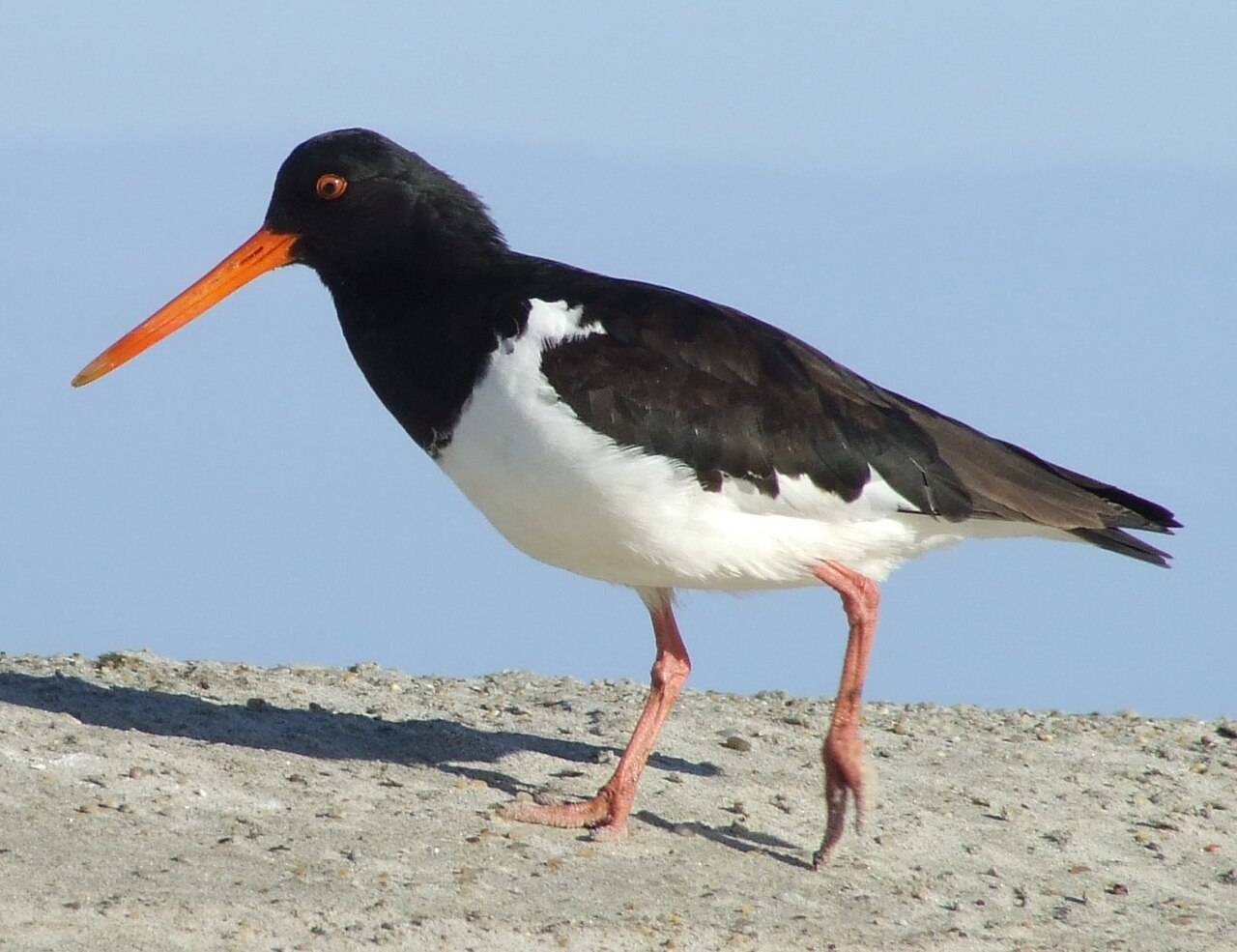
South Island Oystercatcher is New Zealand's black-and-white oystercatcher: crisply marked, with a long straight orange-red bill and stout pink legs. It is the only oystercatcher in the world that breeds far inland on braided riverbeds and farmland, and that afterwards moves to coastal estuaries in tens of thousands.
Voice
The flight call is a loud, high, piercing kleep that carries across a whole estuary and comes from dozens of throats at once when a flock lifts. On territory it turns into a piping display: a fast accelerating trill given with the bill angled down, pairs calling against each other. Near the nest danger brings a short hard quick.
No freely licensed recording has been found for this species yet; what to listen for is described below.
Identification
An oystercatcher of forty-six centimetres, black above and pure white below, the border set well forward on the lower breast with a narrow white point pushing up into the black flank. The most useful mark is on the back: a white wedge runs from the rump up into the lower back, visible on a bird walking away and obvious in flight, where a broad white wingbar joins in. The bill is long, straight and orange-red, the legs short and stout pink, the eye red with an orange ring. Young birds are brown-black with a dull red, dark-tipped bill and greyish pink legs.
Confusion species
Pied Oystercatcher (Haematopus longirostris) is the confusion on the Australian east coast: larger and heavier, without the white wedge in the back, and with the black-and-white border set further back, running higher on the breast. The pied morph of Variable Oystercatcher (Haematopus unicolor) is the everyday confusion in New Zealand itself: it has a smudgy, irregularly bleeding border between black and white rather than a clean line, a black instead of white lower back, and a shorter, heavier bill. Chatham Islands Oystercatcher (Haematopus chathamensis) is again shorter and thicker in the bill and stays on the Chatham Islands. Outside the breeding season range is itself a clue: this is the oystercatcher you meet on a paddock or a river shingle far from the sea.
Habitat
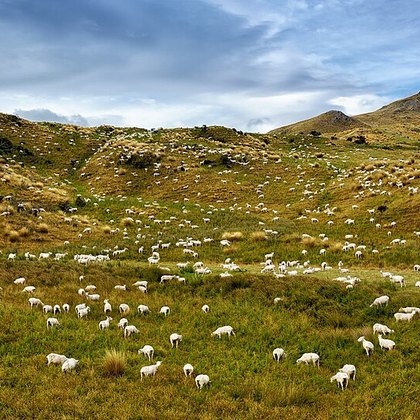
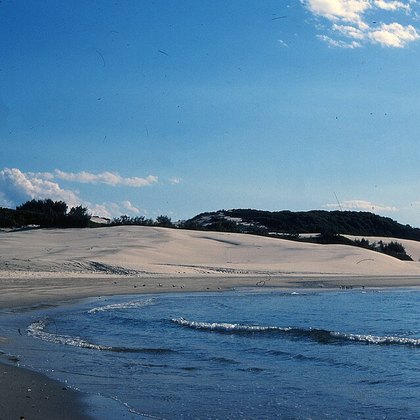
In the breeding season the braided rivers of the eastern South Island — wide shingle beds with bare banks — and the farmland around them, where it takes earthworms and beetle larvae in pasture and freshly sown crop. Outside the breeding season the coast instead: mudflat and estuary, where cockles and worms make the menu. The nest is an unlined scrape on a raised patch of shingle or in a paddock.
Where the bird is most often found, arranged by main group and formation.


Range and movements
Endemic to New Zealand. It breeds almost entirely on the South Island east of the Southern Alps: the Mackenzie Basin and the river plains of Canterbury and Otago, with the Rakaia, the Rangitata and the Waitaki as core ground. After breeding the birds shift to the coast and largely north to the North Island, where Kaipara Harbour, Manukau Harbour and the Firth of Thames hold the biggest concentrations. A handful reach Australia, Norfolk Island and Lord Howe Island each year as vagrants.
- Resident
- dark = core range, pale = thinly spread
Where and when to look
Go to a large northern harbour in February or March on a rising tide: the roosts are then black and white with thousands of birds, and that is exactly where the odd Variable Oystercatcher stands among them, picked out at once by its smudgy breast border. To see the white wedge in the back, wait until a bird walks away from you or takes off.
Conservation
Not threatened globally (LC), with a population put at around a hundred and ten thousand birds at the turn of the century; within New Zealand the species is rated Declining. Numbers fell hard to shooting in the nineteenth and early twentieth centuries; after full protection in 1940 they grew strongly, helped by the conversion of tussock grassland to pasture, which actually supplied food. The present worry is on the breeding grounds: introduced ground predators on the shingle, braided rivers choking up with exotic lupin and willow, water abstraction, and nests trampled by stock.
Scientific name
Haematopus finschi | Martens, 1897
Martens described the species in 1897 as Haematopus finschi, and it has stayed in that genus, so author and year carry no parentheses. The genus Haematopus was introduced by Linnaeus in 1758, from Greek haima, 'blood', and pous, 'foot'. The epithet honours Otto Finsch (1839–1917), the German ornithologist, ethnographer and traveller who published widely on the birds of the Pacific. The type locality is New Zealand; the Maori name is torea.