All species › Waders, gulls and terns › Oystercatchers › Chatham Islands Oystercatcher
Chatham Islands Oystercatcher | Haematopus chathamensis
Chatham-scholekster | Ostrero de las Chatham
Chatham Islands Oystercatcher is a squat, heavily built oystercatcher found only on the Chatham Islands, eight hundred kilometres east of New Zealand. It is one of the rarest oystercatchers in the world: the entire species numbers little more than three hundred birds across four islands. Pairs hold their stretch of rocky shore or beach all year.

Voice
Like all oystercatchers, noisy on territory: a loud, piercing kleep on taking off, and at an intruder a piping display in which the pair walks forward side by side with bills angled down, pouring out an accelerating series of high trilling notes. At the nest comes a short hard alarm at which half-grown young press themselves motionless among the stones.
No freely licensed recording has been found for this species yet; what to listen for is described below.
Identification
An oystercatcher of forty-eight centimetres with a strikingly short, thick and blunt bill — the most useful mark — and short, heavy pink legs, which make it look low and stocky. Head, neck, breast, back, wings and tail are black, the underparts white from the lower breast down, but the border between the two is untidy and bleeding rather than clean; some birds show hardly any white. The bill is orange-red, the eye red with an orange ring. Young birds are dull brown with a dark-tipped bill.
Confusion species
The only confusion on the islands themselves comes from mainland vagrants. South Island Oystercatcher (Haematopus finschi) is then slimmer, finer billed and longer legged, with a dead straight black-and-white border and a white wedge running from the rump up the back — that wedge is entirely absent here. Variable Oystercatcher (Haematopus unicolor) is close in build, but larger, longer billed and, in the south, usually all black. Note that unlike the all-black New Zealand oystercatchers, this species is genuinely pied, just untidily so; anyone expecting it from the list of 'black oystercatchers' is looking from the wrong end.
Habitat
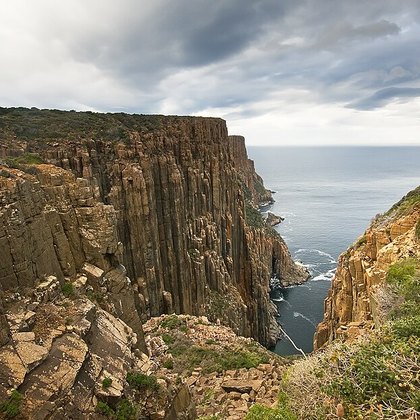
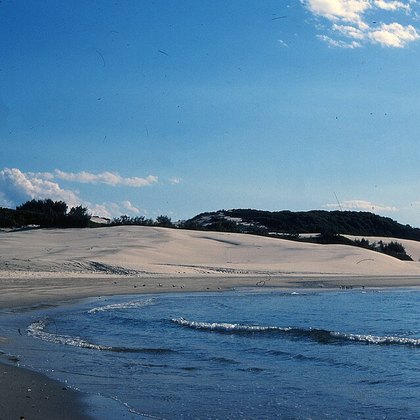
Rocky shore, reef platform and sandy beach with a dune foot or grassy patch behind, usually within a couple of hundred metres of the tideline. It takes barnacles, mussels and worms on the rock platform and roosts on bare stretches of beach. The nest is an unlined scrape among driftwood, stones or dune grass, usually close to high water — a position pushed steadily nearer the tide by planted marram grass.
Where the bird is most often found, arranged by main group and formation.

Range and movements
The Chatham Islands only. The largest numbers are on Chatham Island itself, with smaller breeding populations on Pitt Island, Rangatira (South East Island) and Mangere Island. The species occurs nowhere on the New Zealand mainland, nor on any other island group.
- Resident
- dark = core range, pale = thinly spread
Where and when to look
Drive the north coast of Chatham Island and scan the rock platforms at low tide: pairs stand far apart and are strikingly faithful to place, so an occupied territory sits on the same bay year after year. Look at the bill first — short and blunt rather than long and pointed — and only then at the breast border, which in this species is precisely the unreliable feature.
Conservation
Endangered (EN) on the world list and rated Nationally Critical in New Zealand. In the late 1980s the species numbered fewer than a hundred and ten birds. An intensive management programme has run since 1998: control of feral cats, hedgehogs and weka around the northern territories, video monitoring of nests, and the moving of nests away from the tideline combined with dune restoration, replacing the introduced marram grass that has squeezed the birds towards the water with native sand-binders. By December 2004 that had produced eighty-eight breeding pairs and three hundred and eleven birds, and around 2014 the count stood at just over three hundred; since then numbers have fluctuated. The standing risks are storm surge, trampling by wandering stock, weakening cat control, and low genetic variation after the bottleneck.
Scientific name
Haematopus chathamensis | Hartert, 1927
Hartert described the species in 1927 as Haematopus chathamensis, and it has stayed in that genus, so author and year carry no parentheses. The genus Haematopus was introduced by Linnaeus in 1758, from Greek haima, 'blood', and pous, 'foot', for the red legs. chathamensis simply means 'of the Chathams', which is also the type locality. The Maori name is torea tai, the 'torea of the tide'.