All species › Waders, gulls and terns › Stilts and avocets › Red-necked Avocet
Red-necked Avocet | Recurvirostra novaehollandiae
Australische kluut | Avoceta australiana
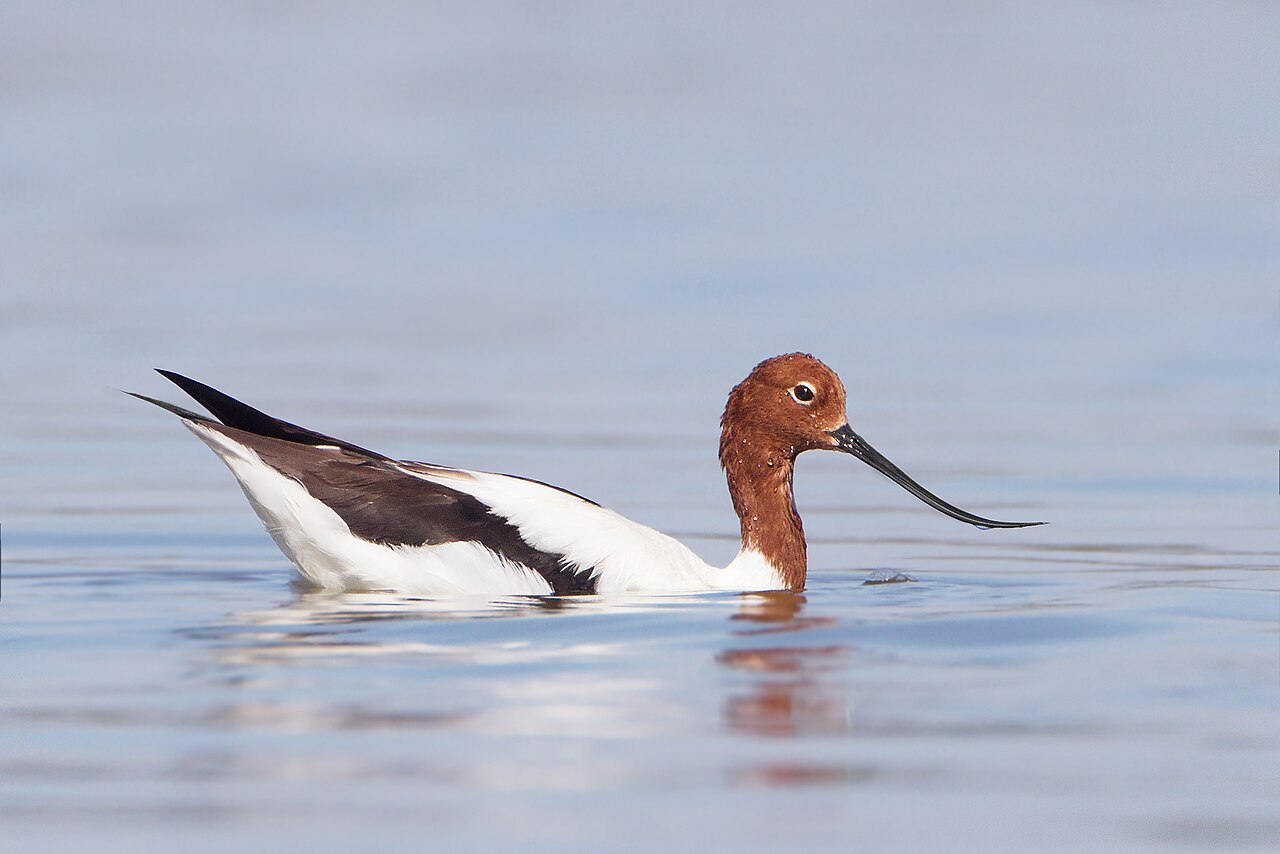
Red-necked Avocet is the continent's only avocet: a brilliant white bird with black wing markings, a deep chestnut head and neck, and a long black bill curving up like an awl. With it the bird scythes sideways through shallow water, and in large flocks they all do it at once, in the same rhythm. Where it appears depends entirely on where the rain has fallen in recent months.
Voice
A clear, fluting toot-toot, usually in twos or threes, with shorter yelping and wheezing notes between. A flock lifting produces a far-carrying hollow chorus that the literature invariably compares to dogs barking in the distance. At the nest comes a sharper, nervous alarm.
No freely licensed recording has been found for this species yet; what to listen for is described below.
Identification
A large, elegant wader of forty to forty-five centimetres, pure white on the body with black shoulder stripes and black primaries that give a banded black-and-white pattern in flight. Head and neck are deep red-brown to chestnut, with a narrow white eye-ring that shows at distance as a pale spot in the brown. The bill is long, jet black, needle-fine and clearly upcurved — more strongly curved in the male than in the female. The legs are long and pale blue-grey and project beyond the tail in flight. The sexes are otherwise alike and there is no seasonal plumage; young birds have a duller, browner head.
Confusion species
No other avocet occurs in this region, so the upcurved bill together with the brown head settles it. At distance and against the light it may stand among Banded Stilts (Cladorhynchus leucocephalus), which look equally white but have a straight bill, a chestnut band across the breast instead of a brown head, and shorter legs. Pied Stilt (Himantopus leucocephalus) is slimmer, taller on the legs, has a dead straight bill and black on the hindneck. A flock of avocets scything through the water can be named on behaviour alone, before the bill shape is visible.
Habitat
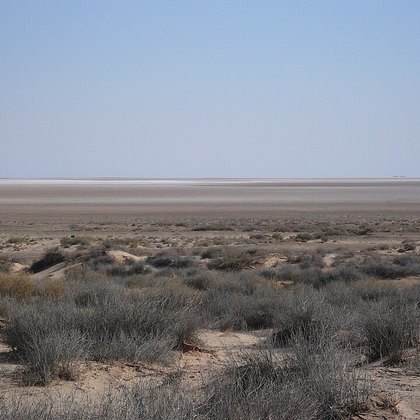
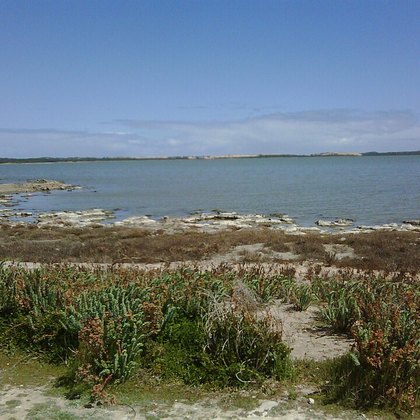
Shallow salt, brackish and fresh water in open country: inland salt lakes and salt pans, claypans and ephemeral lakes that fill after rain, estuarine mudflats, saltmarsh, reservoirs and the ponds of saltworks and sewage treatment. It wants space and a low, bare shore; dense reedbeds it avoids. Breeding is in loose colonies on bare islets and shores, in a scrape lined with plant material.
Where the bird is most often found, arranged by main group and formation.



Range and movements
Endemic to Australia and spread over nearly the whole mainland, with its weight in the south and west; along the northern and north-eastern coasts it is scarce. It breeds mainly in the dry interior — the salt lakes around Lake Eyre and the inland plains of Western Australia — from August to November, and outside that wanders in flocks to wherever water stands. In dry years numbers build up near the coast, at places such as the Coorong in South Australia, the Dry Creek saltfields near Adelaide and the Werribee treatment plant near Melbourne. In Tasmania and on Cape York it is no more than an occasional visitor, and it does not reach New Zealand.
- Resident
- dark = core range, pale = thinly spread
Where and when to look
Look for it on a large, shallow saline pool with a bare shore, and scan for colour rather than shape: the chestnut head gives a flock away across hundreds of metres of open water, while the white body dissolves in the heat haze. Watch for the scything — the head swings from side to side with the bill tip just under the surface — because no other Australian wader feeds like that.
Conservation
Not threatened (LC) and rated secure in every state where it occurs. Its strength lies in its wandering: it does not depend on one wetland but follows the rain, and the building of reservoirs, sewage ponds and saltworks has added permanent, safe refuges for the dry years. Prolonged drought and the abstraction of water from the inland river systems can nonetheless wipe out whole breeding seasons, and colony nests are lost to foxes and feral cats as soon as a falling water level joins an islet to the shore.
Scientific name
Recurvirostra novaehollandiae | Vieillot, 1816
Vieillot described the species in 1816 as Recurvirostra novaehollandiae, and it has stayed in that genus, so author and year carry no parentheses. The genus Recurvirostra was introduced by Linnaeus in 1758, from Latin recurvus, 'bent backwards', and rostrum, 'bill'. novaehollandiae means 'of New Holland', the name Australia then carried, and that also stands as the type locality. In Australia the bird is colloquially the cobbler's awl, after that same bill.