All species › Waders, gulls and terns › Stilts and avocets › Black Stilt
Black Stilt | Himantopus novaezelandiae
Zwarte steltkluut | Cigueñuela negra
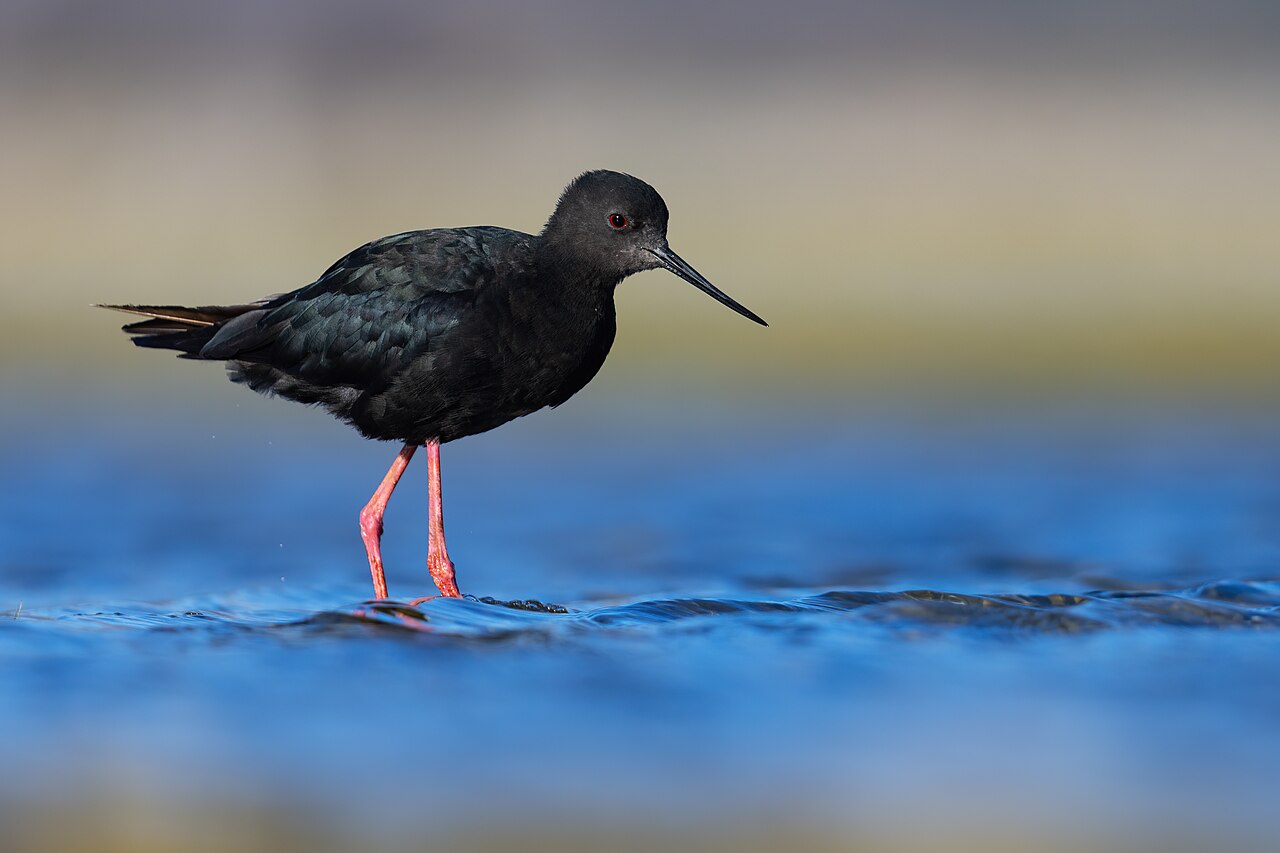
Black Stilt, or kaki, is the rarest wader in the world: an entirely black bird on long red legs that now breeds only on the braided rivers of the Mackenzie Basin in the South Island. In 1981 twenty-three adults were left. That the species still exists is the result of forty years of lifting eggs, incubating them artificially and releasing the young.
Voice
A high yapping call much like that of Pied Stilt but softer, lower and slower, with longer-held notes: yek … yek … yek, plaintive rather than snappy. At the nest and against an intruder it runs into a faster, sustained series while the bird circles the river shingle with its legs dangling. A mixed pair of the two species can be heard calling audibly across each other.
No freely licensed recording has been found for this species yet; what to listen for is described below.
Identification
A wader of forty centimetres, entirely black as an adult, with a green gloss over back and wings, a thin, dead straight jet-black bill, a red eye and long deep pink to red legs. It is clearly larger, heavier and shorter-legged than Pied Stilt. Young birds are the opposite: largely white on head, neck and breast with a black eye patch and a black band across the breast, turning fully black only in their first or second year — so a bird in that transitional plumage looks like a hybrid without being one.
Confusion species
Pied Stilt (Himantopus leucocephalus) often stands in the same pool and always has a spotless white breast and belly and a black cap on a white head. The hard birds are the hybrids between the two species, which occur regularly in the Mackenzie Basin: they carry a variable amount of black across breast and belly, often as a dirty irregular blotch, and sit between both parents. A young Black Stilt can be told from them because its black keeps spreading over the first years until the whole plumage is black, while a hybrid keeps its intermediate plumage. Banded Stilt (Cladorhynchus leucocephalus) does not occur in New Zealand and is in any case white with a brown breastband.
Habitat
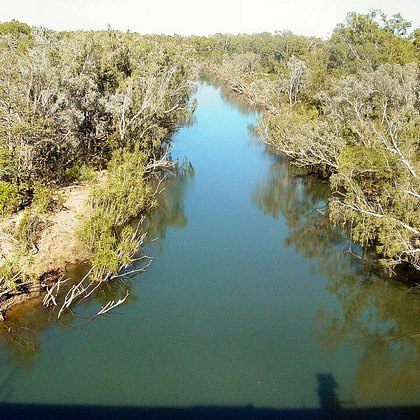
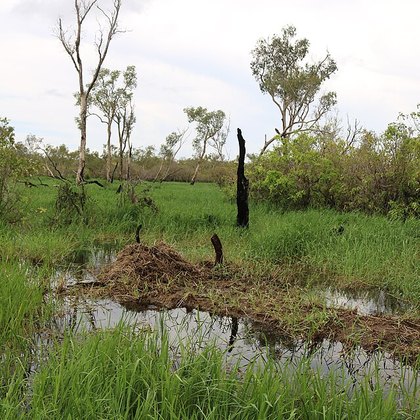
Braided rivers: wide beds of loose shingle with shallow side channels, seepages and muddy edges, where it hunts mayfly larvae, caddis and water mites in shallow water. It also visits adjoining swamps, spring-fed wetlands and the margins of the Waitaki hydro lakes. Some birds move in winter to northern harbours and estuaries, up to about six hundred kilometres away, but most stay in the basin through the winter. The nest is a scrape on a bare shingle bank, often close to running water.
Where the bird is most often found, arranged by main group and formation.



Range and movements
Endemic to New Zealand and now confined to the Mackenzie Basin of South Canterbury and North Otago: the upper Waitaki with the Tasman valley, the Godley, and the shores of Lake Tekapo/Takapo and Lake Ohau. Before human arrival the species bred far more widely, as far as the North Island; that old range vanished in the nineteenth century.
- Resident
- dark = core range, pale = thinly spread
Where and when to look
Go to a lookout over a shingle river in the Mackenzie Basin early in the morning and scan the side channels; kaki are faithful to place and often stand close to the water. Any all-black stilt in New Zealand is this species. Keep off the river shingle in the breeding season, from August to December: a pair you see walking on the bed will leave the nest if disturbed, and every one of those eggs counts.
Conservation
Critically Endangered (CR) and rated Nationally Critical in New Zealand. In the 1940s there were still five hundred to a thousand birds; in 1981 the species reached its low point at twenty-three adults. An intensive recovery programme has run since then from the Department of Conservation kaki rearing centre near Twizel, together with the Isaac Conservation and Wildlife Trust near Christchurch: eggs are lifted from wild nests, incubated artificially, and the young are reared and released at three to nine months old. In 2025 a hundred and forty-eight young birds went out that way, seventy-five at Lake Tekapo/Takapo and seventy-three in the Tasman valley; about thirty per cent of released birds reach adulthood. The number of wild adults stood at a hundred and sixty-nine in August 2023 and about a hundred and forty-one in 2025, against four productive breeding pairs in 1999 and forty-one pairs in 2024 — the recovery is real, but numbers swing from year to year. The threats are introduced predators (ferrets, stoats, feral cats, hedgehogs and rats), the choking of the braided rivers by exotic lupin, willow and broom, which removes the bare shingle banks and gives predators cover, water abstraction and damming for hydro power, agricultural intensification in the basin, flooding, and disturbance from four-wheel drives and anglers. Hybridisation is a genuine part of the picture as well: Pied Stilt settled in New Zealand in the nineteenth century and now numbers some thirty thousand birds there against a hundred-odd kaki, so a kaki that cannot find its own kind pairs with a Pied Stilt. The offspring are fertile; genetic work published in 2020 and 2021 shows that hybridisation does occur but that the kaki genome has not yet dissolved into a hybrid swarm, which makes the management of mixed pairs a core part of the programme.
Scientific name
Himantopus novaezelandiae | Gould, 1841
Gould described the species in 1841 as Himantopus novaezelandiae, and it has stayed in that genus, so author and year carry no parentheses. The genus Himantopus was introduced by Brisson in 1760, from Greek himas, himantos, 'strap' or 'thong', and pous, 'foot', for the thin strap-like legs. novaezelandiae means 'of New Zealand', which is also the type locality. The Maori name kaki is the name under which the species is almost always referred to in New Zealand, official documents included.