All species › Waders, gulls and terns › Stilts and avocets › Pied Stilt
Pied Stilt | Himantopus leucocephalus
Australische steltkluut | Cigueñuela australiana
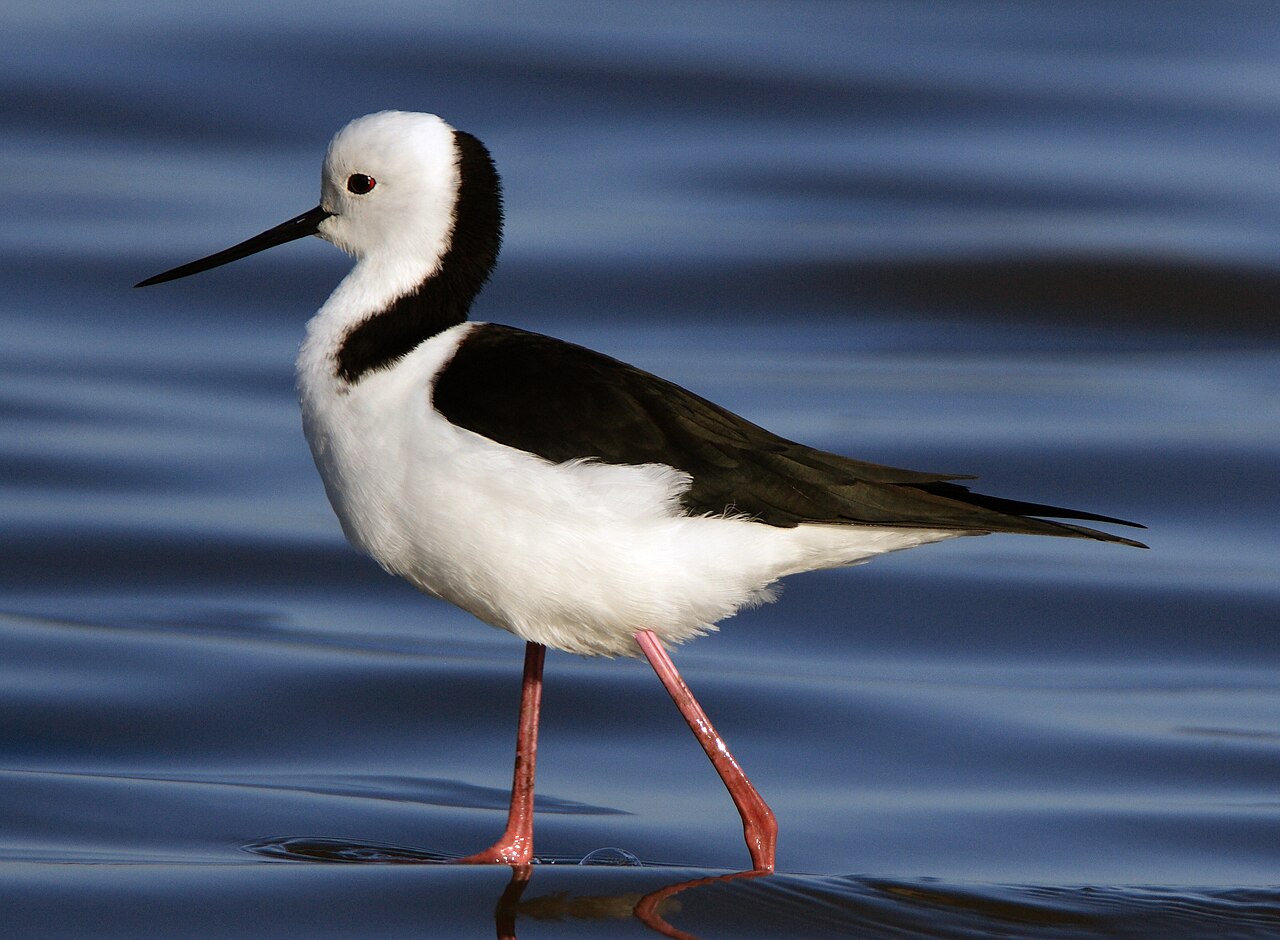
Pied Stilt is the most conspicuous wader on any shallow pool in Australasia: brilliant white with a black back and black wings, set on two absurdly long, deep pink legs. It walks the water in small, deliberate steps, picking insects from the surface. In New Zealand it is a newcomer that settled itself in the nineteenth century and is now the country's commonest wader.
Voice
Very noisy and impossible to miss: a sharp, yapping kik-kik-kik that starts the moment anyone approaches a colony and is best compared to a small dog barking. A flock lifting turns it into a sustained nasal chorus. At the nest it runs into longer, plaintive series, often delivered while the bird hangs above the intruder with its legs dangling.
No freely licensed recording has been found for this species yet; what to listen for is described below.
Identification
A slender, tall wader of thirty-five centimetres whose body is white, with a glossy greenish-black mantle and black wings, and with black on the hindcrown and hindneck carried down as a cap or a broad band. The bill is long, dead straight, needle-fine and jet black; the eye is red. The legs are extravagantly long and bright pink, and project well beyond the tail in flight — the decisive mark in silhouette. The underwing is wholly black. Young birds have a grey-brown mottled hindneck instead of a black one, brown feather edges on the back, and dull pink legs.
Confusion species
Black Stilt (Himantopus novaezelandiae) of the Mackenzie Basin is all black as an adult and so immediately different, but its young birds, and above all the hybrids between the two species, are the real trap: they carry a variable amount of black on breast, belly and flanks and an untidy, irregular cap — a pure Pied Stilt always has a spotless white breast and belly. Banded Stilt (Cladorhynchus leucocephalus) lacks the black hindneck, carries a chestnut breastband, has shorter legs that barely clear the tail, and swims freely, which this species does not. Red-necked Avocet (Recurvirostra novaehollandiae) has a clearly upcurved bill and a chestnut head.
Habitat
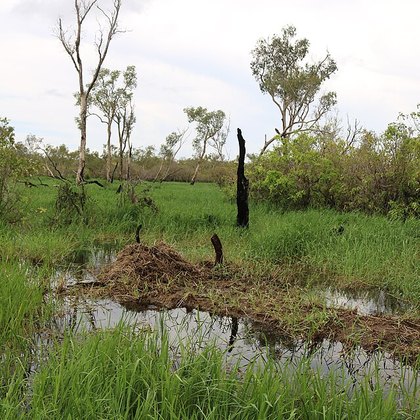
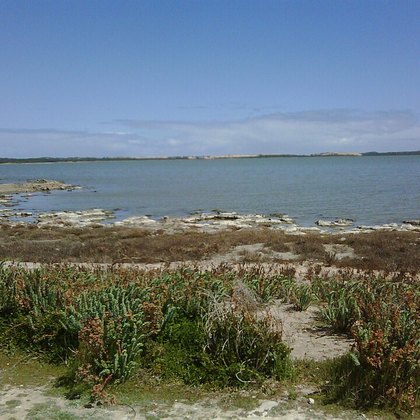
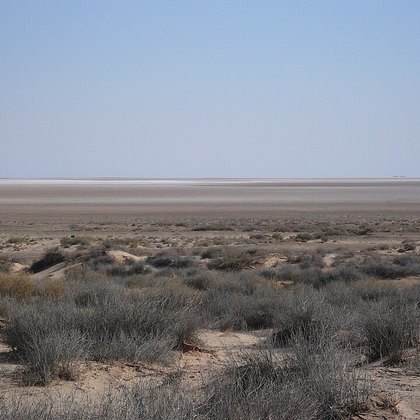
Almost any shallow water: estuaries and tidal flats, saltmarsh, freshwater swamp and reedbed, lakes and reservoirs, claypans that fill after rain, rice fields and sewage ponds. It needs an open muddy edge and water it can stand knee-deep in. It breeds in loose colonies averaging some fifteen pairs on a bare shore or islet, in a scrape built up with plant material as the water rises.
Where the bird is most often found, arranged by main group and formation.


Range and movements
Everywhere in Australia where there is water, from coastal estuaries to far inland, shifting with the rainfall: after good rain stilts appear on interior lakes that held nothing for years. In New Zealand it is common on both main islands, with the largest numbers on estuaries and braided rivers; the country was only colonised under the bird's own power in the nineteenth century, after which the population grew to about thirty thousand. There are a couple of records for Norfolk Island.
- Resident
- dark = core range, pale = thinly spread
Where and when to look
Do not look for it, listen for it: the yapping alarm gives a colony away from hundreds of metres. In any New Zealand flock, watch for birds with black on breast or belly — those are not young Pied Stilts but hybrids or genuine Black Stilts, and such a record is worth passing to conservation staff.
Conservation
Not threatened (LC) and common in both countries. The species actually profits from human water management: sewage ponds, stock dams, rice fields and saltworks supply exactly the shallow, insect-rich water it needs, and unlike many native New Zealand birds it holds its own among the introduced predators. The one place where its success is a problem is the Mackenzie Basin, where through hybridisation it threatens the survival of Black Stilt.
Scientific name
Himantopus leucocephalus | Gould, 1837
Gould described the species in 1837 as Himantopus leucocephalus, and it has stayed in that genus, so author and year carry no parentheses. The genus Himantopus was introduced by Brisson in 1760, from Greek himas, himantos, 'strap' or 'thong', and pous, 'foot', for the thin strap-like legs. leucocephalus means 'white-headed'. Australia stands as the type locality. The bird was long treated as a subspecies of the Old World Black-winged Stilt (Himantopus himantopus); the Maori name is poaka.