All species › Waders, gulls and terns › Stilts and avocets › Banded Stilt
Banded Stilt | Cladorhynchus leucocephalus
Bandsteltkluut | Cigueñuela pechirroja
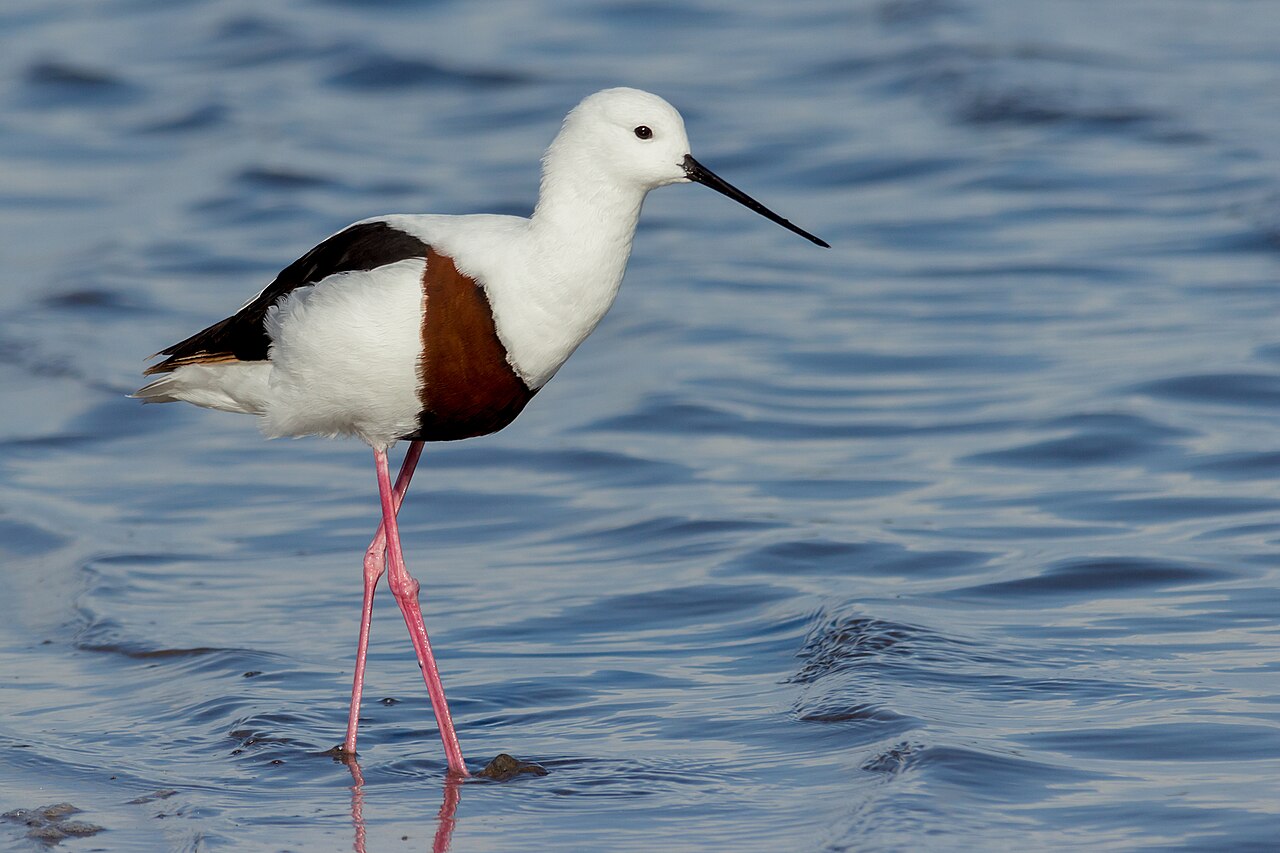
The Banded Stilt is the strangest wader in Australia: a white bird with black wings and a chestnut band across the breast, which spends its life on the coast but breeds only on the salt lakes of the interior, as soon as rain fills them. It does so in colonies of tens of thousands, and years can pass between one breeding event and the next.
Voice
The usual note is a barking chowk, sometimes two-syllabled as chowk-uk, heard above all as a flock takes off or drops in. At the colony thousands of birds chatter softly and tunefully together, a sound that carries across the lake as a steady murmur. A feeding flock on the coast is usually silent.
No freely licensed recording has been found for this species yet; what to listen for is described below.
Identification
A wader of thirty-five to forty-three centimetres, white with black wings and a broad, sharply defined chestnut band lying like an inverted arch across the breast. The bill is black, twice the length of the head and slightly upturned; the legs are red-pink, shorter than in the other stilts and partly webbed. Outside the breeding season the band fades to ashy brown or becomes mottled with white, and the legs pale to orange-pink. Young birds lack the band, have a greyish forehead and duller black wings.
Confusion species
The Pied Stilt (Himantopus leucocephalus) often stands in the same pool: it is longer in the leg, with red legs trailing well beyond the tail, a black hindneck and never a breast band. The Red-necked Avocet (Recurvirostra novaehollandiae) has a clearly upturned bill and a chestnut head and neck rather than a band across the breast. At range the behaviour gives it away: the Banded Stilt feeds in a dense, constantly shifting patch and swims regularly while doing so, which the Pied Stilt does not.
Habitat
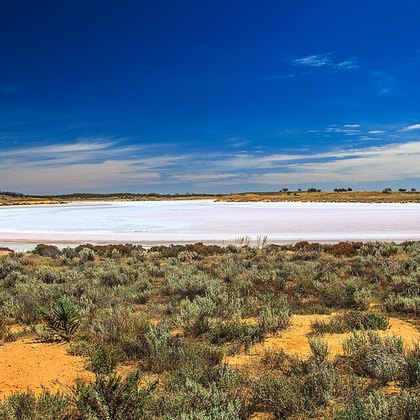
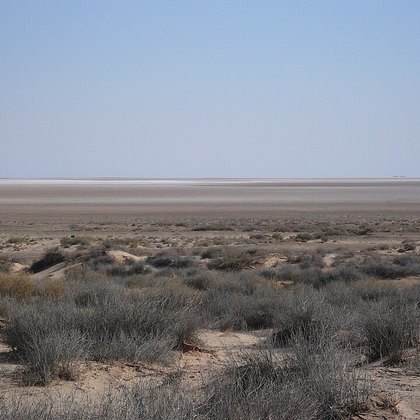
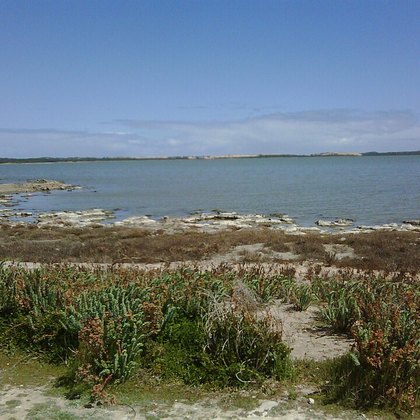
Large, shallow saline and hypersaline waters: ephemeral salt lakes and claypans inland, and on the coast saltworks, lagoons and estuaries. It lives largely on brine shrimp and small water snails, which come up from dry eggs within days of a salt lake filling. It rarely uses fresh water or vegetated shores; it is tied to salt and follows it across the continent.
Where the bird is most often found, arranged by main group and formation.

Range and movements
Southern Australia, from southwestern Western Australia to Queensland and Tasmania, with most birds on the southern coast all year. It breeds only inland, and only when a salt lake such as Lake Eyre, Lake Torrens or Lake Barlee fills: within days tens of thousands of birds appear on the islands — some hundred and fifty thousand at Lake Torrens in July 2010 — and if the lake dries again too soon, nothing at all comes of the attempt. Tracking showed where those birds come from: two flew from a drying Lake Eyre more than fifteen hundred kilometres to a newly filled lake system in Western Australia.
- Resident
- Breeding (summer)
- dark = core range, pale = thinly spread
Where and when to look
Look for it on the coast at saltworks or a coastal lagoon: Dry Creek and the ponds at Price in South Australia, or the lagoon at Lake MacLeod in Western Australia. In a tight flock of white stilts check the breasts — young birds lack the band and outside the breeding season it is vague — and watch for the birds that swim rather than wade.
Conservation
Least Concern (LC) globally, but listed as vulnerable in South Australia. Numbers swing widely, because everything hangs on a few breeding events that can be decades apart. Silver Gulls, which raid the island colonies, count as the heaviest threat, and on some lakes they are controlled for that reason; beyond that, water extraction and the rain itself decide whether a breeding event succeeds.
Scientific name
Cladorhynchus leucocephalus | (Vieillot, 1816)
Vieillot described the species in 1816 as Recurvirostra leucocephala, among the avocets; it has since stood in a genus of its own, so author and year sit in parentheses. The genus Cladorhynchus was introduced by Gray in 1840, after Greek klados, 'twig', and rhynchos, 'bill', for the thin, slightly curved bill. leucocephalus means 'white-headed'. The description gives only the 'Terres Australes' as the source; Mathews fixed the type locality as Victoria.