All species › Waders, gulls and terns › Thick-knees and stone-curlews › Beach Stone-Curlew
Beach Stone-Curlew | Esacus magnirostris
Rifgriel | Alcaraván picogrueso australiano
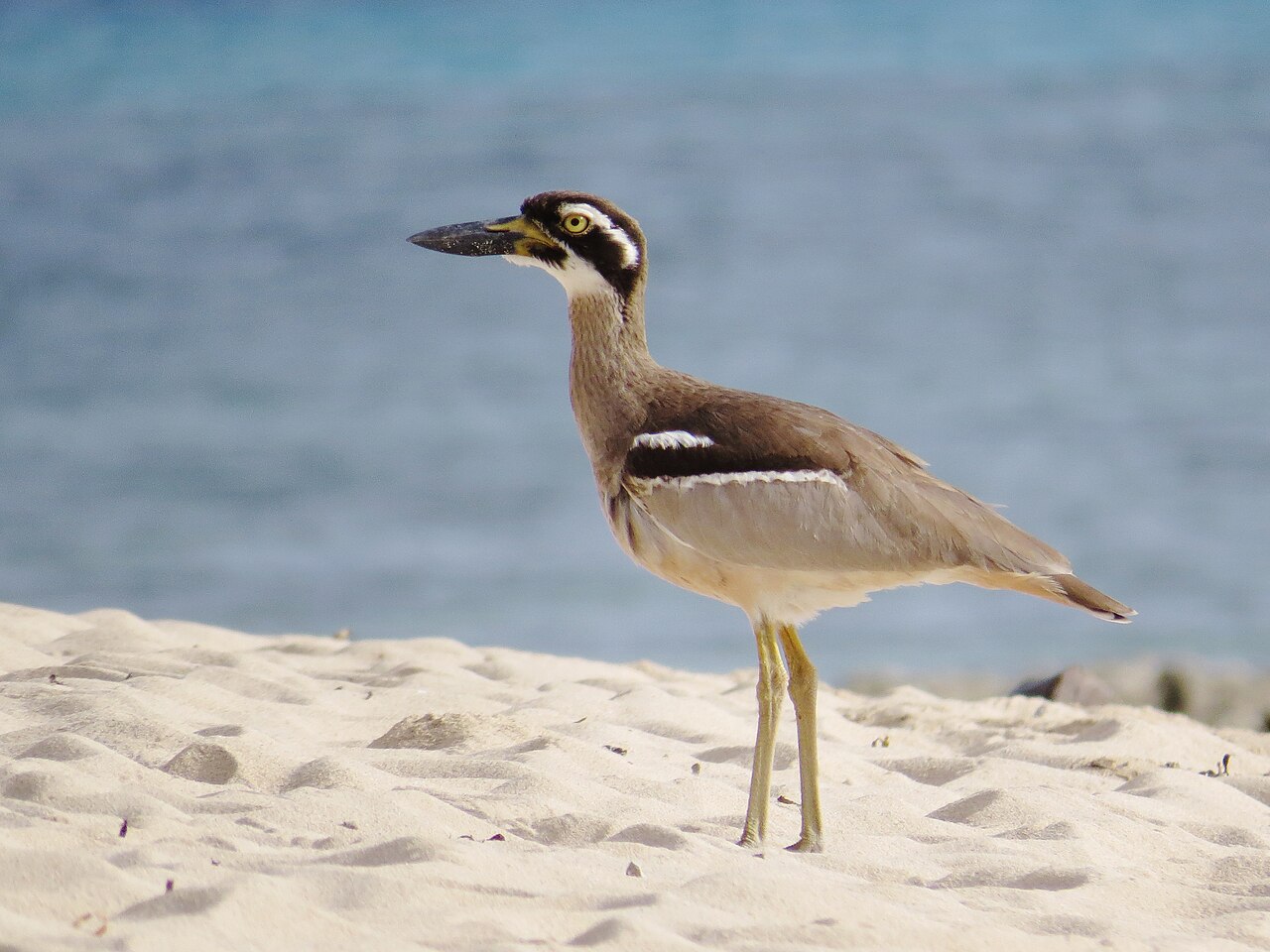
The Beach Stone-Curlew is the heaviest wader of the tropical coast: a large, pale bird with an enormous bill, a black-and-white face pattern and a big yellow eye. It stands motionless on a sandbar or a reef flat for most of the day, and a pair holds the same stretch of shore all year.
Voice
At night it gives a mournful, rising whistle that carries over the water, with silences of minutes between calls; pairs answer each other across the whole width of a river mouth. When disturbed it warns with a short, hoarse chwip-chwip, repeated as it walks away. By day it is usually silent.
Recording: Mike FitzGerald — CC BY-NC-SA 4.0 · Richmond River Nature Reserve (near South Ballina), Ballina Shire, New South Wales, Australia · xeno-canto
Identification
A stone-curlew of fifty-four to fifty-six centimetres, grey-brown on back and breast and white on the belly, on long yellow-grey legs. The bill is exceptionally heavy, black with a yellow base, and the face is patterned black and white: a black mask through the eye, a white stripe below it and a white forehead patch. The eye is large and yellow, that of a bird which hunts by night as well. A pale shoulder stripe shows on the closed wing, and in flight bold black and white panels light up. Young birds are more washed out.
Confusion species
The Bush Stone-Curlew (Burhinus grallarius) comes onto the same northern beaches and is much the same length, but is slimmer, streaked grey-brown throughout, with a far thinner bill and a smaller head. Its call is a long, wailing whistle that swells, where the Beach Stone-Curlew sounds shorter and hoarser. At range a standing stone-curlew can suggest an oystercatcher or a curlew; the massive bill and the upright, high-standing posture settle it at once.
Habitat
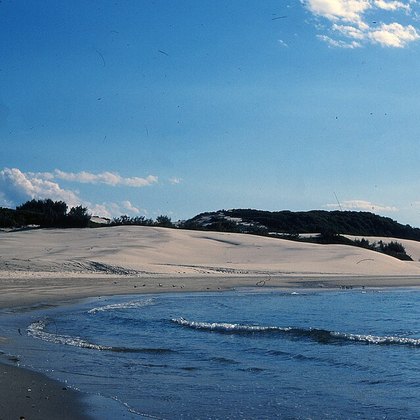
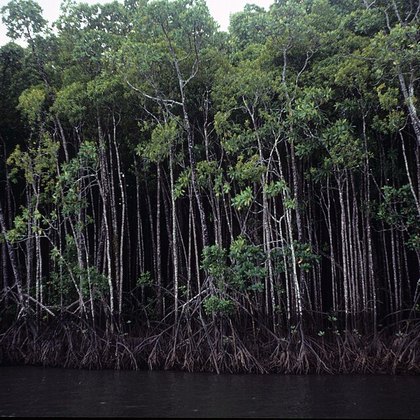
Undisturbed beaches, sandbars and reef flats exposed at low tide, and the muddy mouths of creeks among the mangroves. It lives largely on crabs, which it breaks open with the heavy bill, and roosts at high tide on a sandbar or under an overhanging tree. It avoids beaches with vehicles and loose dogs; its presence is a measure of how quiet a coast is.
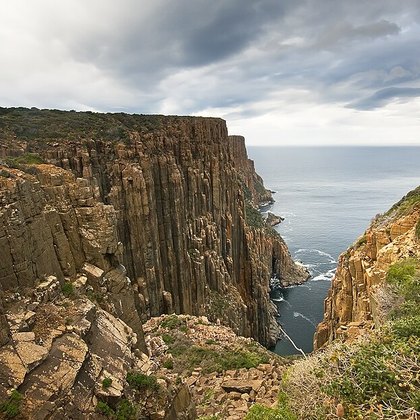
Where the bird is most often found, arranged by main group and formation.

Range and movements
The tropical and subtropical coast of Australia, from the Kimberley along the north to Queensland and south to far eastern Victoria, and beyond that from the Andamans through southeast Asia to New Guinea and the Solomons. It does not migrate: a pair holds the same territory all year, so occupied river mouths can be counted. In New South Wales, the southern limit of the range, a survey in 2003 found thirteen adults left at eight river mouths.
- Resident
- dark = core range, pale = thinly spread
Where and when to look
Go at low tide to the sandbar at the mouth of a northern river and look for a large pale bird standing still; it gives itself away by bulk rather than by movement. Keep your distance — it walks or flies off before you have it properly in view — and watch from a boat or from behind the foot of the dune.
Conservation
Near Threatened (NT), and critically endangered in New South Wales, where only about ten pairs still breed. The nest is a scrape just above the tideline, and everything that threatens the species meets there: four-wheel drives, loose dogs, foxes and feral pigs, coastal building and recreation in the September to November breeding season. The Australian total is regarded as stable, but the southern edge is crumbling.
Scientific name
Esacus magnirostris | (Vieillot, 1818)
Vieillot described the species in 1818 as Oedicnemus magnirostris; because it was later placed in another genus, author and year stand in parentheses. The genus Esacus was introduced by Lesson in 1831, after Aesacus, a son of King Priam of Troy who in the tales was turned into a diving bird. magnirostris means 'large-billed', which is exactly the field mark. No locality was given with the description; Australia stands as the type locality.