All species › Waders, gulls and terns › Thick-knees and stone-curlews › Bush Stone-curlew
Bush Stone-curlew | Burhinus grallarius
Australische griel | Alcaraván colilargo
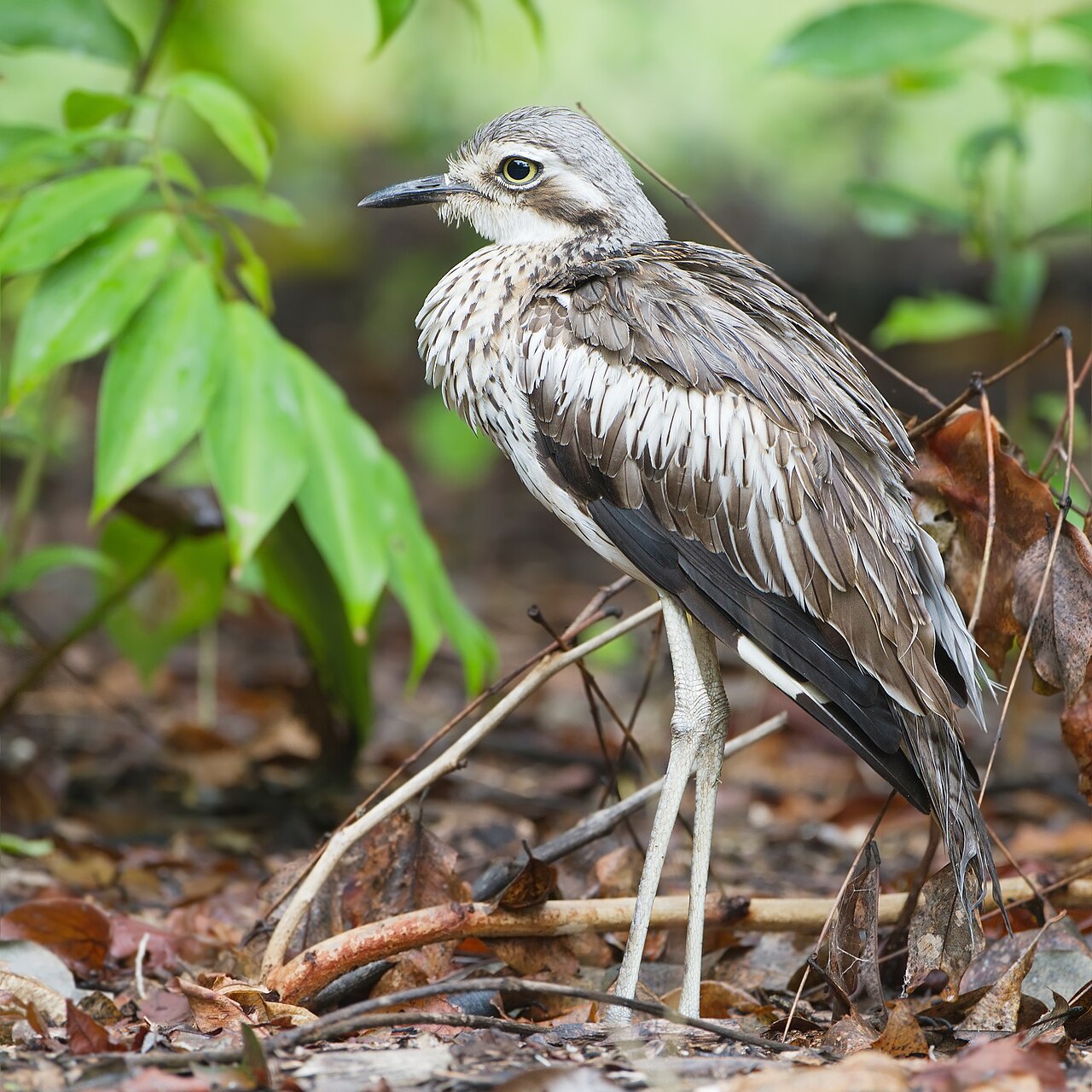
Bush Stone-curlew is the night bird of Australia's open woodland: a slim, long-legged wader with an enormous yellow eye, a streaked grey-brown plumage and a shy, motionless manner. By day it stands or lies still among fallen branches and leaf litter, where it is all but invisible; by night it walks the woodland after insects and lizards, and then its wailing call gives it away for kilometres.
Voice
The most famous night sound of rural Australia: a long drawn-out, mournful whistle that rises slowly in pitch and then falls away, wer-loo-oo, usually started shortly after sunset and answered by other birds around until a chorus builds. At the height of a display night it turns into a shrill, almost screaming outburst. Disturbed, it gives a short hard chak. The display itself is a dance with wings spread, tail raised and feet stamping in unison, loudly accompanied.
No freely licensed recording has been found for this species yet; what to listen for is described below.
Identification
A slim, upright bird of well over half a metre, grey-brown above with black and rufous streaks, whitish below with sharp vertical black streaks running like a barcode across the breast. The head carries a broad white eyebrow over a dark eye-stripe, and the eye itself is large, bright yellow and ringed with bare black skin. The bill is small, straight and black. The legs are long and olive-green to dull yellow, with clearly thickened heel joints — the 'thick knees' that give the family its other English name. In flight, which it puts off as long as it can, the long broad wings with bold black-and-white patches on the primaries are surprisingly wide. The sexes look alike; young birds are paler and browner.
Confusion species
The other stone-curlew of this region, the coastal Esacus magnirostris, reaches the same beaches in the north and is nearly the same length, but is far more heavily built: it has a massive thick bill, a black-and-white patterned face instead of a streaked plumage, and never leaves beach, flat or reef platform. Its call is shorter and harsher than the long wail of this species. At distance a standing bird can suggest a curlew, but the bill here is small and straight rather than long and curved. A crouching bird in grass is regularly taken for a nightjar; the long legs and the yellow eye rule that out.
Habitat
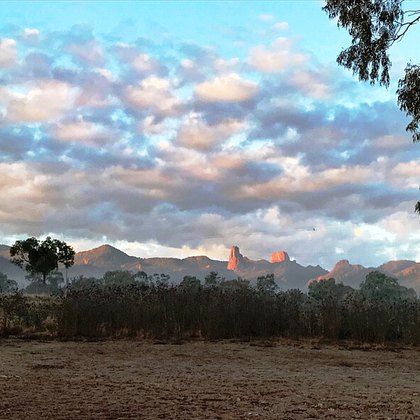
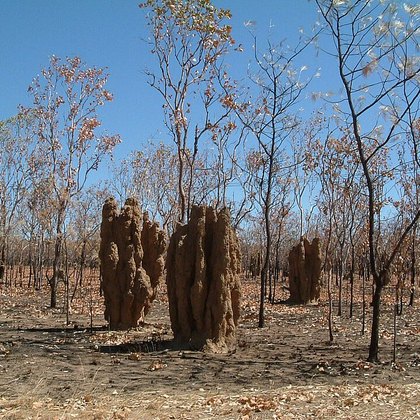
Open eucalypt forest and woodland with a short, sparse understorey and above all plenty of fallen branches, stumps and leaf litter — that clutter on the ground is essential to it, because that is what it disappears into by day. Beyond that, eucalypt savanna, riverine woodland along creeks, the edges of monsoon forest and mangrove, and in Queensland also man-made versions: golf courses, cemeteries, school grounds and parks with old trees. The nest is no more than a bare patch of ground, often beside a fallen branch.
Where the bird is most often found, arranged by main group and formation.


Range and movements
Nearly the whole Australian mainland, with an outlier in southern New Guinea. It is still common in the tropical north — Queensland, the Northern Territory and the Kimberley — but in the south-east and south it has become rare and fragmented. From the Cumberland Plain around Sydney it has gone altogether. It is absent from Tasmania and from much of the Western Australian coast, and it does not reach New Zealand.
- Resident
- dark = core range, pale = thinly spread
Where and when to look
Do not search for it by day with binoculars, but by ear in the evening: stand in a clearing at sunset and wait for the wailing whistle. To see it, drive a country road slowly after dark and watch for two glowing eyes in the beam — the reflection is a fierce orange-red. If you find a motionless bird by day, keep your distance: it trusts its camouflage completely and would rather not leave its nest.
Conservation
Not threatened globally (LC), with an estimated ten to fifteen thousand adults, but that figure hides a sharp north-south divide. In the north it does well; in the south-east its range has shrunk by an estimated ninety per cent and the species is listed as endangered in New South Wales and Victoria and as vulnerable in South Australia. The causes are the fox and the feral cat, which find a nest on bare ground easily, the clearing of dead wood and leaf litter from paddocks and parks, and the conversion of open woodland to crop and pasture. Reintroductions into fenced sanctuaries in Victoria and New South Wales do succeed, which shows that the bottleneck lies with the predators and not with the food.
Scientific name
Burhinus grallarius | (Latham, 1801)
Latham described the species in 1801 as Charadrius grallarius, among the plovers; the later move to another genus puts author and year in parentheses. The genus Burhinus was introduced by Illiger in 1811, from Greek bous, 'ox', and rhis, rhinos, 'nose', for the large nostrils in the heavy bill. grallarius comes from Latin grallae, 'stilts', and means something like 'the one on stilts'. The type locality is New South Wales.