All species › Passerines › Woodswallows, bellmagpies and allies › Pied Butcherbird
Pied Butcherbird | Cracticus nigrogularis
Zwartkeelorgelvogel | Verdugo gorjinegro
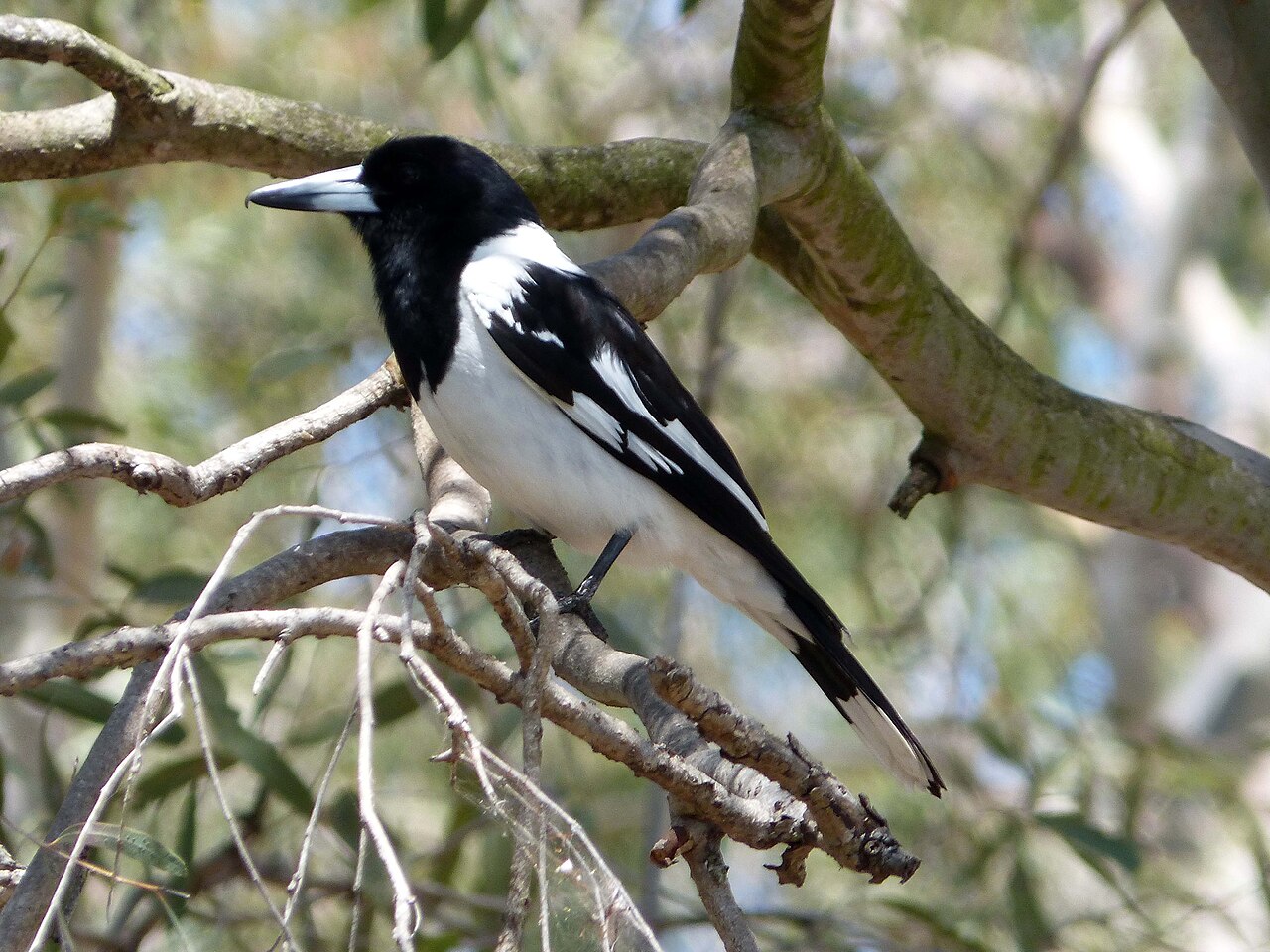
The Pied Butcherbird counts for many Australians as the finest songster on the continent: a black-and-white bird with a heavy blue-grey bill that rolls long, pure flute notes across the woodland from a bare branch, sometimes by moonlight. The Dutch name orgelvogel refers to that sound; the English name to its habit of wedging prey in a thorn or a fork of a branch.
Voice
The song is built of slow, glass-clear flute phrases with long pauses, starting low and then climbing, often in duet or in chorus with the whole family group. There is no continent-wide melody: every district, sometimes every group, holds a repertoire of its own that shifts from year to year. Alongside it come a soft murmuring subsong and a harsh warning rasp. It sings at first light, at dusk, and on clear nights.
No freely licensed recording has been found for this species yet; what to listen for is described below.
Identification
A heavy songbird of 28 to 32 centimetres with a wholly black hood over head, nape and throat, running on as a broad bib onto the upper breast. Below that the bird is clean white, with a white collar separating the black hood from the black mantle; wing and tail are black and white, the tail white-tipped. The bill is heavy, pale blue-grey with a black hooked tip. Young birds are a scruffy brown where the adult is black.
Confusion species
Grey Butcherbird (Cracticus torquatus) is smaller, has a grey back and only a black cap with a white throat below it — no continuous black bib. Black-backed Butcherbird (C. mentalis) of Cape York is smaller and lighter built, with a narrower white collar and far less black on the throat. Black Butcherbird (Melloria quoyi) is all black. Australian Magpie (Gymnorhina tibicen) is larger, with a white nape and back and a red-brown eye.
Habitat
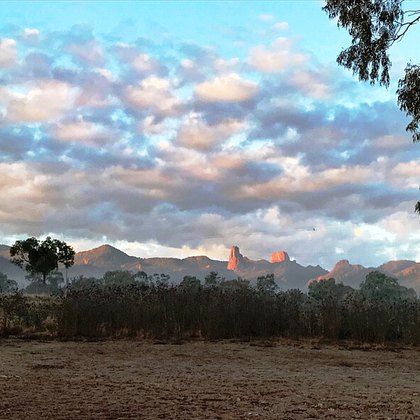
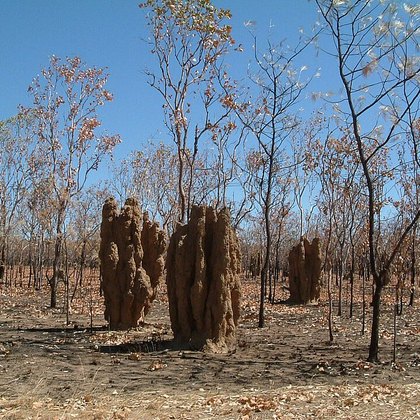
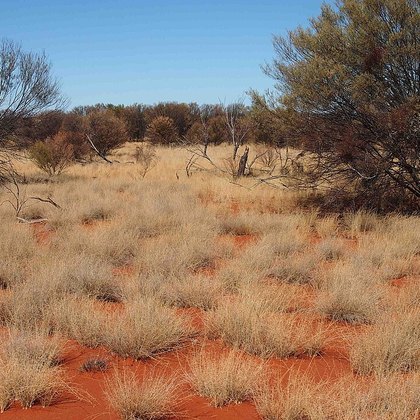
Open eucalypt forest and woodland with little understorey, eucalypt savanna, mulga and other acacia scrub, and anywhere perches and open ground meet: farmyards, roadsides, parks, campgrounds and inland gardens. It hunts from a low branch and drops onto the ground or takes prey in the air. Dense closed forest it avoids.
Where the bird is most often found, arranged by main group and formation.

Range and movements
Almost all of mainland Australia, except Tasmania, the far south and the wettest coastal strips. Two subspecies: nigrogularis in the east and picatus in the Northern Territory, Western Australia and northern South Australia, which has a broader white collar and a paler rump. Sedentary: territorial pairs and family groups hold the same ground all year.
- Resident
- dark = core range, pale = thinly spread
Where and when to look
Go by ear in the first twenty minutes after sunrise — one bird on a bare branch gives away the whole group. Where Grey Butcherbird is possible, check the throat: black running unbroken onto the breast means this species. Search thorn branches, tree forks and barbed wire for a larder with a lizard or grasshopper wedged in place.
Conservation
Least Concern (LC). The species is common and does well on open, half-shaded country: farmyards, stock troughs and planted street trees have widened its range rather than narrowed it. It breeds cooperatively, older young helping the pair to feed, which makes the group resilient. It is sensitive, though, to the complete removal of old trees with hollows and heavy lateral limbs.
Scientific name
Cracticus nigrogularis | (Gould, 1837)
Gould described the species in 1837 as Vanga nigrogularis; the later move to Cracticus puts author and year in parentheses. The type locality is in New South Wales. Cracticus is from Greek kraktikos, 'noisy', and nigrogularis from Latin niger, 'black', and gula, 'throat' — black-throated, the very mark the Dutch name also picks out.