All species › Parrots › Old World parrots › Red-collared Lorikeet
Red-collared Lorikeet | Trichoglossus rubritorquis
Roodhalsregenbooglori | Lori cuellirrojo
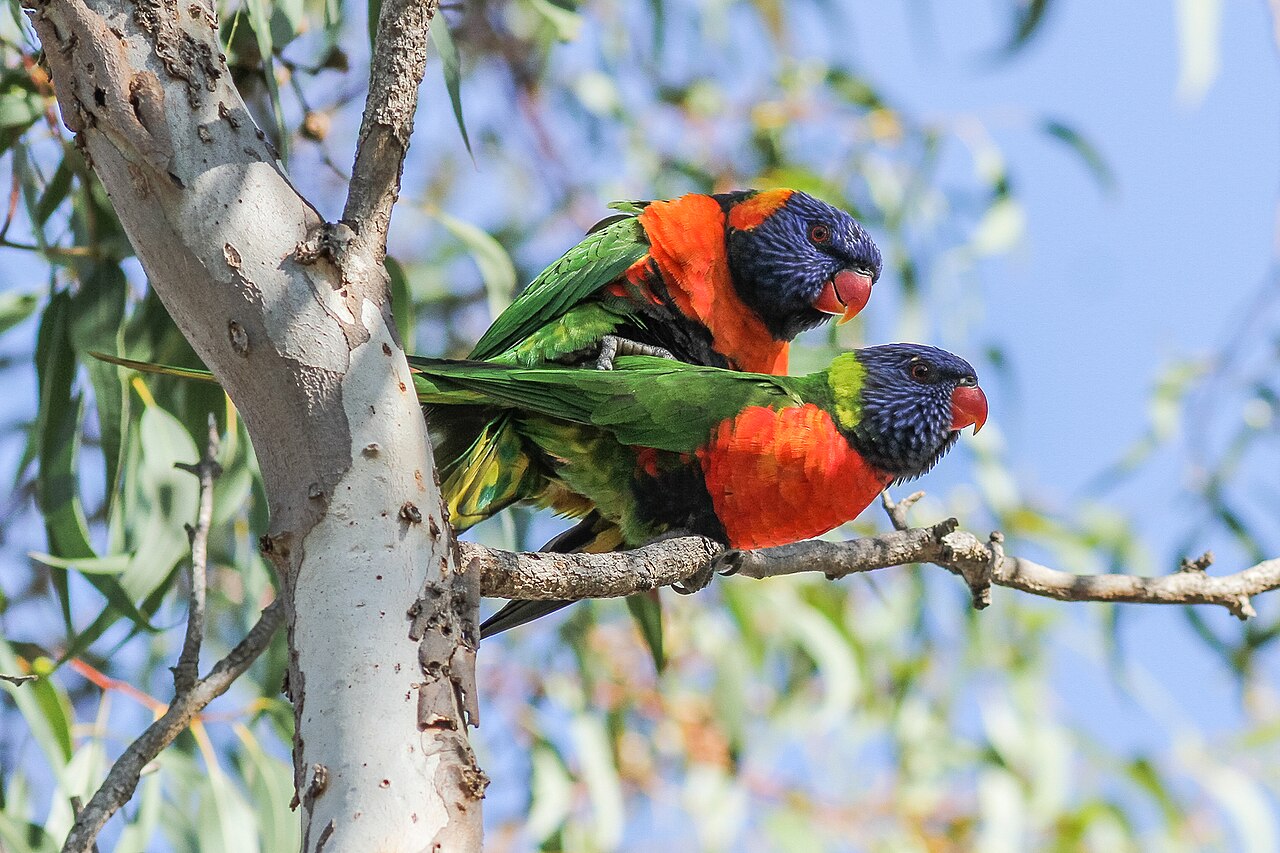
The Red-collared Lorikeet is the rainbow lorikeet of tropical northern Australia: a large, vivid bird with a dark blue head, a broad orange-red collar on the nape and a black belly. In Darwin and across the Kimberley it is one of the commonest and noisiest birds, and until 1997 it was still carried as a subspecies of the Rainbow Lorikeet.
Voice
A shrill rolling screech given without pause in flight, practically inseparable from that of the Rainbow Lorikeet: a hard kweet-kweet with drawn-out hoarse cries between. At the roost, often a line of palms or mangoes in the middle of a town, hundreds of birds build a deafening, swelling chorus in the last half hour before dark. Feeding birds keep up a soft high chatter and grating.
No freely licensed recording has been found for this species yet; what to listen for is described below.
Identification
Twenty-six to thirty-one centimetres and a hundred to a hundred and forty grams, with a pointed tail and a bright red bill. The head is dark violet-blue with fine pale blue shaft streaks; behind it lies the key to the species: a broad orange-red collar across the nape, scalloped black along its lower edge, with a dark blue base to the hindneck below it. The breast is bright orange-red, the belly black to very dark, the vent green scalloped with yellow, and the underwing coverts red. Mantle, wings and tail are green. Sexes alike; juveniles duller with a brown-black bill.
Confusion species
This is the central confusion of the whole lorikeet group: Rainbow Lorikeet (Trichoglossus moluccanus) is the same size and shape, but has a green-yellow rather than orange-red nape band and a deep blue-purple rather than black belly, and its breast is more strongly barred blue-black. The two meet around the Gulf of Carpentaria and in north-western Queensland, where intermediates with a part-red, part-yellow collar occur — in that contact zone not every bird can be named. Varied Lorikeet (Psitteuteles versicolor) shares the whole range but is barely more than half as long, green with yellow streaks and with a red crown rather than a blue head. Scaly-breasted Lorikeet (Trichoglossus chlorolepidotus) does not occur here.
Habitat
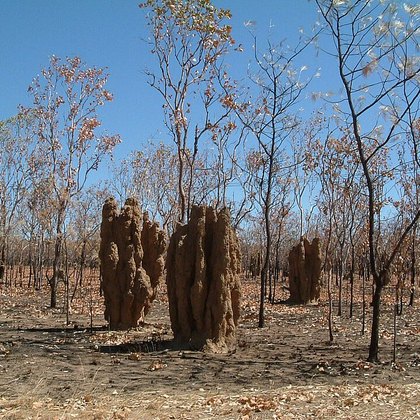
Eucalypt savanna and open tropical forest are the core, with the flowering of Darwin Woollybutt and Darwin Stringybark the annual high point. Beyond that it uses monsoon forest and vine thicket, gallery forest along creeks, flowering melaleuca swamps and the edge of mangrove. In Darwin, Katherine, Kununurra and Broome it is an everyday bird of streets, parks and gardens, coming to flowering African Tulip Trees, coconut palms and mangoes.
Where the bird is most often found, arranged by main group and formation.


Range and movements
Tropical northern Australia: from King Sound and the Kimberley in Western Australia through the Top End of the Northern Territory to the Gulf of Carpentaria and north-western Queensland. The southern limit runs roughly from the southern tip of the Gulf to the headwaters of the Fitzroy. It does not migrate but wanders hundreds of kilometres after the blossom, so numbers in any one town swing sharply between seasons. On the eastern side of its range it abuts the Rainbow Lorikeet.
- Resident
- dark = core range, pale = thinly spread
Where and when to look
In Darwin, stand by a line of street palms half an hour before sunset: the birds come in to roost in parties of dozens, and at that moment you get exactly what you need from below — the red underwing and the black belly. On every lorikeet check the nape first: the broad orange-red panel reads even in poor light. Travelling along the Gulf of Carpentaria, note both collar and belly colour when in doubt, because hybridisation with the Rainbow Lorikeet is a real possibility there.
Conservation
Not threatened (LC): the species is common to very common in the north and has if anything gained from urban planting of flowering trees, so that Darwin carries one of the densest populations. Changed fire regimes in the savanna do bear on the old hollow-bearing eucalypts it nests in: fires that are too frequent and too hot leave fewer hollow trees standing. Birds are also lost locally to vehicles and to illegal trapping for the cage-bird trade, for which its colours make it attractive.
Scientific name
Trichoglossus rubritorquis | Vigors & Horsfield, 1827
Vigors and Horsfield described the bird in 1827 as Trichoglossus rubritorquis, in the Transactions of the Linnean Society of London; it remains in that genus, so authors and year carry no parentheses. The type locality is given as ‘Australia’ and was fixed by Mathews on Derby in north-western Australia. The epithet is Latin: ruber, ‘red’, and torquis, ‘collar’ — precisely the mark you identify it by. The genus Trichoglossus was introduced by Stephens in 1826, from Greek thrix, trikhos, ‘hair’, and glōssa, ‘tongue’. Until 1997 the bird was treated as a subspecies of the Rainbow Lorikeet; work on mitochondrial cytochrome b gave it species status, which AviList v2025b upholds.