All species › Passerines › New Zealand wrens › Rifleman
Rifleman | Acanthisitta chloris
Geweervogel | Acantisita verdoso
At seven to nine centimetres and six grams the Rifleman is the smallest bird in New Zealand: a ball with almost no tail, a thin upturned bill and a white eyebrow. It climbs trunks and branches in a spiral, hanging upside down as it goes, and is in motion almost without pause. It is one of the last two New Zealand wrens; the other members of that family are gone.

Voice
The sound is a very high, short and simple zip, pip or chuck, given by both sexes and repeated almost without a break while foraging. Many of those contact notes lie so high that human ears catch them poorly or not at all, which makes the bird less conspicuous than it really is. Alarm brings a rapid high series that falls away in strength. There is no song worth the name: it is a continuous rustle of short notes.
No freely licensed recording has been found for this species yet; what to listen for is described below.
Identification
A minute bird with a short, upturned, sharply pointed black bill, long toes and a tail that is little more than a stub. The male is bright green on head and back, the female largely yellow-brown with dark speckling on head and mantle; both are pale grey below, with a white eyebrow and a pale wing bar. The female is larger than the male, which is unusual in birds this small. Young birds resemble the female. In flight it is no more than a whirring dot shooting from one trunk to the next.
Confusion species
Grey Gerygone (Gerygone igata) lives in the same forest and is just as light, but grey-brown, with a red eye, a far longer tail and a long trilling song; it hovers at the leaf instead of climbing the trunk. New Zealand Rockwren (Xenicus gilviventris) is the nearest relative but sits above the bushline among scree, with longer legs and yellow flanks. Silvereye (Zosterops lateralis) is larger and has a white eye-ring. A small bird spiralling up a trunk and hanging upside down as it does so is, in New Zealand, this species.
Habitat
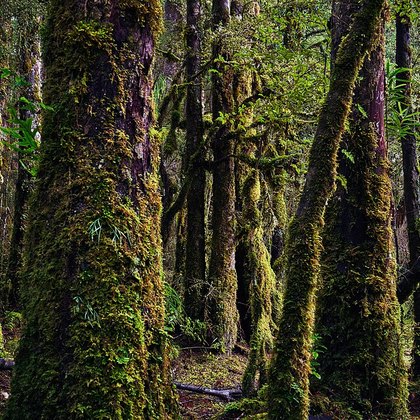
Old, closed forest: beech, kauri, kamahi and podocarp forest with a dense understorey and plenty of dead wood. It forages through the whole height of the forest, from the base of the trunk into the crown, taking small invertebrates from bark, moss and dead wood. It nests in an existing cavity — a split in the bark, a hole in a dead trunk, a hollow among roots — building an enclosed, spherical nest inside it. In most places it now holds mainly to the higher forest.
Where the bird is most often found, arranged by main group and formation.


Range and movements
Endemic to New Zealand and present on both main islands, but with a very uneven picture. The North Island subspecies is patchy in the eastern ranges south to the Remutakas, on the central plateau at Pureora and Tongariro, and in relict populations in Warawara Forest in Northland, on Little Barrier Island and on Taranaki. On the South Island the bird is widespread through the west, on Banks Peninsula and in the seaward Kaikoura ranges. On Stewart Island it is scarce, except on Codfish Island. It is sedentary and moves little.
- Resident
- Breeding (summer)
- dark = core range, pale = thinly spread
Where and when to look
Stand in old beech forest where it is quiet and listen for the constant high ticking; the bird gives itself away by sound long before it does by movement. Then look not at the crown but at the trunks at eye level, and follow the movement upward: it starts low and works its way up in a spiral. Anyone who cannot hear the call should watch for the family party — there are often three or four birds working the same trunk one after the other.
Conservation
Not threatened (LC) on the world list, and not threatened within New Zealand for the South Island; the North Island form is ranked there as at risk, declining. Clearance of lowland forest has pushed it back to higher remnants, and introduced predators, stoats above all, empty nests out of their cavities. Where predators are controlled at scale the species recovers quickly, because it breeds in family groups and raises two broods in a season.
Scientific name
Acanthisitta chloris | (Sparrman, 1787)
Sparrman described the species in 1787 as Sitta chloris; because it was later moved to another genus, author and year stand in parentheses. The genus Acanthisitta was introduced by Lafresnaye in 1842 and joins the Greek akanthis, a small bird, to sitta, the nuthatch, after its climbing habits. The epithet chloris means greenish yellow. The original description gives the Cape of Good Hope as the locality, an error: the specimen came from Queen Charlotte Sound on the South Island. The English name Rifleman goes back, on the usual explanation, to the resemblance of the plumage to the uniform of a colonial rifle regiment; the Maori name is titipounamu.