All species › Passerines › New Zealand wrens › New Zealand Rockwren
New Zealand Rockwren | Xenicus gilviventris
Rotswinterkoning | Acantisita roquero
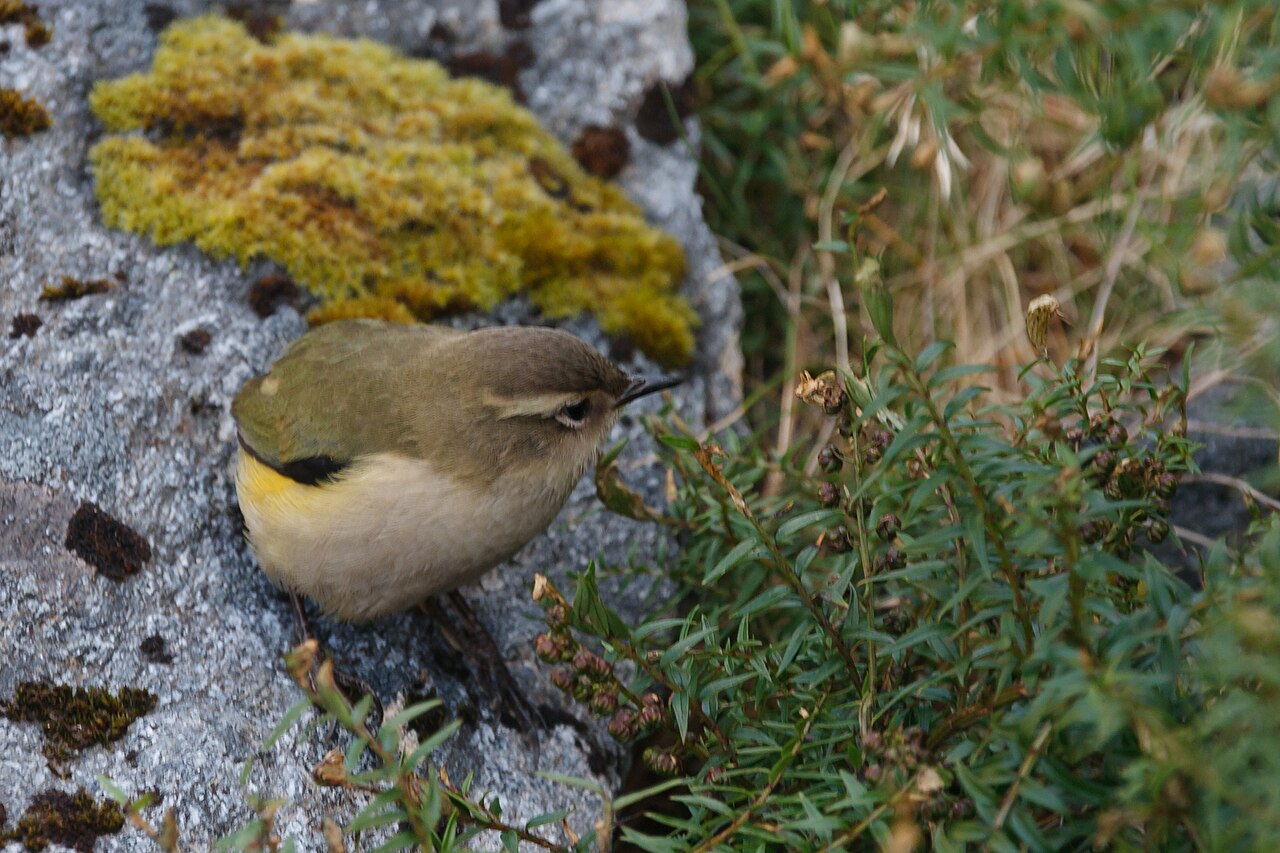
The New Zealand Rockwren is the only bird in New Zealand that stays above the treeline all year: an almost tailless ball of less than twenty grams living among the boulderfields and rock crevices of the Southern Alps, including when they lie under snow. It is also a living relic — with the Rifleman, the last of a bird family older than any other songbird group in the world. That same species is now listed as endangered, for its ground nest is defenceless against the stoats and mice that have reached the mountains.
Voice
Very high, thin and soft: three or four short reedy tzit notes, sometimes run together in a short series. The sound is easily lost in the wind of the high country and lies so high that older ears no longer pick it up, which means the species is often missed where it is simply present. There is no exuberant song; most of what one hears are contact notes between partners working a boulderfield together. Once the pitch is known the bird is heard before it is seen, but it remains a sound that demands concentration.
Recording: Nicholas Allen — CC BY-NC-SA 4.0 · Fiordland National Park, Southland District, Southland, New Zealand · xeno-canto
Identification
Nine to ten centimetres, but with the tail all but absent it looks more like a round pellet than a bird. The legs are strikingly long and the toes large, and the bird bobs and bows without stopping, sinking at the knees — that bobbing is the first thing to register at a distance. The male is olive-green above with bright yellow flanks and grey-white underparts; the female is duller and more olive-brown, with the same yellow flanks. Both have a pale yellowish brow and a fine straight bill. The flight is weak and fluttering and rarely covers more than a few tens of metres; the bird prefers to move by bounding over the stones and disappears into a crevice at any alarm.
Confusion species
Within the alpine zone no second bird looks like this. Rifleman (Acanthisitta chloris), the only living relative, is smaller and lighter still, has a short but visible tail, flicks that tail instead of bobbing at the knees, and stays in forest below the treeline; the two seldom meet. A Silvereye (Zosterops lateralis) straying high on passage has a white eye-ring and a normal tail. The extinct Bushwren (Xenicus longipes), which survived into the nineteen-seventies, closely resembled this species but lived in forest; anyone assessing old records must allow for that. In practice the combination of no tail, long legs and the ceaseless bobbing settles it.
Habitat
Alpine herbfield and rock terrain above the treeline, roughly between nine hundred and two thousand metres, with a preference for boulderfields, scree and rock crevices where low alpine shrubs and cushion plants grow between the stones. The stones themselves are indispensable: they hold the shelter, they hold the nest, and beneath them cavities stay clear of snow in winter and give the bird somewhere to forage. Ground that is all grass or all bare rock is too poor; the species needs the transition, where rock, shrub and herbfield run into one another. In winter it does not leave but lives on in the spaces under the snow layer.
Where the bird is most often found, arranged by main group and formation.


Range and movements
Confined to the South Island of New Zealand, along the spine of the Southern Alps: from Kahurangi and north-western Nelson south over the central Alps into Fiordland. There is no migration and no seasonal movement of consequence, beyond birds dropping a little lower in hard winters. The distribution has withdrawn from the north and from the margins over the course of the twentieth century and now consists of a run of strongholds along the main divide. In addition there are translocated populations on predator-free islands in Fiordland, established as insurance against loss on the mainland.
- Breeding (summer)
- dark = core range, pale = thinly spread
Where and when to look
Search above the treeline on boulderfields and stony slopes with low shrubs between, and watch not for birds in flight but for movement among the stones. Sit down and wait: the bird works a boulderfield systematically and reappears of its own accord, often much closer than expected. The nodding, bowing bob is recognisable at fifty metres even before the colour can be made out. Because the voice is so high and soft, it pays to settle in a sheltered spot behind a boulder rather than to keep walking.
Conservation
Endangered (EN), and placed in the highest threatened categories of the New Zealand national threat listing. The cause is single and well understood: the bird nests in an enclosed nest in a rock crevice or under a stone, sits for a long incubation and rarely leaves, and is thereby easy prey for stoats and rats. Mice are a second and underrated problem; a heavy beech seed year is followed by an explosion of mice and then of stoats above the treeline, and it is precisely in those years that whole broods are lost. Management consists of large-scale predator control by trapping and by aerial application in the key areas, and of moving birds to predator-free islands in Fiordland, where populations have now established. In the longer term there is also the rising treeline under a warming climate, which shrinks the alpine zone from below.
Scientific name
Xenicus gilviventris | Pelzeln, 1867
August von Pelzeln described the species in 1867 from material out of the South Island mountains. The genus name Xenicus goes back to Ancient Greek xenikos ('strange, foreign'), a name nineteenth-century ornithologists gave to birds that would not fit anywhere — and it was well chosen, for the family Acanthisittidae, the New Zealand wrens, turns out to be the branch that split off first of all the passerines, before the division between the oscines and the suboscines. Of that whole ancient line two species remain: this one and the Rifleman (Acanthisitta chloris); the Bushwren (Xenicus longipes) went in the twentieth century and Lyall's Wren (Traversia lyalli) at the end of the nineteenth. The epithet gilviventris is formed from Latin gilvus ('pale yellow') and venter ('belly'). The English New Zealand Rockwren, the Spanish acantisita roquero and the Dutch rotswinterkoning all take the rock country; the word wren is a likeness and not a relationship, for this bird has nothing to do with the wrens of the northern hemisphere.