All species › Passerines › Pittas › Papuan Pitta
Papuan Pitta | Erythropitta macklotii
Papoeapitta | Pita de Nueva Guinea
The Papuan Pitta is a boldly patterned, short-tailed ground bird of the rainforest, with a bright red belly, a broad blue breast band and an orange-rufous hindcrown. It belongs to New Guinea and the Aru Islands, and reaches Australia only at the very tip of Cape York and on the islands of Torres Strait. Since the split of the Red-bellied Pitta it stands there as a breeding bird in its own right, not as a stray from elsewhere.

Voice
A soft, two-syllable whistle given from the forest floor at long intervals, its direction deceptive: the bird is seldom where the sound seems to come from. It calls mostly in the first hour after sunrise and late in the afternoon, and most often after rain. For the rest of the day it stays largely silent. When disturbed it gives a short, sharp chak.
No freely licensed recording has been found for this species yet; what to listen for is described below.
Identification
Sixteen to eighteen centimetres, a compact bird on long legs with a short tail and an upright stance. Crown, face and throat are dark, set against a bright orange-rufous hindcrown and nape; the ear-coverts have a blue wash and the mantle and back are dark green. A broad, glossy blue band crosses the breast, with a variable black band below it, and the belly is bright scarlet. The female is duller, with less blue on the breast. Young birds are brown above, with a dull blue rump and tail, and still largely lack the red.
Confusion species
The Noisy Pitta (Pitta versicolor) breeds in the same country, green above with a chestnut crown and yellow-green underparts, and noticeably larger; its range barely touches that of the Papuan Pitta at the tip of Cape York. The Rainbow Pitta (Pitta iris) has a black head and black underparts, but it lives far to the west, in the Top End and the Kimberley, and never meets the Papuan Pitta. All three live on the forest floor, but no site holds all three together: it is always one pitta per area. A ground bird with a blue breast and a red belly is, in Australia, always the Papuan Pitta.
Habitat
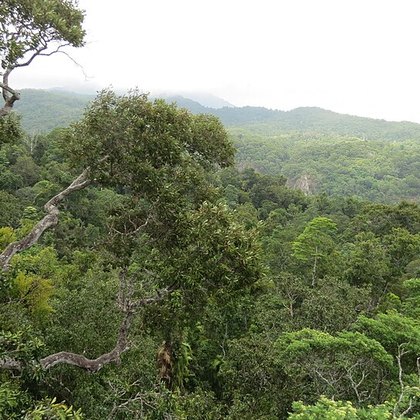
The floor of closed rainforest is its world: it works the litter layer for worms, insects and snails and stays in the shade of the lowest layer. At the forest edge it also uses monsoon forest and the dense vine thickets that on Cape York and in Torres Strait are the only closed cover on offer. It avoids open country and planted forest. The bright colours that stand out in a photograph are, in the dim, dappled light of the forest floor, exactly what camouflages it.
Where the bird is most often found, arranged by main group and formation.

Range and movements
The range covers New Guinea and the Aru Islands; in Australia that means only the very tip of Cape York and the islands of Torres Strait. It is a breeding bird there, but not a year-round resident: in the dry season, as the forest turns drier and poorer, part of the Australian population withdraws to New Guinea and returns only with the wet season. In the north the wet season runs from November to April; the birds breed there in the Australian summer, in December and January.
- Breeding (summer)
- dark = core range, pale = thinly spread
Where and when to look
Go by the call in the first and last hour of the day, ideally just after rain. Look on the forest floor for a fixed stone with a pile of broken snail shells: such an anvil gives away a territory even when the bird itself stays silent. Approach slowly, because a Papuan Pitta is more likely to flatten itself against the ground than to fly off.
Conservation
Not threatened (LC). The species is widespread across New Guinea and the Aru Islands and holds on in Australia in the protected rainforest remnants of Cape York. The loss of lowland rainforest in New Guinea is the main threat in the longer term; hard numbers for the Australian part of the range are lacking.
Scientific name
Erythropitta macklotii | (Temminck, 1834)
Temminck described the bird in 1834 as Pitta macklotii; because the species was later moved to another genus, author and year stand in parentheses. The species name honours Heinrich Christian Macklot, a German naturalist who travelled New Guinea and Timor for the Rijksmuseum in Leiden between 1828 and 1830 aboard the corvette Triton, and who was killed in 1832 during an uprising in Java. The genus Erythropitta is formed from Greek erythros (red) and pitta, a Telugu word for 'small bird' that entered scientific naming by way of British ornithology. The type locality is Lobo, on Triton Bay in south-western New Guinea, named after that same ship.