All species › Passerines › Pittas › Rainbow Pitta
Rainbow Pitta | Pitta iris
Regenboogpitta | Pita arcoiris
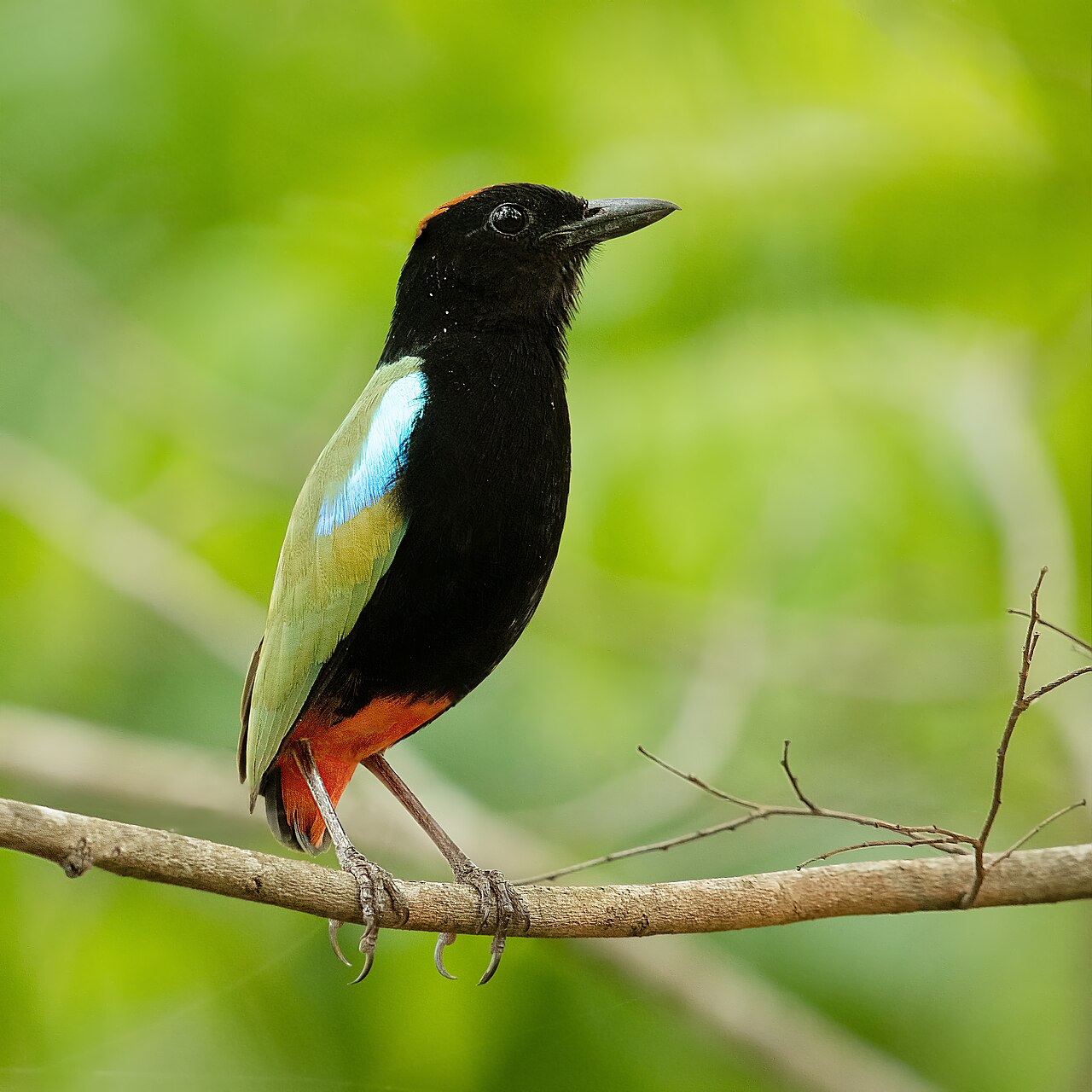
The Rainbow Pitta is the pitta of the north-west: a squat, short-tailed ground bird of the monsoon thickets of the Top End and the Kimberley, with a velvet-black head and underparts, a green back, a glowing blue shoulder patch and a fiery red undertail. For all those colours it is extremely hard to see: in the half-dark of a vine thicket black merges with shadow and green with leaf, and the bird walks away rather than flying up. It is the only pitta of the Australian north-west and thus the most isolated of the three.
Voice
A loud, far-carrying whistle of two or three notes, usually rendered in Australia as want-a-whip, the last note rising and emphatic. It closely resembles the walk-to-work of the Noisy Pitta but is shorter and a little lower, and the two species nowhere occur together, so that in the Top End the sound is always this one. It calls chiefly in the early morning and after rain at the start of the wet season; through the dry season a patch of forest may be silent for weeks with the birds still in it. There is besides a low growling alarm and a short hard kwok when disturbed.
No freely licensed recording has been found for this species yet; what to listen for is described below.
Identification
Sixteen to eighteen centimetres, heavily built, with long legs, a short stout bill and a tail that is scarcely visible. Head, throat, breast and belly are deep velvet-black; across the side of the head, from eye to nape, runs a broad chestnut to reddish-brown band, the only pale thing on an otherwise black head. Back and wings are deep green, with a bright sky-blue patch on the wing coverts that flashes when the bird moves. The undertail coverts are bright red. The sexes look alike. Young birds are dull brown with a pale bill base and lack both the blue and the red. The silhouette is that of a small, ball-round fowl on legs too long for it.
Confusion species
Noisy Pitta (Pitta versicolor) is the species it is confused with on paper: that one is larger, has a chestnut crown on top of the head rather than a band along its side, and is buff below with a black belly stripe rather than wholly black. In the field, however, confusion is impossible, for that species occurs only in the east and the two ranges nowhere touch. Papuan Pitta (Erythropitta macklotii) has a blue breast band and a red belly and lives at the tip of Cape York, also out of reach. Within the Top End no other bird has this silhouette; an observer is likelier to miss the bird altogether than to mistake it.
Habitat
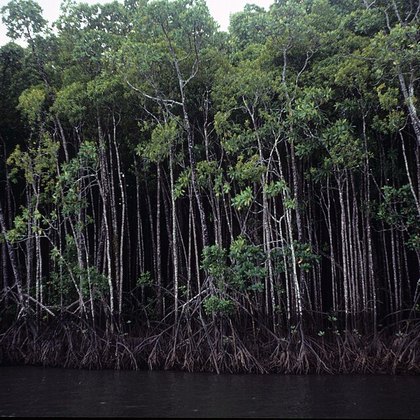
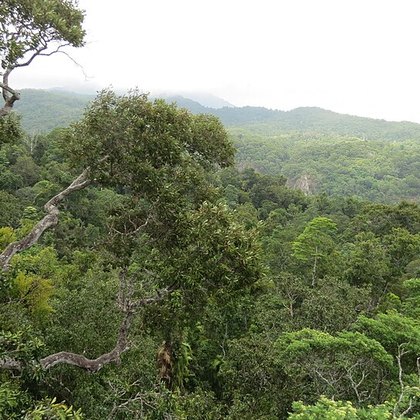
Monsoon forest and vine thicket: the small, dense, evergreen patches of liana forest that lie like islands in the savanna of the Top End, often at a spring, in a small gorge or just behind a beach ridge. Besides these the species uses mangrove, bamboo thickets and the dense moist forest along creeks. What matters each time is a closed canopy, a deep litter layer and ground that stays damp even in the dry season; there the bird hunts land snails, beetles, earthworms and centipedes. Like the Noisy Pitta it uses a regular anvil — a stone or root where it smashes snail shells, recognisable by the little heap of fragments. Together these patches make up only a fraction of the Top End, which makes the species local despite its large range.
Where the bird is most often found, arranged by main group and formation.

Range and movements
Endemic to north-western Australia: the Top End of the Northern Territory, roughly from the Kimberley in Western Australia through Darwin, Kakadu and Arnhem Land to the Gulf of Carpentaria, plus the Tiwi Islands (Melville and Bathurst) and Groote Eylandt. Within that area the distribution is a patchwork following the placement of the monsoon thickets. There is no migration, but there is some local movement: in the wet season birds spread into temporarily suitable forest, in the dry season they withdraw into the permanently moist core patches.
- Resident
- dark = core range, pale = thinly spread
Where and when to look
Go at the start of the wet season, when the birds are calling, and choose a monsoon thicket with a closed canopy, preferably at a spring or in a gorge — in the dry season the same patch can seem completely silent. Sit at the edge rather than walking through it and let the bird come; this is a species one sees sitting and misses walking. Watch the contrast: the vivid blue and red are invisible in shadow, but the moment the bird crosses a fleck of light they blaze for a second. Look here too for little heaps of broken snail shells, which betray a resident bird even when it is silent.
Conservation
Least Concern (LC). Within its own habitat the species is common and locally even numerous, and most of its range lies in thinly populated country with much protected and Indigenous-managed land. The concern lies not in the bird but in its habitat: the monsoon thickets are small, sharply bounded islands, highly sensitive to fire pushing in from the savanna and to water buffalo and feral pigs trampling the margins, turning over the ground and drying the patches out. The continuing spread of gamba grass, which burns hotter than the native grasses, increases fire pressure on precisely those margins. Management in Kakadu and on the lands of traditional owners is accordingly directed at early dry-season burning and at keeping large stock out of the thickets.
Scientific name
Pitta iris | Gould, 1842
John Gould described the species in 1842 in The Birds of Australia from birds of the Cobourg Peninsula in northern Australia. The epithet iris refers to Iris, the Greek goddess of the rainbow, and is a well-judged choice for the bird's palette; the Dutch regenboogpitta, the English Rainbow Pitta and the Spanish pita arcoíris all translate it literally. The genus name Pitta comes from the Telugu of southern India, where it simply means 'small bird', and entered scientific nomenclature through the British naturalists in India.