All species › Passerines › Honeyeaters › Red Wattlebird
Red Wattlebird | Anthochaera carunculata
Roodlelhoningeter | Mielero carunculado
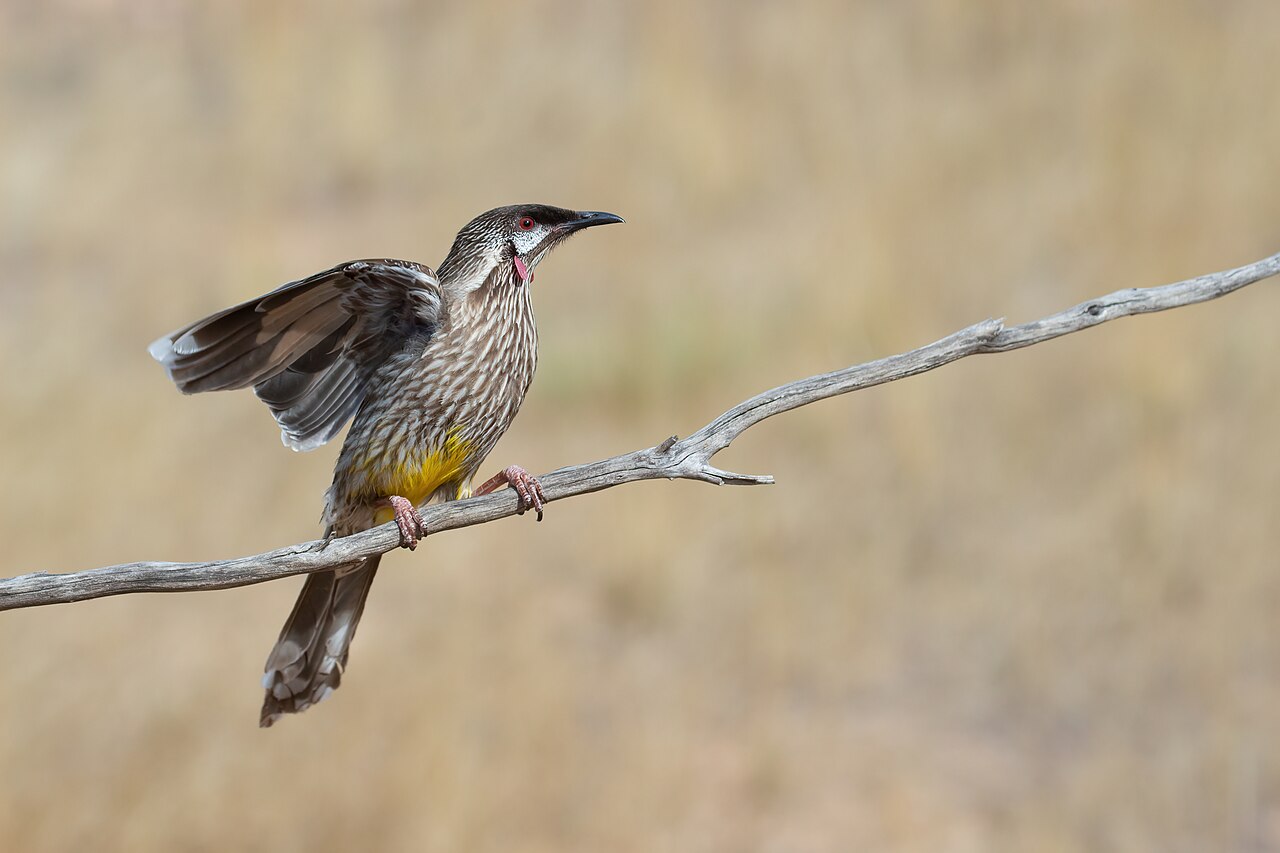
At thirty-five centimetres the Red Wattlebird is the largest honeyeater on the Australian mainland: a grey-brown, white-streaked bird with a pink-red wattle on the neck and a bright yellow belly. It is loud, bold and domineering, and will hold a flowering eucalypt on its own if it can. Where the blossom moves, it moves with it.
Voice
Musical it is not. The best known sound is a harsh coughing yak-a-yak, as though the bird were clearing its throat, followed by a loud single chok that serves as a contact call. Males call low and raw from a bare top, females give a rising whistle. At an owl or a snake the whole neighbourhood gathers, shouting.
Recording: James Ray — CC BY-SA 4.0 · Faulconbridge, Blue Mountains City Council, New South Wales, Australia · xeno-canto
Identification
A large, slim honeyeater of 34 to 36 centimetres with a long white-tipped tail. The plumage is grey-brown with fine white streaks, the face pale, the eye red, and a pink-red fleshy wattle hangs on each side behind the eye. The lower belly is bright yellow, the bill black and slightly decurved. Sexes are alike; young birds have a brown eye, a duller belly and barely any wattle.
Confusion species
Yellow Wattlebird (Anthochaera paradoxa) of Tasmania is larger still, with long pendulous yellow wattles, and replaces this species there. Little Wattlebird (A. chrysoptera) and Western Wattlebird (A. lunulata) are smaller, lack the wattle and flash a rufous wing patch in flight. Regent Honeyeater is scaled black and yellow and very rare. Friarbirds have a bare black head and no wattle.
Habitat
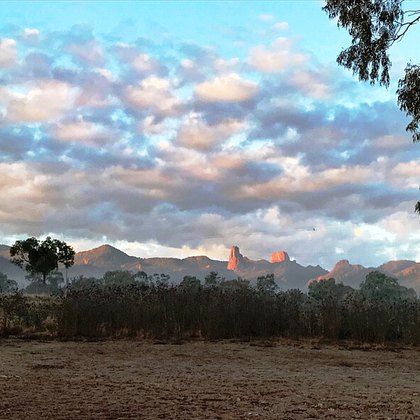
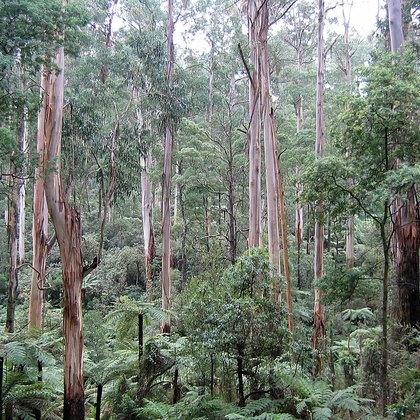
Open eucalypt forest and dry woodland are the core, with wet montane forest and mallee alongside. Beyond that, anywhere gardens, parks and streets carry native flowering plants: eucalypt, banksia, grevillea, and in winter the nectar of planted shrubs. It avoids closed rainforest and the bare inland plains, but follows planted road verges far into dry country.
Where the bird is most often found, arranged by main group and formation.


Range and movements
The southern mainland: from southeastern Queensland through New South Wales and Victoria into South Australia, and separately in the southwest of Western Australia. It is absent from Tasmania. Three subspecies, including a dark form on Kangaroo Island. Resident and wanderer at once: large numbers shift north or coastwards in autumn and winter, following flowering banksias and eucalypts.
- Resident
- dark = core range, pale = thinly spread
Where and when to look
Find the highest bare branch above a flowering tree: that is where it sits, and from there it drives every other honeyeater off. The coughing call carries far and is the quickest lead. In doubt, check the yellow belly and the white tail tip, because the wattle is often invisible at range; from July to December the nest sits two to sixteen metres up in a eucalypt.
Conservation
Least Concern (LC). The species is numerous, has a large range and has gained from the planting of native nectar shrubs in gardens and road verges; in many cities it is the most conspicuous bird of winter. Wholesale clearing of dry woodland in the nineteenth and twentieth centuries cost numbers locally, but the picture now is stable.
Scientific name
Anthochaera carunculata | (Shaw, 1790)
Shaw described the bird in 1790 as Merops carunculatus, among the bee-eaters — John White had called it the 'wattled bee-eater' in his journal; the later move puts author and year in parentheses. Vigors and Horsfield placed it in Anthochaera in 1827, from Greek anthos, 'flower', and khairo, 'to enjoy'. carunculata comes from Latin caruncula, 'a small piece of flesh'.