All species › Passerines › Honeyeaters › Eastern Spinebill
Eastern Spinebill | Acanthorhynchus tenuirostris
Zwarthalshoningvogel | Pico de espina oriental
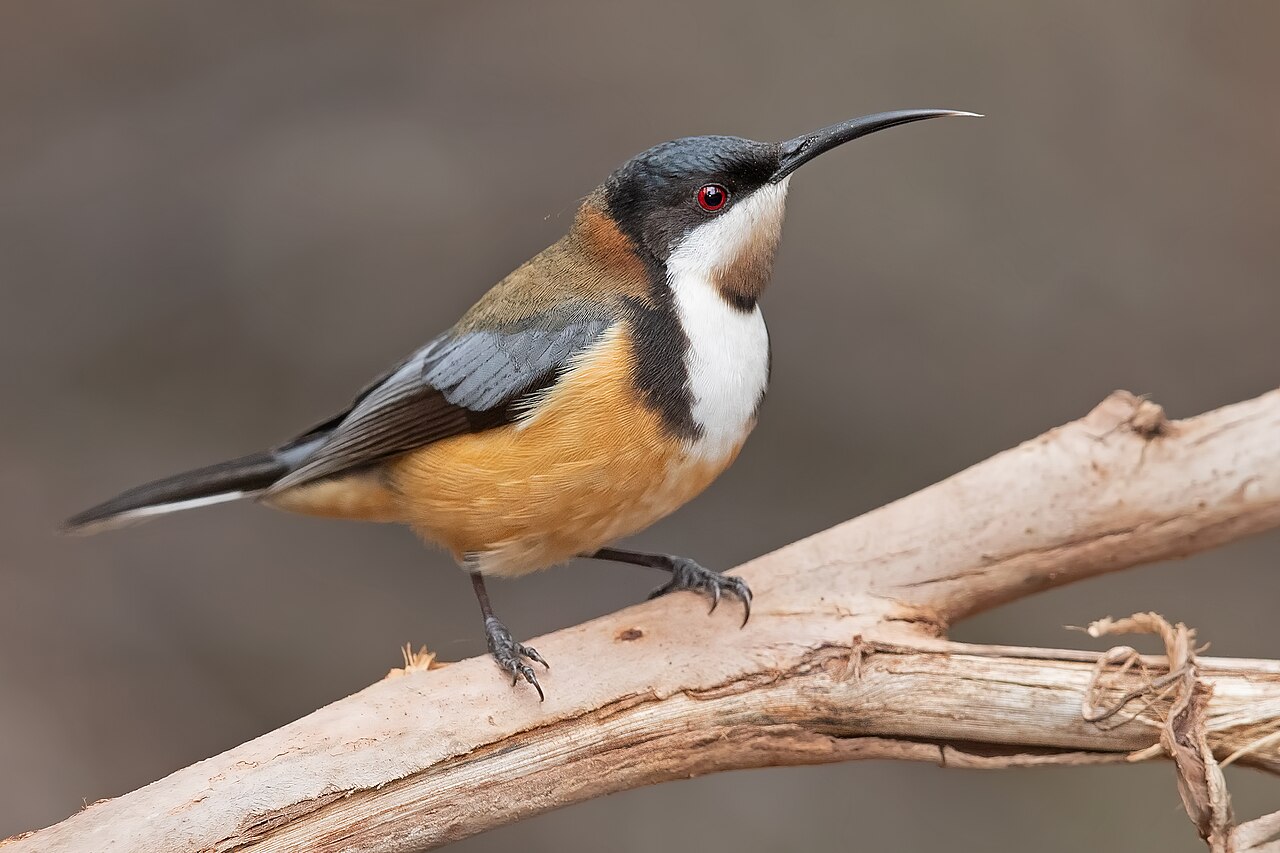
The Eastern Spinebill is the hummingbird-like honeyeater of eastern Australia: a small, restless bird with a needle-fine, strongly decurved bill that darts from flower to flower in the garden and regularly hovers while it feeds. The male has a black crown and neck, a white throat with a cinnamon patch in the middle and rufous underparts; at every flight the white outer tail feathers flash. Over much of south-eastern Australia he is the best-known visitor to correas and fuchsias.
Voice
A clear, high, staccato piping, chip-chip-chip-chip, which he can keep up at the same tempo for minutes on end from a high perch. The sound is sharp but not unpleasant, and quickens into a thinner rattle when he is excited. At the flowers themselves he is nearly silent; there it is the wingbeats you hear first, because his flight audibly hums.
No freely licensed recording has been found for this species yet; what to listen for is described below.
Identification
A small, finely built honeyeater of thirteen to sixteen centimetres and about eleven grams, with a strikingly long, thin, downcurved black bill. The male has a black crown and black neck sides driving a wedge into the white throat, a cinnamon throat patch, rufous underparts, a grey mantle with a rufous nape and a red eye. The female shows the same pattern but duller and less sharply bounded, with a greyer head. Juveniles are warm cinnamon below with grey to olive-brown upperparts and lack the black head wedge. In flight — fast, jerky and audibly humming — the white outer tail feathers stand out most.
Confusion species
The western sister species, Western Spinebill (Acanthorhynchus superciliosus), occurs only in south-western Australia and nowhere overlaps; it has a wholly rufous throat with a broad rufous collar and a white eyebrow, where this bird has a white throat with a cinnamon patch in the middle. Real confusion is likelier with Crescent Honeyeater (Phylidonyris pyrrhopterus), which shares the same forest and the same garden: it is larger, darker, straighter-billed, has a black breast band across white underparts and yellow wing edges. Juvenile and female Eastern Spinebills recall other small curve-billed honeyeaters, but none of those combines an exceptionally long thin bill, white outer tail and a humming flight.
Habitat
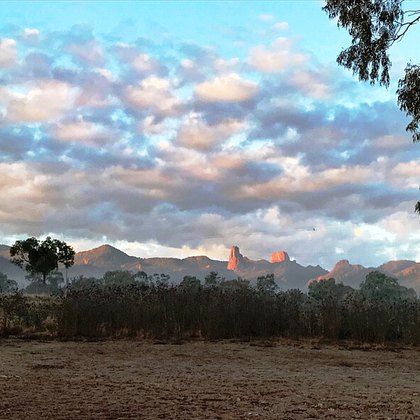
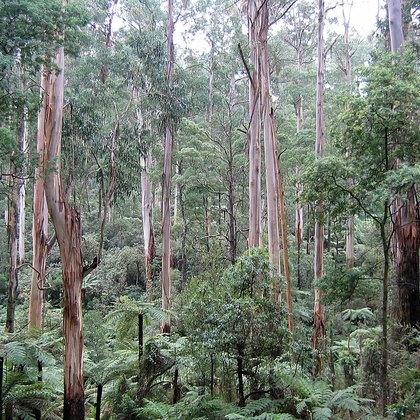
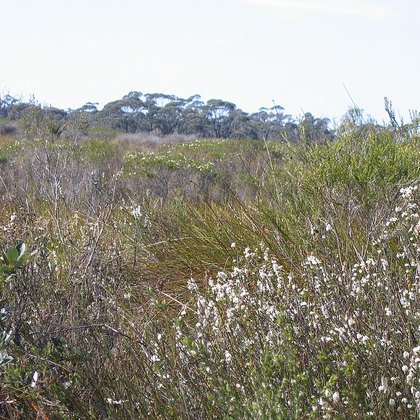
Dry and wet sclerophyll forest, heath and scrub along the east coast, from coastal banksias to montane forest with tree ferns; in the south also the understorey of wet forest and the margins of Tasmanian rainforest. It is besides one of the most taken-for-granted garden birds of south-eastern Australia, visiting correa, grevillea, kangaroo paw and introduced fuchsia and abutilon.
Where the bird is most often found, arranged by main group and formation.

Range and movements
Eastern Australia from Cooktown in north Queensland south to Victoria, west to the Flinders Ranges in South Australia, and throughout Tasmania. In the north it is confined to cool montane forest, sitting in isolated populations on the tablelands; in the south it occupies everything from sea level to the subalpine zone. It is largely sedentary but shifts seasonally in altitude: in autumn and winter the mountain birds drop to the lower coastal plains and the towns.
- Resident
- dark = core range, pale = thinly spread
Where and when to look
Look for it in a garden or on a forest track at flowering correa or grevillea and watch the flight rather than the colour: no other small honeyeater hangs so deliberately still in front of a flower while showing so much white in the tail. On Queensland mountain tops such as Lamington or the Atherton Tableland it is often easier to find on the flowering herb layer round the car park than inside the forest.
Conservation
Least Concern (LC) and common throughout its eastern range; every Australian state lists it as secure. It benefits from gardens planted with native nectar plants and so penetrates the suburbs as well. The isolated mountain populations of north Queensland are vulnerable to warming, because their cool altitudinal band has nowhere further to climb; beyond that it is chiefly the loss of the shrub layer to too-frequent fire and to grazing that weighs locally.
Scientific name
Acanthorhynchus tenuirostris | (Latham, 1801)
John Latham described the species in 1801 as Certhia tenuirostris; because it later moved to Acanthorhynchus, author and date stand in parentheses. The genus Acanthorhynchus was erected by John Gould in 1837, from Greek akantha, thorn, and rhynchos, bill — exactly what the English name spinebill says too. tenuirostris is Latin for 'slender-billed', from tenuis, thin, and rostrum, bill. The Dutch name refers to the black wedge along the neck, the clearest difference from the western species.