All species › Passerines › Thornbills, scrubwrens, gerygones and allies › Rockwarbler
Rockwarbler | Origma solitaria
Rotsstruiksluiper | Acantiza minero
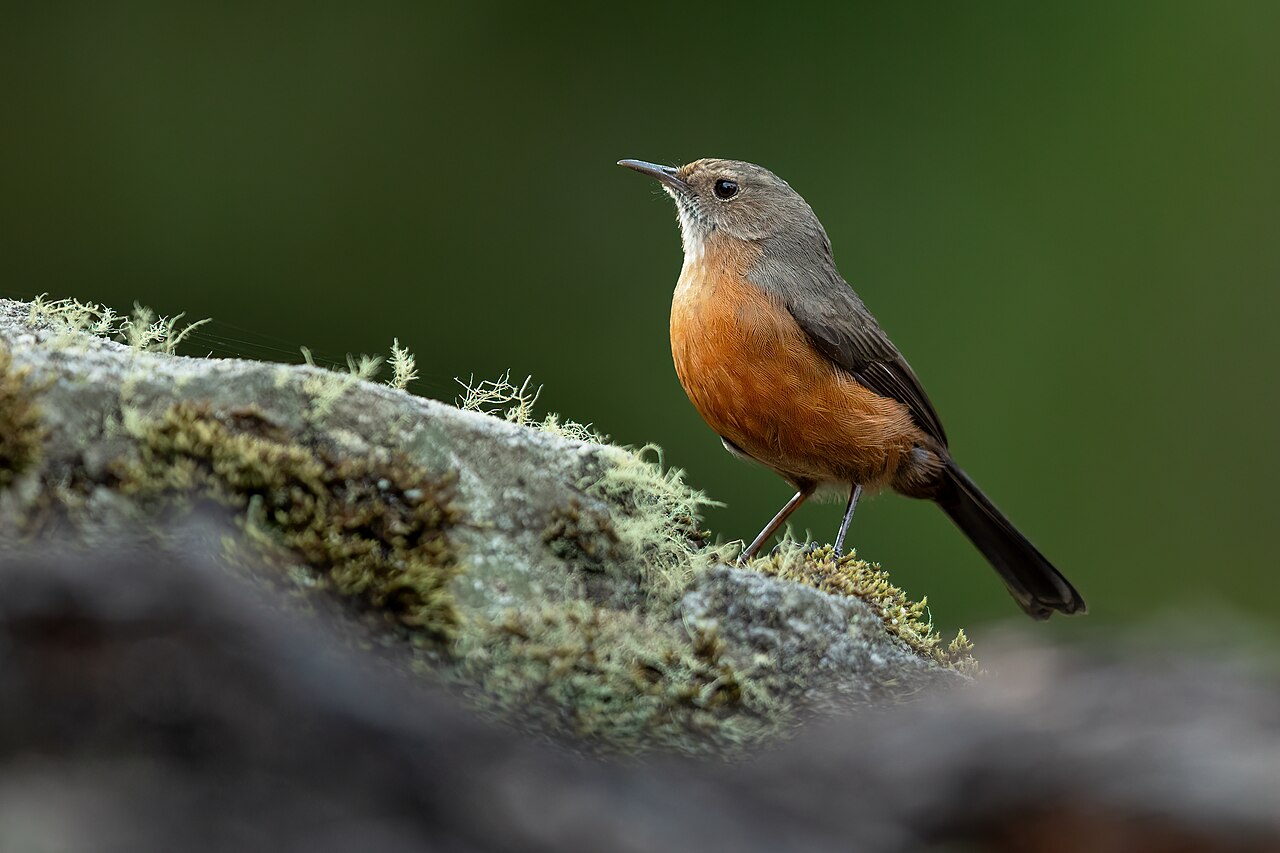
The Rockwarbler is the only bird confined to mainland New South Wales and found nowhere else on earth. It lives on and among the sandstone of the Sydney Basin: on the clifflines, in the gorges and under the overhangs where the rock flakes away in sheets. Anyone in the Blue Mountains or the Royal National Park who sees a small rufous bird hopping over a boulder and constantly flicking its black tail sideways has found it.
Voice
The usual call is a shrill, two-syllable chis-sick that bounces off the rock face and is therefore hard to place; in the breeding season it is repeated without end. There is also a plaintive, falling whistle long rendered in Australia as a mournful 'goodbye', and a penetrating pink with grating overtones in alarm. The species mimics other birds as well, so an unexpected phrase in a sandstone gorge may well be this one.
No freely licensed recording has been found for this species yet; what to listen for is described below.
Identification
Fourteen centimetres, about fourteen grams: a compact bird with a fine, slightly decurved bill and long legs. The upperparts are dark grey-brown with still darker wings, the forehead and face carry a cinnamon wash, the throat is dull white finely speckled black, and the breast and belly are rufous. The tail is black and is swung not up and down but sideways — at a distance that gesture is often the first thing seen. The sexes are alike; young birds are duller and lack the warm rufous.
Confusion species
Pilotbird (Pycnoptilus floccosus) is the one real trap: also rufous below and also a ground bird, but clearly larger and rounder, with a heavier head, a rusty forehead and scalloping on the breast, and it flicks its tail up and down rather than sideways. The Pilotbird also keeps to damp fern gullies, not to bare rock. Sericornis frontalis has a conspicuous white eyebrow and a pale cream iris, both of which this species lacks. Acanthiza pusilla is smaller and shorter-legged, with a scalloped forehead and a dull buff rump. A small brown bird foraging on sandstone and swinging its tail sideways is, within the Sydney Basin, this species.
Habitat
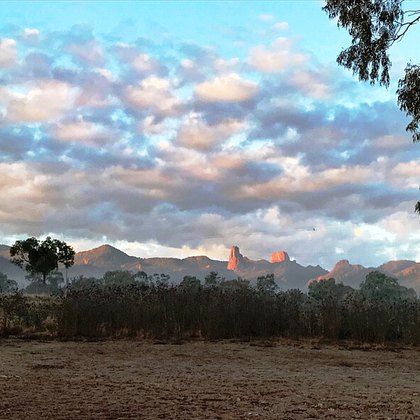
Sandstone, and almost nothing else. It occupies dry eucalypt forest and woodland where rock comes to the surface: ledges, boulder fields, steep gorges with a creek on the floor, overhangs and caves, and along the coast the sea cliffs as well. Limestone and granite are used locally. Water is nearly always close by. It forages on the rock itself and in the lowest branches, picking insects from crevices, from under ledges and in the half dark of caves.
Where the bird is most often found, arranged by main group and formation.

Range and movements
Central eastern New South Wales, broadly within two hundred and forty kilometres of Sydney: from Scone in the north to the Budawang Range in the south, and inland as far as the Hawkesbury sandstone runs. It has never been recorded beyond that. It is sedentary, holds the same territory all year and does not migrate. Because the range follows the geology rather than the vegetation, the map is a mirror of the sandstone plateau around the city.
- Resident
- dark = core range, pale = thinly spread
Where and when to look
Look for the rock, not the forest. In the Blue Mountains, the Royal National Park or Ku-ring-gai Chase, walk a track that runs along a clifftop or through a sandstone gorge and watch for movement on the boulders themselves. Stop at caves and overhangs: the suspended domed nest of grass, rootlets and moss, bound with spider web, often hangs in the same place for years and betrays a territory even when the bird is silent. The shrill chis-sick carries far, but the echo misleads; walk toward the rock face, not toward the sound.
Conservation
Least Concern (LC). Most of the sandstone plateau around Sydney lies within national parks, and the habitat itself — bare rock — is worthless for farming and so does not disappear. The risks lie with urban expansion at the plateau edges, with fire too frequent to let the gully understorey recover, and with cats and foxes emptying ground-level nests in reachable caves. The population is small but stable.
Scientific name
Origma solitaria | (Lewin, 1808)
Lewin described the bird in 1808 as Sylvia solitaria; because it was later placed in a genus of its own, author and year stand in parentheses. Gould erected the genus Origma in 1838. solitaria is Latin for 'solitary', after the impression the bird gives: usually alone or in a pair, never in flocks. The Dutch name and the English Rockwarbler both point to the rock. The type locality is Parramatta near Sydney.