All species › Passerines › Thornbills, scrubwrens, gerygones and allies › Pilotbird
Pilotbird | Pycnoptilus floccosus
Loodsvogel | Acantiza piloto
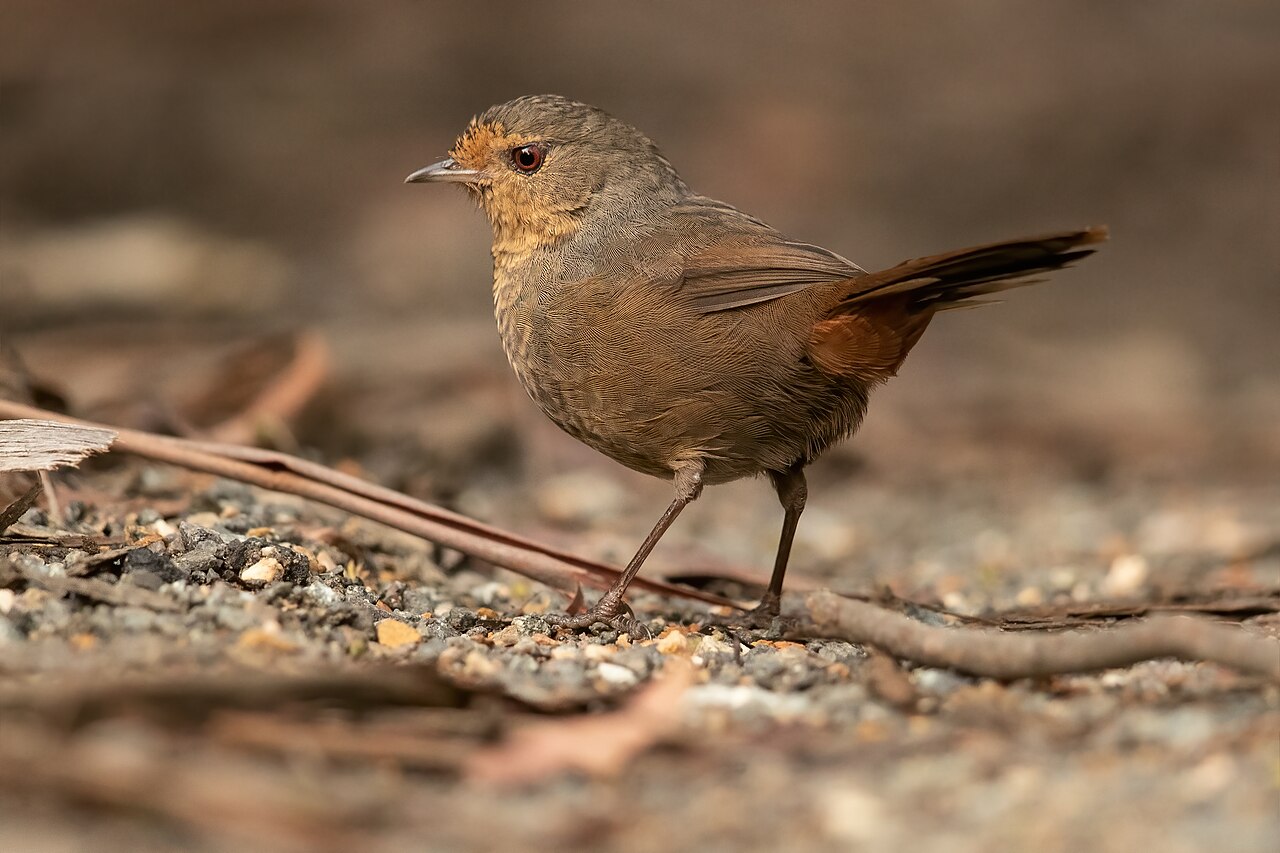
The Pilotbird is a heavy, rounded ground bird of the wet mountain forests of the south-east: chocolate brown above, rufous below, scalloped on the breast, and carrying a broad tail half cocked. Its name comes from the company it keeps: it walks behind foraging lyrebirds and takes what they turn up out of the litter, and bushmen long used its call to find lyrebirds.
Voice
A loud, clear whistled phrase that shoots upward at the end and carries far through wet forest — rendered in Australia as wit-wit-weet-WHEER or as 'guinea-a-week'. The male sings it sharply and piercingly, the female answering with a softer version, so that a pair sounds like a duet. Otherwise one mostly hears short, quiet contact notes close to the ground. In closed fern forest you will nearly always hear the bird before you see it.
No freely licensed recording has been found for this species yet; what to listen for is described below.
Identification
Seventeen to nineteen centimetres and some twenty-seven grams: for a member of this family a stout, thickset bird with a large head and a short, pointed bill. The upperparts are dark chocolate brown, the forehead a contrasting rusty brown, the eye ring pale and the eye amber. Chin, throat and breast are warm rufous with fine dark scalloping, the belly centre more lightly speckled. The broad tail is held half cocked and flicked up and down while feeding. It flies poorly and almost never far.
Confusion species
Eastern Bristlebird (Dasyornis brachypterus) is closest in outline and behaviour, but is clearly larger, with a much longer tail, longer legs and a less rounded head, and it keeps to coastal heath rather than montane fern forest. Rockwarbler (Origma solitaria) is rufous below but far smaller and slimmer, with a small head and a short tail flicked sideways, and it sits on bare sandstone. Sericornis frontalis and Acanthiza pusilla share the habitat but are half the size and much more restless. A large, rounded, rufous, scalloped bird shuffling over a fern floor is this species.
Habitat
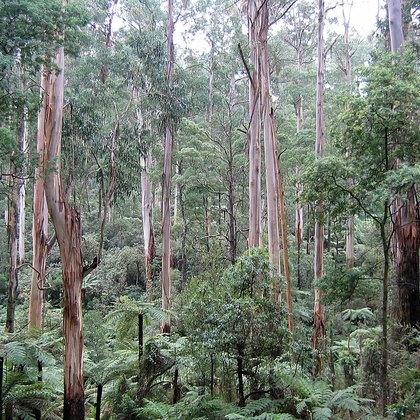
The floor of wet eucalypt forest on the coastal ranges and in damp gullies, under mature gums with a dense understorey of bracken, tree ferns and low shrubs, and with much fallen timber and deep litter. Locally it also enters cool temperate beech rainforest. It rarely leaves the ground and finds its food — chiefly insects, sometimes seeds and small fruits — by shuffling among leaves and sticks. Where a lyrebird is at work, it follows.
Where the bird is most often found, arranged by main group and formation.

Range and movements
South-eastern Australia, from Wollemi and Blue Mountains National Parks in New South Wales through the southern tablelands and Gippsland to the Dandenong Ranges near Melbourne, along the coastal ranges and inland to the Great Dividing Range. Two subspecies are recognised: the nominate form in the higher country and sandfordi in the lowlands. It is sedentary, has no seasonal movements and is a poor flier, so burnt-out blocks of forest can only be recolonised from the edges.
- Resident
- dark = core range, pale = thinly spread
Where and when to look
Look for it early in the morning on a track through a fern gully in the Blue Mountains, Kangaroo Valley, the Errinundra or the Dandenong Ranges. Listen first: the loud, rising whistle stands apart from everything else around. Then walk slowly toward it and look low — the bird stays on the ground and slips along behind fern stems. If you meet a lyrebird turning over the litter, stand still and wait: the Pilotbird is often shuffling a few metres behind it.
Conservation
Vulnerable (VU). The species was long regarded as common, but the bushfires of 2019-2020 burnt about forty-seven per cent of its range, and the population has since been estimated thirty to fifty per cent lower. In 2022 it was accordingly listed as threatened under Australia's national environment law as well. The problem is not the fire alone but the recovery: the dense, damp understorey it needs takes years to return, and a bird that hardly flies comes back slowly.
Scientific name
Pycnoptilus floccosus | Gould, 1851
Gould described the species in 1851. The genus name Pycnoptilus is formed from Greek pyknos (dense) and ptilon (feather), after the full, loose plumage; floccosus is Late Latin for 'flocked with wool' and says the same thing again. The Dutch name translates the English Pilotbird: the bird that pilots you to the lyrebird. The type locality is in New South Wales, according to later authors the Blue Mountains.