All species › Passerines › Thornbills, scrubwrens, gerygones and allies › Redthroat
Redthroat | Pyrrholaemus brunneus
Roodkeelstruiksluiper | Sedosito gorgirrojo
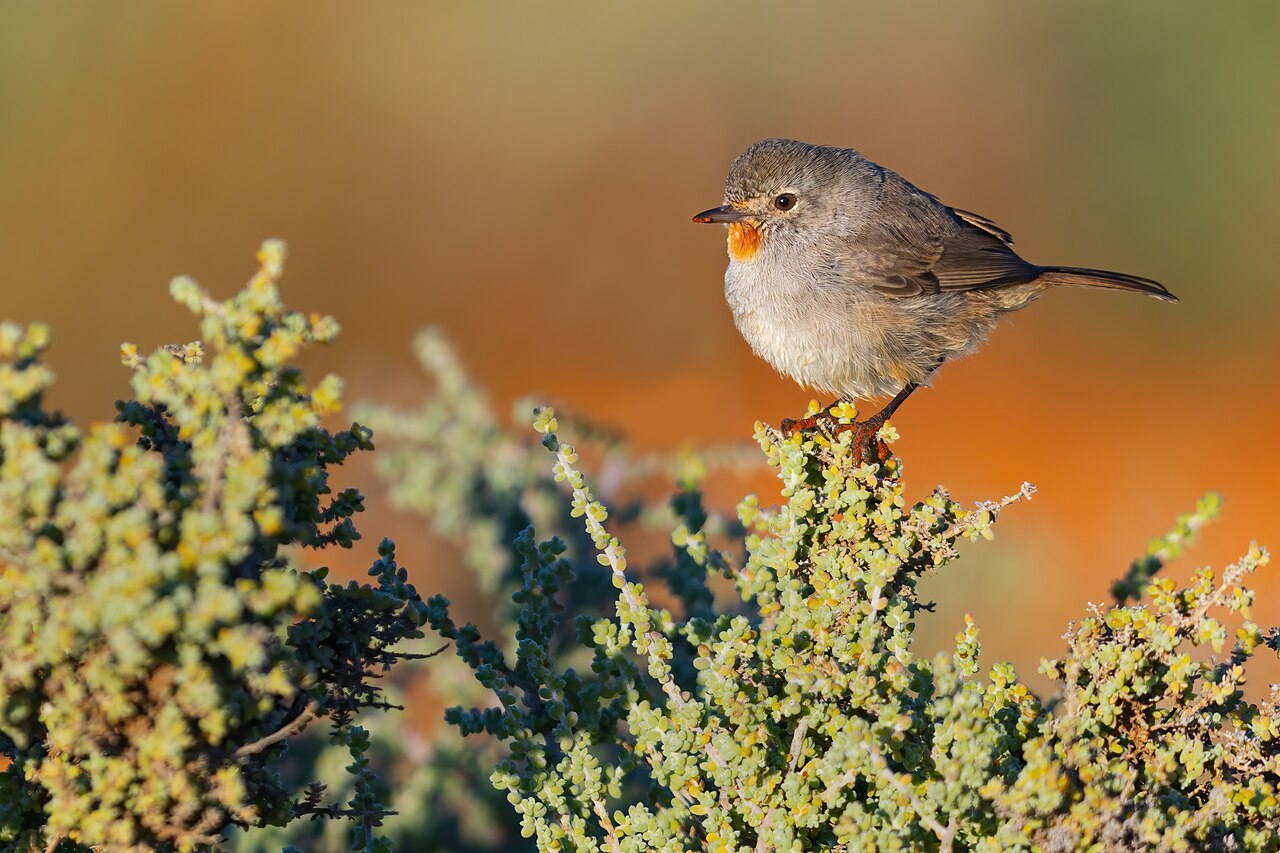
The Redthroat is the shy, plain grey-brown acanthizid of the dry interior: a bird of mulga and saltbush that shuffles along the ground between the bushes and seldom lets itself be looked at. Only the male carries the mark the species is named for, a small rusty throat patch. What gives it away is its voice: a canary-like, sustained warble in which it imitates half the bird community around it.
Voice
A melodious, long sustained warble with clear, cheery notes that carries surprisingly far for the size of the bird and calls a canary to mind. It is one of the best mimics of the Australian interior: its song contains phrases of Pied Butcherbird, fairywrens and fantails, and even the non-vocal whistling wingbeats of the Crested Pigeon. On taking off its own wings whirr audibly, just as in its sister species.
No freely licensed recording has been found for this species yet; what to listen for is described below.
Identification
Eleven to twelve centimetres: a small, slim bird with no streaking or spotting at all — that plainness is the feature. The upperparts are dark grey-brown, the underparts greyish white, and the outer tail feathers carry white tips that flash briefly as the bird flushes. The bill is fine and pointed. Only the adult male has the small rusty throat patch; females and young birds lack it entirely and then look like a plain brown bird with no marks.
Confusion species
Its sister species Pyrrholaemus sagittatus is heavily streaked black below and lives on the other side of the continent in eastern woodland; the two are geographically separate and are told apart in the field by the streaking alone. The thornbills of the same mulga country — Acanthiza uropygialis, Acanthiza apicalis and Acanthiza robustirostris — are shorter in tail and head and all have a conspicuously coloured rump and a red or pale iris, which this species lacks. Calamanthus campestris and Hylacola cauta are streaked and cock their tails. A plain grey-brown bird slipping low through saltbush and warbling like a canary is this species.
Habitat
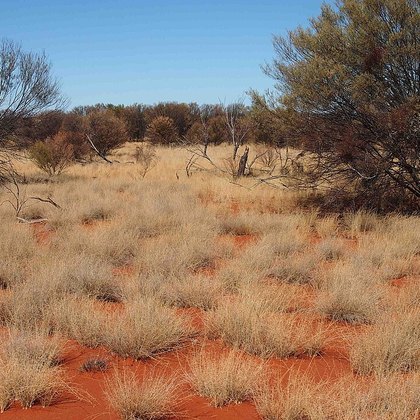
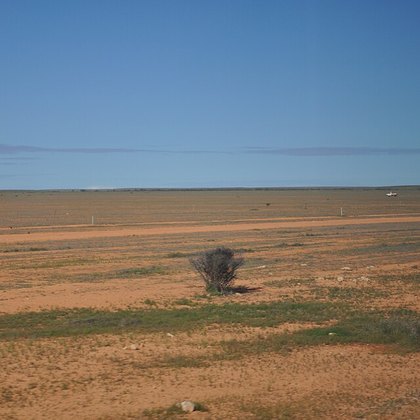
Arid and semi-arid shrublands of the interior: mulga and related acacias as the overstorey, with an understorey of saltbush and bluebush beneath. What it needs everywhere is that complex understorey — it feeds there and it nests there. Where stock have eaten the shrub layer out and only the acacias remain standing, it goes. It forages on and just above the ground, usually alone or in a pair.
Where the bird is most often found, arranged by main group and formation.
Range and movements
Endemic to mainland Australia and spread across every state but Tasmania and the Australian Capital Territory, with its weight in Western Australia and South Australia: from the central west coast east to south-western Queensland, and south to the mallee of north-western Victoria and far western New South Wales. Toward the east of that range it is scarce and local. It is sedentary, but in dry years numbers shift with the state of the understorey.
- Resident
- dark = core range, pale = thinly spread
Where and when to look
In Western Australia or northern South Australia, drive out onto a mulga plain and get out where the saltbush under the acacias is still dense. Sit quietly and listen: the long canary-like warble is probably all you will get, because the bird would rather walk away than fly. The breeding season runs June to December; a large, loosely built domed nest of bark strips, nine to fourteen centimetres across and low in a saltbush, is a reliable sign that you are in the right place.
Conservation
Least Concern (LC): the range is vast and in the western core the species is locally common. At the eastern edge it is another story — New South Wales calls it vulnerable and Victoria threatened. The causes there are shrubland clearing, overgrazing by stock, goats and rabbits that strips the understorey, invading exotic weeds, and predation by fox and cat. The species is also a regular host of the Black-eared and Fan-tailed Cuckoos, which weighs more where densities are low.
Scientific name
Pyrrholaemus brunneus | Gould, 1841
Gould described the species in 1841. The genus name Pyrrholaemus is Greek, from pyrrhos (flame-coloured, red) and laimos (throat): the name was coined for this species, since only here is the throat patch present. brunneus is modern Latin for 'brown'. The Dutch and English names both name that same throat. The type locality is the 'Belts of the Murray' in South Australia.