All species › Passerines › Cuckooshrikes › Sahul Cicadabird
Sahul Cicadabird | Edolisoma tenuirostre
Monniksrupsvogel | Oruguero picofino
The Sahul Cicadabird is the cuckooshrike you will almost certainly hear before you see, and which even then sounds most like an insect. Its call is a dry buzzing rattle exactly like a cricket or cicada in the crown of a tree — hence the English name. The male is plain dark slate-grey with a blackish face, an austere bird that explains its Dutch name of 'monk cuckooshrike'; the female, by contrast, is brownish with a pale eyebrow and barred underparts and looks at first glance like an altogether different bird.

Voice
The best character of the species, and one of the strangest sounds of the Australian bush: a dry, rasping, buzzing 'zzzrrt … zzzrrt … zzzrrt', slowly repeated in a long series that may run on for minutes, with an unhurried pause between each note. It does not sound like a bird but like an insect, and many observers listen past it for years. The sound is most often given on hot days and towards dusk. There is also a softer churring or rolling contact note between partners. Once you know this buzzing, you notice how common the species is in some places: the male often calls from a fixed, high perch where he otherwise sits completely still.
No freely licensed recording has been found for this species yet; what to listen for is described below.
Identification
A slender cuckooshrike of about twenty-four to twenty-seven centimetres with a strikingly fine, pointed bill — finer than in any other cuckooshrike in this guide — and a long tail. The sexes differ strongly. The male is uniformly dark blue-grey to slate-grey from crown to undertail coverts, with no white belly and no barring at all, and a blackish mask on lores and chin that in the field is often barely visible against the dark plumage. The female is entirely different: grey-brown to warm brown above, with a pale buff eyebrow over a dark eye-stripe, and pale underparts finely barred with dark from throat to belly. Young birds resemble the female. The bird moves slowly and sedately through the canopy, where the male in particular disappears with ease.
Confusion species
The male is most often confused with the White-bellied Cuckooshrike (Coracina papuensis), but that bird has a clean white belly and a much heavier bill; on the Sahul Cicadabird the dark grey runs unbroken from throat to tail. The Black-faced Cuckooshrike (Coracina novaehollandiae) is larger, paler grey and has a broad black mask taking in the whole throat. The female is the real problem: with her eyebrow and barred underparts she recalls the female Varied Triller (Lalage leucomela), but that bird is considerably smaller, shorter-tailed and has clear pale wing markings, while the cicadabird has plain wings and the bulk of a cuckooshrike. Immature Black-faced Cuckooshrikes are barred too, but are bulkier and already show the beginnings of the black mask. In every case the rule is: wait for the call. The buzzing insect-like sound cannot be confused with anything else in the Australian bush.
Habitat
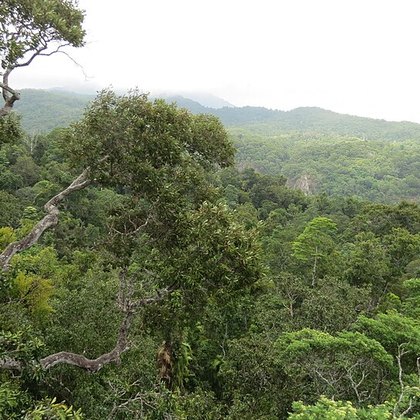
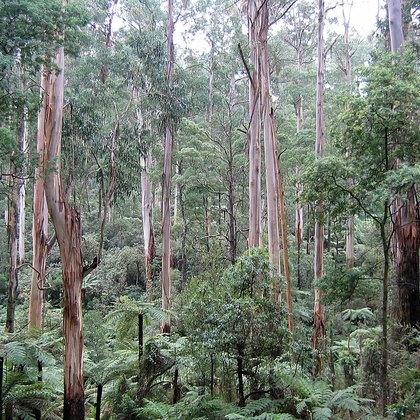
Tropical rainforest and its edges, wet and dry sclerophyll forest, woodland, monsoon vine forest and vine thicket, gallery forest along creeks and mangrove. The species keeps almost entirely to the canopy, where it moves slowly through the foliage and gleans caterpillars, beetles, stick insects and other large insects from the leaves; soft fruit is taken as well. The nest is a small, very shallow saucer of twigs, bark and lichen bound with cobweb on a horizontal branch high in a tree and all but indistinguishable from a knot when seen from below. The clutch is usually a single egg, unusually few even for a cuckooshrike.
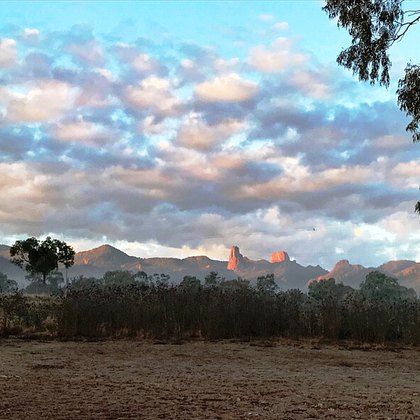
Where the bird is most often found, arranged by main group and formation.


Range and movements
In Australia along the northern and eastern coast and adjoining hinterland: from the Kimberley through the Top End and the Gulf Country to Cape York, and down the east coast into Victoria. South-eastern birds are decidedly migratory: they breed there in the southern spring and summer and leave in autumn to winter in northern Australia and New Guinea, while the tropical populations stay all year. That is why the species carries both the resident and the summer-visitor label in this guide. Beyond Australia it occurs on New Guinea and its surrounding islands. It does not occur in New Zealand.
- Resident
- Breeding (summer)
- dark = core range, pale = thinly spread
Where and when to look
Learn the sound first and the bird second. Walk through wet sclerophyll forest or along a rainforest edge in November or December and listen for a slow, dry buzz high in the canopy that you will be inclined to put down to a cicada. Then find the highest bare twig in that direction with binoculars: that is usually where the calling male sits, motionless and dark against the sky, so that the silhouette and the fine bill stand out most. You will rarely get such a view of the female; if you pick up a brownish, barred bird of that size in the same tree, assume it is the mate and check the plain, unmarked wing.
Conservation
In the taxonomic list used here this species is Not Evaluated (NE), and that is not an oversight but a direct consequence of the taxonomy: species limits within the cicadabirds have recently been redrawn, and the old broad concept fell apart into several species. A global assessment of this Australian and New Guinean taxon in particular has therefore still to follow. There is no indication that the species is in trouble: it is spread across an enormous area, uses a wide range of forest types and is locally common, though its unobtrusiveness means it is almost always undercounted. Its vulnerability lies, as with all canopy birds, in the loss of old forest with a closed canopy, and along the southern edge additionally in the condition of the northern wintering grounds.
Scientific name
Edolisoma tenuirostre | (Jardine, 1831)
William Jardine described the species in 1831 as Gracaulus tenuirostris, from a bird taken in 'New Holland', later restricted to New South Wales. The epithet is formed from Latin tenuis, 'thin' or 'slender', and rostrum, 'bill', and names a genuine field character: this cuckooshrike has the finest bill in the family. The ending changed from tenuirostris to tenuirostre because the species came to sit in a genus of different grammatical gender. That genus is Edolisoma, and there lies the story: until recently the bird stood as Coracina tenuirostris among the ordinary cuckooshrikes, but molecular work showed that Coracina in the broad sense was not a natural group. The cicadabirds proved to be a branch of their own, and the older name Edolisoma was brought back into use for them — formed from Edolius, an old genus name for the drongos, and Greek soma, 'body', so roughly 'built like a drongo'. The Dutch name refers to the austere, uniformly dark grey male, the English name Cicadabird to the voice and the Spanish oruguero picofino to the bill: three names, three different characters, all three well chosen.